


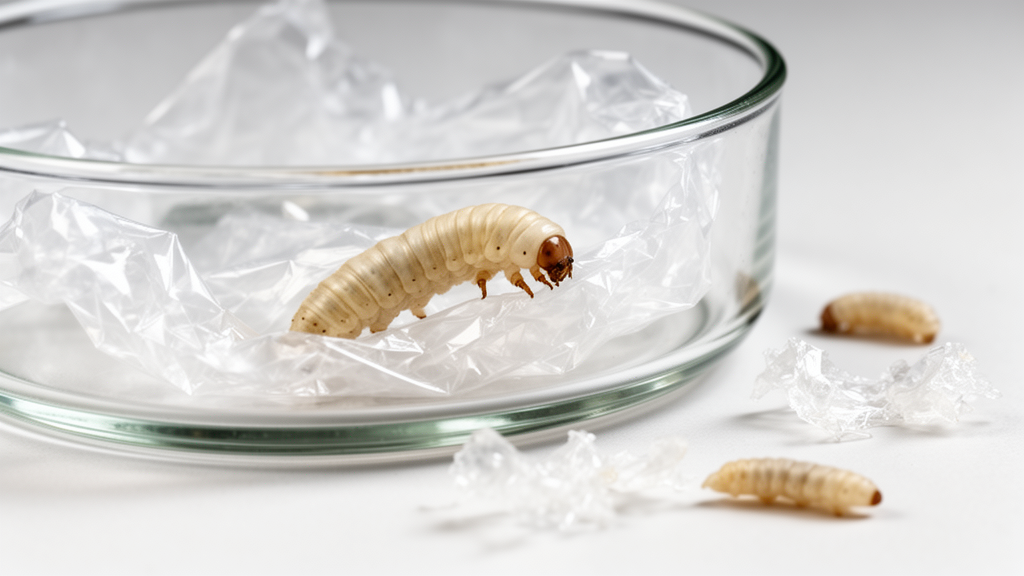
The greater wax moth, Galleria mellonella, has become one of the most closely watched insects in the search for biological answers to plastic pollution. Since larvae of this species were reported chewing through polyethylene films, researchers have wondered whether the moth and its gut microbes could help break down some of the synthetic polymers that now saturate landfills and oceans. A new study from the Universidad Autónoma de Guadalajara in Mexico adds an important layer of caution and detail to that story. By following entire colonies of wax moths across two generations on diets laced with polyethylene terephthalate, polystyrene, or polyethylene, the team measured how these materials affect long-term reproductive output and recovered a collection of living gut bacteria that can now be tested for polymer-degrading abilities.
The research, published in Frontiers in Insect Science, was designed around a simple but demanding question: what happens to a wax moth population when most of its food is replaced by plastic? To find out, the investigators established four dietary treatments. One group received only a commercial waxworm feed made from cereal flours, honey, glycerin, vitamins, and minerals. Three other groups received diets in which 80 percent of that feed, measured by volume, was replaced with finely grated PET from a clean bottle, crumbled polystyrene beads, or cut fragments of polyethylene protective material. Each treatment included five independent experimental units, each starting with 15 larvae, for a total of 300 insects drawn from a single commercial batch.
Rather than tracking individual larvae, the researchers used cumulative adult production as their main measure of colony performance. This metric captures the total number of second-generation adults that emerged in each experimental unit by the end of monitoring, integrating reproduction by the founding cohort with the survival and development of their offspring. Each colony remained on its assigned diet until the initial cohort completed its full life cycle. The offspring stayed in the same containers under the same dietary conditions, and adults were counted only after natural death, which served as a practical endpoint for enumeration rather than as a measure of longevity.
The results revealed a clear hierarchy among the diets. Colonies on the control feed produced the highest mean number of second-generation adults, at 122.0 per unit, with a standard deviation of 56.3. Polystyrene and polyethylene diets yielded intermediate means of 60.4 and 64.0 adults respectively, while the PET diet produced the lowest mean at 41.8 adults per unit. A one-way analysis of variance confirmed that these differences were statistically significant, with an F statistic of 4.402 across three degrees of freedom in the numerator and sixteen in the denominator, yielding a P value of 0.0194. Tukey’s post hoc test showed that only the PET treatment differed significantly from the control, at P equal to 0.0163, while polystyrene and polyethylene fell short of significance with P values of 0.0767 and 0.1016.
In relative terms, the polymer diets reduced adult production by substantial margins. Colonies fed polystyrene produced 50.5 percent fewer adults than controls, those on polyethylene produced 47.5 percent fewer, and those on PET produced 65.7 percent fewer. However, the authors are careful to note that these figures describe responses to the complete dietary formulations rather than to the polymers alone. Because the polymer-containing diets contained only 20 percent commercial feed by volume while the control received 100 percent, the reduced nutrient content alone could account for much of the observed decline. Without quantifying cumulative feed intake, the study cannot separate the effect of polymer exposure from the effect of simple food scarcity.
Alongside the population measurements, the team pursued a parallel microbiological objective: recovering viable bacteria from the larval gut under aerobic laboratory conditions. This culture-dependent approach contrasts with the DNA-based community profiling that has dominated recent studies of the wax moth microbiome. While sequencing surveys can reveal which organisms are present, they do not necessarily yield living cells that can be preserved, grown, and tested directly for enzymatic activity. Culture-dependent isolation, by contrast, provides organisms that can be subjected to functional assays, which is essential for any future bioprospecting effort aimed at finding bacteria capable of degrading synthetic polymers.
To recover bacteria, the researchers dissected the intestinal tracts of five large second-generation larvae from each treatment, selecting individuals weighing between 200 and 300 milligrams to standardize body size and ensure sufficient gut material. The five intestinal samples from each treatment were pooled into a single composite sample, suspended in sterile saline with peptone, and briefly pre-enriched at 35 degrees Celsius. The suspensions were then serially diluted and spread onto five different culture media: lysine iron agar, triple sugar iron agar, yeast extract-supplemented bacteriological agar, MacConkey agar, and brain heart infusion agar. Plates were incubated aerobically at 35 degrees Celsius for 96 hours and examined daily.
The culture media screening revealed a striking pattern of medium-dependent recovery. Yeast extract agar and brain heart infusion agar supported visible growth from all four treatments within the first 24 hours, making them the most permissive media in the panel. Triple sugar iron agar showed growth from 48 hours onward but only from the control and polystyrene samples. Lysine iron agar and MacConkey agar produced no detectable growth from any composite sample during the entire incubation period. These differences demonstrate that the fraction of gut bacteria recovered depends heavily on the composition and selective properties of the medium used, and that no single medium captures the full cultivable diversity present in the insect gut.
From the plates that did support growth, the researchers selected 14 isolates representing visually distinct colony morphotypes, chosen based on differences in size, shape, margin, elevation, color, and surface appearance. Six isolates came from the control sample, four from polystyrene, and two each from polyethylene and PET. The team emphasized that these 14 isolates were not assumed to represent 14 distinct taxa or strains, since morphotype selection can converge on the same organism recovered under different conditions. Each isolate was grown in nutrient broth, its genomic DNA extracted using a phenol-chloroform method, and the V4 region of the 16S rRNA gene amplified with the widely used 515F and 806R primers. Bidirectional Sanger sequencing produced consensus fragments of 244 to 253 base pairs after trimming, which were compared against the NCBI nucleotide database using BLASTn.
The taxonomic assignments revealed a strong dominance of a single genus. Thirteen of the 14 isolates were assigned to Bacillus, a genus of spore-forming bacteria that appears frequently in studies of insects exposed to plastic materials and that includes strains previously reported to degrade multiple polymer types. The remaining isolate, recovered only from the PET sample, was assigned to Psychrobacillus, a less commonly reported genus in this context. Because each treatment was represented by a single pooled gut sample with no independent microbiological replicates, the authors caution that these assignments describe the composition of the culture collection rather than treatment-level differences in bacterial abundance or diversity. The recovery of Bacillus from both the control and all three polymer diets indicates that its presence was not exclusive to any formulation and cannot by itself be interpreted as evidence of polymer-related metabolic activity.
The study’s two components, population performance and bacterial recovery, were examined using different sampling frameworks and should be read as parallel findings rather than as evidence of a direct causal relationship. The authors explicitly state that recovering cultivable bacteria does not demonstrate their ability to utilize or modify PET, polystyrene, or polyethylene. Establishing such activity will require functional assays with individual isolates, combined with physicochemical analyses that document verifiable changes in polymer structure. Previous work on PET degradation has focused on specialized microbial enzymes such as PETases, and recent reports have begun to evaluate insect-associated bacteria for similar activity, but the field remains in its early stages.
Looking forward, the researchers identify several priorities for strengthening future investigations. Nutritionally comparable controls would allow the contribution of polymer exposure to be separated from the effect of reduced feed availability. Quantitative feed-intake measurements would clarify how much polymer larvae actually encounter. Stage-specific monitoring of oviposition, larval development, pupation, and adult emergence would reveal which life stages are most sensitive to dietary composition. On the microbiological side, independent replicates, additional cultivation conditions including anaerobic and microaerophilic atmospheres, higher-resolution taxonomic identification through whole-genome sequencing, and systematic functional screening against PET, polystyrene, and polyethylene would help determine whether any of the recovered isolates possess genuinely useful degradative capabilities.
For now, the study stands as a careful, methodologically transparent contribution to a field that has sometimes outrun its evidence. It confirms that wax moth colonies can complete their life cycles on diets dominated by synthetic polymers, though at a measurable reproductive cost that is most severe for PET. It also delivers a tangible resource: a preserved collection of viable gut-associated bacteria, dominated by Bacillus and including one Psychrobacillus isolate, that can be prioritized for the functional assays that will ultimately determine whether these insects and their microbial partners hold real promise for plastic bioremediation. The sequences have been deposited in GenBank under accession numbers PZ779718 through PZ779731, making the collection available for verification and further study by the broader research community.
Subject of Research: Effects of polymer-containing diets on wax moth reproduction and recovery of cultivable gut bacteria
Article Title: Cumulative adult production and aerobic culture-dependent recovery of gut-associated bacteria in Galleria mellonella maintained on polymer-containing diets
Article References: Cumulative adult production and aerobic culture-dependent recovery of gut-associated bacteria in Galleria mellonella maintained on polymer-containing diets. (n.d.). https://doi.org/10.3389/finsc.2026.1960793
Image Credits: AI Generated
DOI: 10.3389/finsc.2026.1960793
Keywords: Galleria mellonella, greater wax moth, plastic biodegradation, polyethylene terephthalate, polystyrene, polyethylene, gut microbiome, Bacillus, Psychrobacillus, 16S rRNA sequencing, insect physiology, bioprospecting
Cite Scienmag News
Morgan Morrow. (October 16, 2026). Wax Moths Fed Plastic Diets Reveal Hidden Gut Bacteria and a Cost to Reproduction. Scienmag. https://scienmag.com/wax-moths-fed-plastic-diets-reveal-hidden-gut-bacteria-and-a-cost-to-reproduction/
Morgan Morrow. "Wax Moths Fed Plastic Diets Reveal Hidden Gut Bacteria and a Cost to Reproduction." Scienmag, 16 October 2026, https://scienmag.com/wax-moths-fed-plastic-diets-reveal-hidden-gut-bacteria-and-a-cost-to-reproduction/. Accessed 16 October 2026.
Morgan Morrow. "Wax Moths Fed Plastic Diets Reveal Hidden Gut Bacteria and a Cost to Reproduction." Scienmag. October 16, 2026. https://scienmag.com/wax-moths-fed-plastic-diets-reveal-hidden-gut-bacteria-and-a-cost-to-reproduction/


