


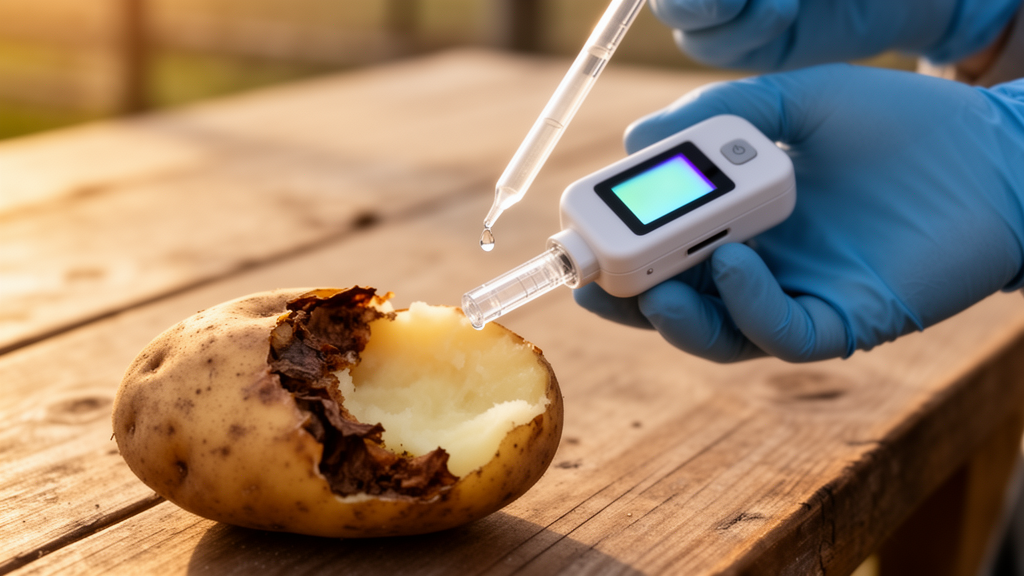
Soft rot is one of the most destructive bacterial diseases of potato worldwide, and a new study reports a diagnostic tool that can identify its main culprit in the field, using nothing more sophisticated than a thermal flask. Researchers at the University of Kufa and Al-Qasim Green University in Iraq have developed a loop-mediated isothermal amplification, or LAMP, assay that specifically detects Pectobacterium, the genus of bacteria responsible for devastating tuber decay, while ignoring its close relative Dickeya, which produces indistinguishable symptoms on the same hosts. The work, published in Frontiers in Horticulture, describes an assay that runs at a constant 65 degrees Celsius for 40 minutes and delivers its answer as a simple color change visible to the naked eye.
The economic stakes are considerable. According to the authors, soft rot causes greater quantitative losses than any other bacterial plant disease, with global crop losses exceeding 420 million dollars annually and postharvest losses estimated at roughly 20 to 30 percent of harvested produce. The disease is not confined to potato; Pectobacterium and Dickeya also attack tomato, maize, pineapple, carrot, sugar beet, and several ornamental plants, producing wilting, stem rot, blackleg, and maceration both before and after harvest. Particularly harmful Pectobacterium species include P. carotovorum, P. atrosepticum, P. betavasculorum, P. wasabiae, P. brasiliense, P. punjabense, and P. polaris, which affect both monocot and dicot hosts.
The central diagnostic dilemma that motivated the study is that Pectobacterium and Dickeya share a common host range and cause symptoms that cannot be told apart by eye. Some studies have even shown that the two pathogens survive as mixed populations within the same infected tuber tissue. Conventional bacteriological methods are time-consuming and demand specialized skills for routine genus-level identification, while polymerase chain reaction, although the most widely used technique for identifying plant pathogens, is costly, slow, and poorly suited to deployment outside a laboratory. The Iraqi team therefore turned to LAMP, an isothermal amplification method prized for its speed, simplicity, high sensitivity, and compatibility with simple detection chemistries.
LAMP works through a strand-displacement mechanism driven by a DNA polymerase and a set of four core primers: two inner bipartite primers, FIP and BIP, and two outer primers, F3 and B3. The reaction begins when an inner primer hybridizes to its corresponding priming site on the target DNA, after which the outer primer binds upstream and initiates synthesis of a new complementary strand that displaces the inner primer’s extension product. The resulting products form stem-loop structures at both termini, and adding internal loop primers, LF and LB, accelerates the reaction and shortens the overall run time. In this assay, amplification is visualized with phenol red, a pH-sensitive dye that shifts from pink or red to yellow when the accumulating double-stranded DNA pushes the solution’s pH below 6.8.
Choosing the right DNA target was critical to the assay’s specificity. By examining genomes from multiple Pectobacterium and Dickeya species, the researchers selected the prolyl 4-hydroxylase gene, p4h, as a distinctive marker for Pectobacterium. Using Primer Explorer V5, they designed six primers targeting the p4h coding region of P. carotovorum, including the forward and reverse loop primers that boost reaction efficiency. The primer set showed 100 percent identity in BLAST searches against the intended target, and optimization experiments identified 65 degrees Celsius for 40 minutes as the incubation condition that reliably produced a clear color change.
To build the validation panels, the team collected 90 infected potato tuber samples from six Iraqi provinces: Babylon, Baghdad, Karbala, Dohuk, Diwaniyah, and Najaf, with disease incidence in the sampled fields ranging from 10 to 50 percent. After surface sterilization and plating on nutrient agar, single colonies were transferred to crystal violet pectate medium, where cavity formation indicated Pectobacterium. Pathogenicity was confirmed by stab-inoculating healthy tubers of the Arizona cultivar with bacterial suspensions adjusted to an optical density of approximately 0.1 at 600 nanometers and incubating them for 48 hours. Eleven strains were ultimately identified as Pectobacterium species and formed the inclusivity panel, spanning P. brasiliense, P. wasabiae, P. atrosepticum, P. carotovorum, P. odoriferum, P. aroidearum, P. quasiaquaticum, P. peruviense, P. punjabense, P. polaris, and P. zantedeschiae.
Biochemical profiling helped separate the genera before molecular confirmation. Pectobacterium and Dickeya were distinguished from Xanthomonas and Pseudomonas by cavity formation on crystal violet pectate medium, oxidative-fermentative and catalase reactions, and growth on nutrient agar at 37 degrees Celsius, with P. wasabiae and P. atrosepticum being exceptions that did not grow at that temperature. Pectobacterium species were further distinguished by their inability to produce indole. Genomic DNA extracted from pure cultures was amplified with primers targeting the dnaA and 16S rRNA gene regions, sequenced by Sanger methods, and verified against the NCBI GenBank database using BLASTn, yielding nine new accession numbers for the study strains. Pairwise sequence identity among the Pectobacterium species ranged from 57 to 100 percent, while the Dickeya zeae sequence showed more than 95 percent similarity to Pectobacterium strains, underscoring how closely related these soft rot pathogens are.
The performance figures are striking. In specificity testing across 15 bacterial strains, the assay correctly flagged all 11 Pectobacterium species and returned negative results for the exclusivity panel, which comprised Pseudomonas syringae, Xanthomonas campestris, Dickeya zeae, and Dickeya dianthicola, with no false positives or false negatives observed. Sensitivity testing with serial dilutions of purified Pectobacterium genomic DNA established a detection limit of 5 femtograms, which the authors calculate corresponds to roughly 9,000 genomic copies using a target fragment length of 450 to 500 base pairs. Conventional PCR with the outer primers P4H-F3 and P4H-B3 independently confirmed the result, amplifying an approximately 450-base-pair product only in target strains. The assay also succeeded on infected potato tuber samples, and results were consistent between laboratory and field conditions.
What sets this assay apart is its deliberate rejection of laboratory infrastructure. The researchers showed that the reaction works just as well in a simple digital water bath held at 65 degrees Celsius as in a PCR thermal cycler, with positive yellow reactions for P. carotovorum, P. brasiliense, and P. wasabiae DNA and a negative red reaction for D. zeae. More remarkably, they bypassed DNA extraction entirely: 20 to 50 milligrams of rotted tuber tissue were macerated in 500 microliters of Tris-EDTA buffer for two minutes, allowed to settle for ten minutes, and the supernatant was added directly to the 25-microliter reaction mixture. Plant-derived inhibitors, which have undermined other field LAMP assays, including one developed for Xanthomonas in tomato, did not interfere with amplification. The reaction was then incubated in a commercially available thermal flask filled with water at 65 degrees Celsius, a device that requires neither sophisticated instrumentation nor specialized training.
The authors argue that the combination of speed, sensitivity, specificity, visual readout, and minimal equipment makes the assay suitable for routine point-of-care diagnostics, surveillance, agricultural quarantine, seed certification, border protection, and disease management. Sample preparation takes less than one minute, the entire workflow fits within roughly 40 minutes, and the only specialized consumable is a colorimetric master mix. Compared with portable qPCR devices developed for other plant pathogens, such as the field detection systems used against Xylella fastidiosa, the thermal flask approach trades quantitative precision for radical simplicity and low cost. For potato growers and quarantine inspectors confronting a pathogen complex that can silently destroy a fifth to a third of the harvest after it leaves the field, a test that turns yellow in a flask may prove to be exactly the kind of tool that moves molecular diagnostics out of the laboratory and into the field.
Subject of Research: Development of a field-deployable LAMP assay for specific detection of Pectobacterium causing potato soft rot
Article Title: Development of a robust, deployable loop-mediated isothermal amplification assay for rapid and specific detection of soft rot caused by Pectobacterium
Article References: Development of a robust, deployable loop-mediated isothermal amplification assay for rapid and specific detection of soft rot caused by Pectobacterium. (n.d.). https://doi.org/10.3389/fhort.2026.1904930
Image Credits: AI Generated
DOI: 10.3389/fhort.2026.1904930
Keywords: Pectobacterium, soft rot, potato, LAMP, isothermal amplification, plant pathology, diagnostics, Dickeya, p4h gene, colorimetric detection, field diagnostics, phytopathology
Cite Scienmag News
Alan Morgan. (October 16, 2026). Portable DNA Test Spots Potato Soft Rot Bacteria in 40 Minutes Without a Lab. Scienmag. https://scienmag.com/portable-dna-test-spots-potato-soft-rot-bacteria-in-40-minutes-without-a-lab/
Alan Morgan. "Portable DNA Test Spots Potato Soft Rot Bacteria in 40 Minutes Without a Lab." Scienmag, 16 October 2026, https://scienmag.com/portable-dna-test-spots-potato-soft-rot-bacteria-in-40-minutes-without-a-lab/. Accessed 16 October 2026.
Alan Morgan. "Portable DNA Test Spots Potato Soft Rot Bacteria in 40 Minutes Without a Lab." Scienmag. October 16, 2026. https://scienmag.com/portable-dna-test-spots-potato-soft-rot-bacteria-in-40-minutes-without-a-lab/


