


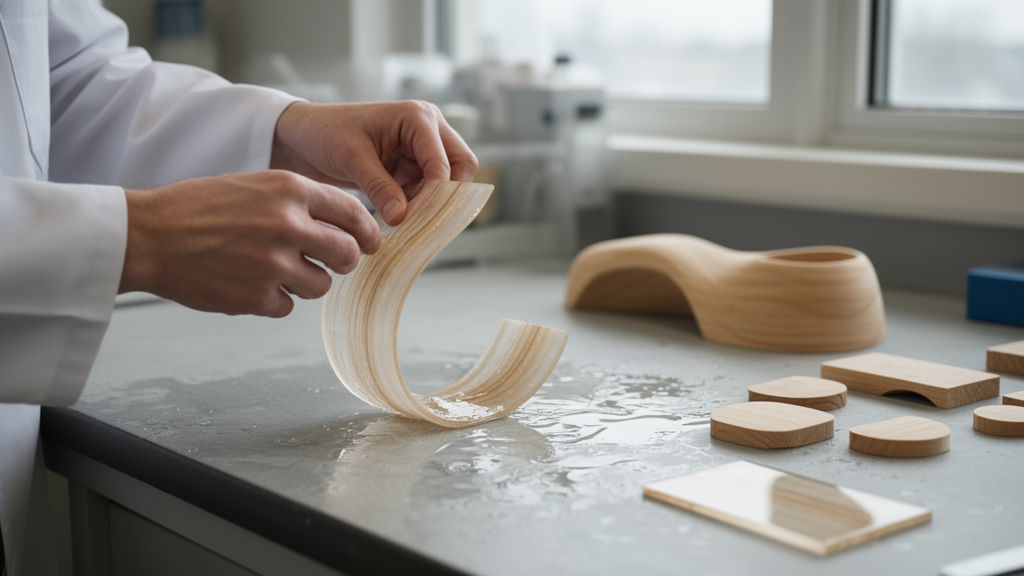
A team of researchers has developed a way to turn ordinary natural wood into a strong, moldable, water-resistant material that could stand in for petroleum-based plastics in everyday products such as cutlery, plates and drinking straws. The approach, described in the Journal of Bioresources and Bioproducts, relies on a room-temperature hydroplasticization strategy that preserves most of the wood’s natural lignin while dramatically upgrading its mechanical performance and processability.
Petroleum-based plastics have become indispensable in modern life, but their persistence in the environment has intensified the search for renewable alternatives that can survive practical, real-world use. Cellulose-based materials have long been considered promising candidates because cellulose is abundant, renewable and biodegradable. Yet these materials face two stubborn obstacles: they tend to be sensitive to water, losing strength when wet, and they often fall short of the mechanical strength that conventional plastics deliver. The new study tackles both problems at once by working with wood itself rather than extracted cellulose alone.
The process begins with a mild delignification step, in which a portion of the lignin that glues wood’s cellulose fibers together is removed to open up the material’s porous structure. A cellulose solution is then infiltrated into that porous network. Water plays a central role as the medium that facilitates shaping: while the wood is hydrated, it can be folded and formed into different geometries. As the material dries, the regenerated cellulose forms a physically crosslinked network with the existing wood structure, and the whole composite densifies without any conventional mechanical hot-pressing. Crucially, most of the original lignin is retained throughout, and that retained lignin helps preserve the wood’s natural resistance to moisture.
The mechanical results are striking. The resulting hydroplastic wood achieved a tensile strength of 405.5 megapascals, approximately 5.9 times that of the untreated wood used for comparison. Even in a wet state, the material held a tensile strength of 86.7 megapascals, an important figure for any material intended to replace plastics in applications involving liquids or humidity. Water uptake after 48 hours of exposure measured 54 percent, indicating that while the material does absorb some water, its structural integrity remains largely intact thanks to the preserved lignin and the crosslinked cellulose network.
Shapeability is where the hydroplastic approach departs most clearly from earlier wood-processing strategies. In its hydrated state, the material can be folded and molded into a variety of forms. The researchers demonstrated this by producing knives, forks, plates and drinking straws from the treated wood. The water acts as a temporary plasticizer, softening the structure so it can be reshaped, and the subsequent drying locks in the new form through the regenerated cellulose network. This means the transformation from raw wood to finished product can proceed without the high temperatures or heavy mechanical presses that many other wood densification methods require.
Biodegradability testing provided one of the study’s most vivid comparisons. In a soil-burial test, a hydroplastic wood straw gradually fragmented within 90 days and was nearly fully degraded after six months. A conventional polyethylene straw, by contrast, showed no observable degradation over the same period. For single-use items such as straws and disposable tableware, which are among the most commonly littered plastic products, this difference in environmental fate could be decisive.
The researchers also conducted a life-cycle assessment to compare the environmental profile of hydroplastic wood with several petroleum-derived plastics. The analysis indicated a considerably lower carbon footprint for the wood-based material. The authors note, however, that the assessment focused on the manufacturing stage and did not include transportation, use or end-of-life treatment, so the full environmental picture would require a broader accounting. Even so, a lower manufacturing footprint combined with demonstrated biodegradability positions the material favorably against conventional plastics.
From a technical standpoint, the study’s significance lies in what it avoids. Many previous efforts to create high-performance wood materials have relied on extensive delignification, which strips away the very component that gives wood its natural water resistance, or on energy-intensive hot-pressing to densify the material. By retaining most of the lignin and densifying the wood through cellulose infiltration and drying alone, the room-temperature strategy sidesteps both drawbacks. The physically crosslinked network formed between the regenerated cellulose and the wood’s existing architecture reinforces the material from within while the native lignin continues to shield it from moisture.
The path from laboratory demonstration to industrial application is not without hurdles. The authors point out that variations among wood species may affect both processing and final performance, meaning the method may need to be tuned for different feedstocks. Uniform treatment also becomes more difficult in wood sections thicker than one centimeter, since the cellulose solution must penetrate the entire porous structure for the reinforcement to be consistent. Scaling up will therefore require attention to how deeply and evenly the solution infiltrates larger pieces of timber.
The researchers identify several priorities for future development: simplified processing, continuous impregnation methods, faster drying techniques and chemical recovery systems that would allow reagents to be reused rather than discarded. Progress on these fronts would bring the process closer to the throughput and cost structure that commercial manufacturing demands. If those challenges can be met, hydroplastic wood could offer a renewable, biodegradable and mechanically robust alternative to plastics in applications ranging from disposable tableware to more durable consumer goods, all while making use of one of the planet’s most abundant natural materials.
Subject of Research: Room-temperature hydroplasticization of natural wood into strong, shapeable, water-resistant biodegradable material for plastic replacement
Article Title: Water-processed wood combines high strength, shapeability and water resistance for plastic replacement
Article References: Water-processed wood combines high strength, shapeability and water resistance for plastic replacement. (n.d.). Original publication
Image Credits: AI Generated
DOI: Not provided
Keywords: hydroplastic wood, cellulose, lignin, biodegradable plastics, sustainable materials, wood processing, tensile strength, plastic replacement, life-cycle assessment, renewable materials, delignification, bioproducts
Cite Scienmag News
Denise Maddox. (October 18, 2026). Water-Treated Wood Emerges as Strong, Moldable Rival to Plastic. Scienmag. https://scienmag.com/water-treated-wood-emerges-as-strong-moldable-rival-to-plastic/
Denise Maddox. "Water-Treated Wood Emerges as Strong, Moldable Rival to Plastic." Scienmag, 18 October 2026, https://scienmag.com/water-treated-wood-emerges-as-strong-moldable-rival-to-plastic/. Accessed 18 October 2026.
Denise Maddox. "Water-Treated Wood Emerges as Strong, Moldable Rival to Plastic." Scienmag. October 18, 2026. https://scienmag.com/water-treated-wood-emerges-as-strong-moldable-rival-to-plastic/


