


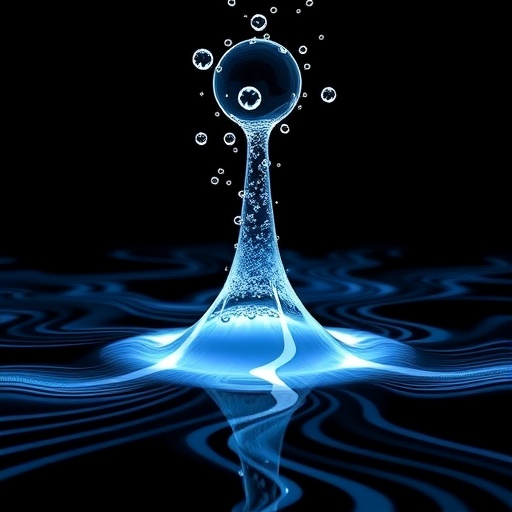
In an innovative leap bridging classical and quantum physics, researchers have unveiled a mesmerizing fluid dynamic phenomenon that vividly illustrates the elusive Aharonov–Bohm (AB) effect using nothing more than water waves and a spinning vortex. This discovery, emanating from a collaborative effort among the Okinawa Institute of Science and Technology (OIST), University of Oslo, and Universidad Adolfo Ibáñez, not only sheds light on quantum-topological phenomena but also provides a tangible, visually striking analogue system accessible through experimental fluid mechanics.
The AB effect, a cornerstone of quantum mechanics first conceptualized in 1959, describes how charged particles are influenced by electromagnetic potentials even when traversing regions free of electromagnetic fields. Historically, electrons encircling a magnetic flux confined within a solenoid experience a shift in their wavefunction phase, revealing the profound nonlocality integral to quantum physics. Despite its radical proposal, experimental confirmation was challenging and indirect, taking decades before definitive manifestation through high-precision interferometry.
Drawing from the seminal work of Michael Berry in 1980, who theorized a classical fluid system emulating AB-like phase shifts via a vortex in draining water, the research team expanded this concept, probing the dynamic interactions of standing water waves in the presence of a spinning vortex. Instead of electrons, the experimental system employs centimeter-scale water waves generated in a large custom-built water tank, with a central vortex serving as the fluid analogue of a confined magnetic flux.
Experimentally, waves were initiated from opposite sides of the tank and allowed to interfere, forming standing wave patterns. Without the vortex, these standing waves exhibit stationary nodal lines—fixed regions on the water surface that remain momentarily flat, manifesting the superposition principle predictably. However, introducing the vortex unveiled an astonishing twist: these nodal lines themselves began to rotate slowly but steadily, spinning counter to the direction of the vortex flow, creating hypnotic, rotating “lines of stillness” on the water’s surface.
High-speed imaging coupled with sub-surface illumination allowed the researchers to capture these ephemeral patterns exquisitely. The nodal lines are loci where destructive interference consistently cancels out wave height, yet their persistent rotation defies conventional anticipation. This rotation is a macroscopic visualization of topological phase shifts analogous to the quantum AB effect’s phase accumulation, but here, robustly visible and directly measurable in a classical fluid setup.
What challenges intuition most is that while spreading waves traveling in opposite directions might be expected to produce symmetric or cancelling pitchfork interference patterns around the vortex, the real interference between standing waves yielded new, complex topological phenomena. The number of nodal lines increased predictably with vortex flow strength, allowing systematic control over the topological features in this fluid system.
Mathematical modeling complemented the experiments, revealing that these rotating nodal lines arise from the interplay between the vortex-induced phase singularity and the coherent interference of counter-propagating waves. The wave function of water surface displacement, governed by classical wave equations influenced by the vortex velocity field, acquires a nontrivial topological character that mirrors quantum mechanical phase phenomena. This cross-disciplinary fusion of fluid dynamics, wave physics, and topology pioneers a novel platform to study synthetic gauge fields in classical systems.
This breakthrough has profound implications beyond pure physics pedagogy. It opens avenues to simulate quantum phenomena such as topological insulators, superconductivity analogues, and vortex lattices within the accessible, scalable framework of fluid dynamics. By arranging multiple vortices in lattice configurations, researchers anticipate mimicking electronic behaviors in unconventional superconductors, potentially illuminating new quantum phases via classical analogues.
Moreover, this work presents a new paradigm for experimental topological wave physics where intricate quantum effects can be emulated, visualized, and manipulated in macroscopic, room-temperature conditions without requiring elaborate quantum state preparation. Such analogues democratize access to studying exotic physics and may inspire engineered metamaterials and devices leveraging topological robustness inherent in wave interferences.
Senior author and Unit head Professor Mahesh Bandi highlights that the true impact lies in the uncharted territories now open for research. “We have only glimpsed the tip of an iceberg in understanding how classical wave systems can host complex topological behavior analogous to quantum matter. As investigations progress into more intricate vortex patterns and waveforms, unexpected emergent phenomena may well be discovered,” Bandi points out.
Importantly, the fluid analogue approach transcends limitations faced by direct quantum experiments, which often struggle to resolve localized phase structures due to decoherence and detection constraints. The water-wave system, easily observed and controlled, acts as a testbed for theories, guiding quantum experimental design and interpretation.
Aditya Singh, a PhD student and co-first author, remarks on the serendipitous nature of their finding: “When the rotating nodal lines first appeared, we suspected experimental errors. Seeing them reproduced in simulations, however, confirmed a new physical phenomenon was in play, spotlighting the power of simple, classical analogues to reveal underlying quantum topological mechanisms.”
This discovery vividly exemplifies how interplay between classical hydrodynamics and quantum topology can foster profound insights, enriching both fundamental science and future technological applications. It raises provocative questions: Can we harness such standing wave-topological interactions for wave-guiding, sensing, or energy transfer in classical systems? How far can classical analogues push our understanding of complex quantum materials?
As the boundary between classical and quantum worlds becomes increasingly permeable through creative models such as this, the rich tapestry of physics continues to unfold in unexpected and beautiful ways—visibly etched onto the fluid surface.
News Publication Date: 20-Apr-2026
Web References:
10.1038/s42005-026-02603-w
References:
Singh et al., (2026) Communications Physics
Keywords
Aharonov-Bohm effect, fluid dynamics, standing waves, vortex, topology, quantum analogue, water waves, phase shift, wave interference, topological physics, synthetic gauge fields, macroscopic quantum simulation
Cite Scienmag News
Katie Riggs. (April 20, 2026). Water Simulation of Renowned Quantum Effect Uncovers Surprising Wave Patterns. Scienmag. https://scienmag.com/water-simulation-of-renowned-quantum-effect-uncovers-surprising-wave-patterns/
Katie Riggs. "Water Simulation of Renowned Quantum Effect Uncovers Surprising Wave Patterns." Scienmag, 20 April 2026, https://scienmag.com/water-simulation-of-renowned-quantum-effect-uncovers-surprising-wave-patterns/. Accessed 4 September 2026.
Katie Riggs. "Water Simulation of Renowned Quantum Effect Uncovers Surprising Wave Patterns." Scienmag. April 20, 2026. https://scienmag.com/water-simulation-of-renowned-quantum-effect-uncovers-surprising-wave-patterns/


