


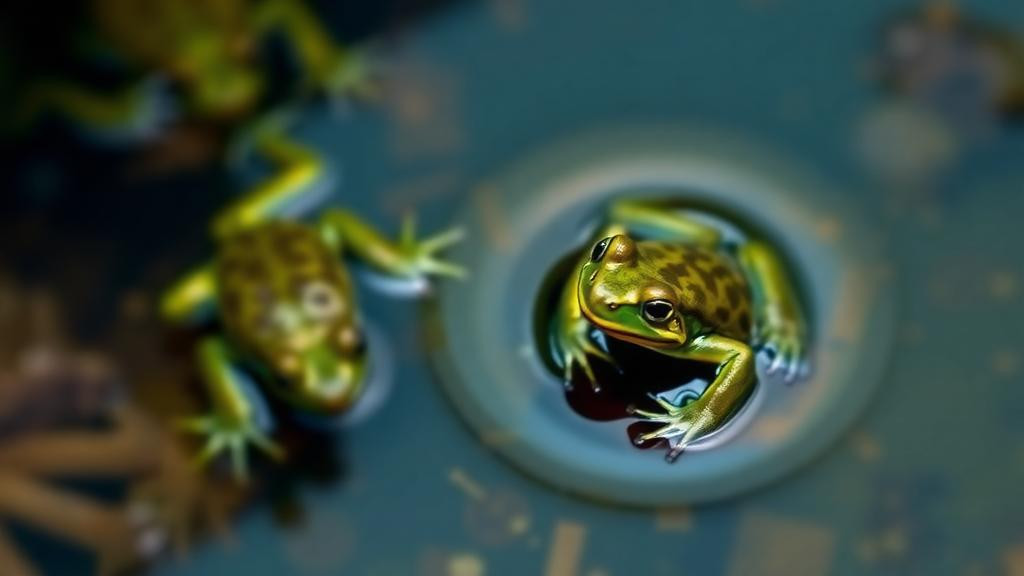
In a controlled outdoor experiment, tadpoles of the American bullfrog (Lithobates catesbeianus) acquired microplastics from both water and food, but water emerged as the clearly dominant source. Tadpoles exposed through both pathways at the same time carried an average of 666 ± 699 particles per gram of waterborne microplastics in their gastrointestinal tract, compared with 120 ± 118 particles per gram of foodborne microplastics. On average, 71 ± 23 percent of all microplastics found in the animals were located in the gut, marking ingestion as the dominant but not exclusive route of uptake. The findings, published on 23 October 2026, come from one of the few amphibian studies designed to separate these two exposure pathways experimentally.
The research team used a 2 × 2 factorial design in outdoor mesocosms, essentially artificial ponds that reproduce more natural conditions than laboratory beakers. Sixty wild-caught tadpoles at Gosner stage 25 were divided among four treatments, with 15 tadpoles per treatment, in which microplastics were either present or absent in the water and either present or absent in the food. This setup allowed the researchers to expose some animals to microplastics in water only, some in food only, some in both, and some in neither, providing a direct comparison of the relative contribution of each pathway.
To create the waterborne exposure, the team added white polyethylene (PE) fragments to the water column at a measured concentration of 888 ± 514 particles per liter. For the foodborne exposure, grey PE fragments were mixed into food at 12.3 ± 3.46 particles per gram of agar. The two colors served a practical purpose: because white fragments only ever entered via water and grey fragments only via food, the researchers could trace which pathway each particle inside a tadpole had come from.
Over the 10-day experiment, tadpoles were collected every 48 hours so that microplastics could be analyzed in two compartments: the gastrointestinal tract and the carcass, defined as the body with the gut removed. This sampling schedule captured how particle burdens changed over time rather than relying on a single endpoint. The analysis showed that the waterborne pathway contributed significantly to total microplastic concentrations in both the gastrointestinal tract and the carcass, whereas the foodborne pathway contributed significantly only to concentrations in the gastrointestinal tract.
That asymmetry carries weight for how plastic exposure is assessed in aquatic animals. If foodborne particles remain largely confined to the gut while waterborne particles appear throughout the body, then studies that measure only gut contents may underestimate the full internal burden from water, and studies that consider only water may miss the contribution of contaminated food. The observation that roughly seven in ten particles sat in the gut leaves a substantial minority, about 29 percent on average, distributed in the rest of the body.
Particle size added a further layer to the results. Microplastic size did not differ between the two exposure routes, but particles recovered from tadpoles were on average smaller, at 0.088 ± 0.099 millimeters, than those in the water (0.231 ± 0.094 millimeters) or the food (0.139 ± 0.078 millimeters). In other words, the fragments retained inside the animals were smaller than the fragments available in either medium, a pattern the researchers report as a measured observation about which particle sizes accumulate in tadpole tissue.
The study addresses a long-standing gap in the experimental literature. According to the authors, most previous studies examining microplastic uptake by aquatic amphibians considered only uptake from water, disregarding other potentially important exposure pathways such as contaminated food. By manipulating both sources simultaneously and using color-coded particles to distinguish them, the mesocosm design makes it possible to state, rather than assume, how much each pathway contributes to the particles found inside an animal.
The experiment has clear boundaries that shape how the results should be read. It ran for 10 days, involved a single amphibian species at one developmental stage, used one polymer type, and applied specific laboratory-controlled particle concentrations in the water and food. Within those limits, the study demonstrates that tadpoles take up microplastics from both water and food, that water is the larger contributor to whole-body burdens, and that ingestion dominates but does not fully account for where particles end up. The authors emphasize that assessing the risks of plastic pollution to aquatic biota requires considering multiple exposure pathways rather than water alone, a conclusion that applies to the design of future exposure studies for amphibians and other aquatic organisms.
Subject of Research: Relative importance of water and food as microplastic exposure pathways in American bullfrog tadpoles
Article Title: Outdoor mesocosm experiment provides novel insights into the relative importance of water and food as sources of microplastics to aquatic amphibians
Article References: Gene, S. M., Katzenback, B. A., Provencher, J. F., Mallory, M. L., Lougheed, S. C., & Orihel, D. M. (2026). Outdoor mesocosm experiment provides novel insights into the relative importance of water and food as sources of microplastics to aquatic amphibians. Ecotoxicology, 35(9), Article 197. https://doi.org/10.1007/s10646-026-03145-1
Image Credits: AI Generated
DOI: 10.1007/s10646-026-03145-1
Keywords: microplastics, polyethylene, American bullfrog, tadpoles, mesocosm, amphibians, ecotoxicology, exposure pathways, gastrointestinal tract, plastic pollution, Outdoor, experiment
Cite Scienmag News
Sloane Callahan. (October 24, 2026). Water outweighs food as microplastic source for bullfrog tadpoles. Scienmag. https://scienmag.com/water-outweighs-food-as-microplastic-source-for-bullfrog-tadpoles/
Sloane Callahan. "Water outweighs food as microplastic source for bullfrog tadpoles." Scienmag, 24 October 2026, https://scienmag.com/water-outweighs-food-as-microplastic-source-for-bullfrog-tadpoles/. Accessed 24 October 2026.
Sloane Callahan. "Water outweighs food as microplastic source for bullfrog tadpoles." Scienmag. October 24, 2026. https://scienmag.com/water-outweighs-food-as-microplastic-source-for-bullfrog-tadpoles/


