


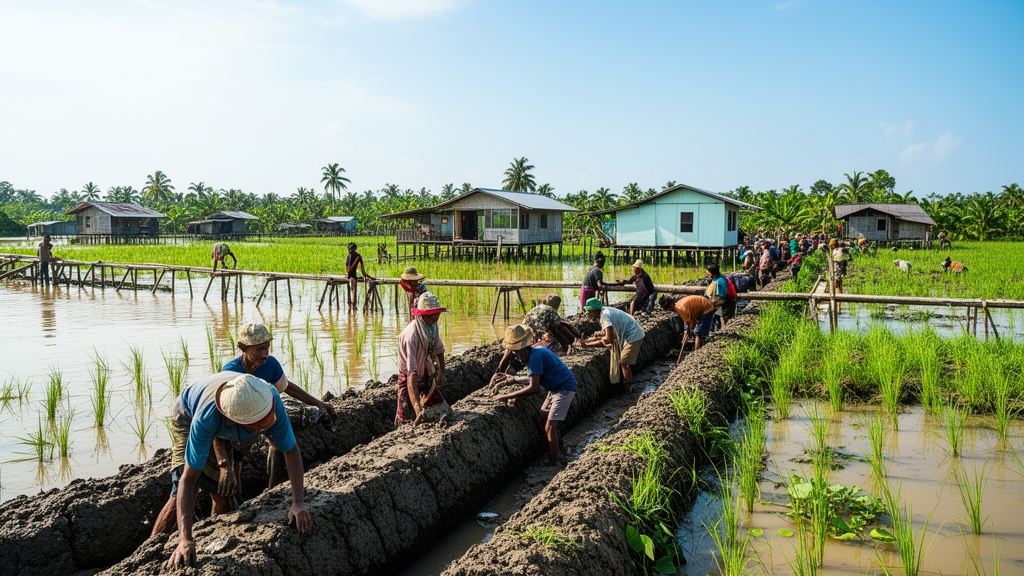
On the island of Mousuni in the Bengal Delta of eastern India, people facing cyclones, coastal floods and erosion are not simply choosing to leave or being forced to stay. A qualitative study published in Regional Environmental Change argues that staying in environmentally stressed places is far more varied than the familiar split between ‘voluntary’ and ‘involuntary’ immobility suggests. Drawing on months of fieldwork and 72 in-depth interviews, the researcher identifies distinct ‘ways’ of staying that fall along a spectrum of choice and constraint, from residents who treasure island life as an end in itself to those who can neither afford to leave nor sustain a living where they are.
The study responds to a long-standing problem in migration research. Since the UK Government’s Foresight Report of 2011 drew attention to ‘trapped populations’ whose resources are too depleted to move out of harm’s way, scholars have recognised that environmental change can immobilise people involuntarily. Later work showed that staying can also be an active preference rooted in cultural and affective ties to place, or in indigenous knowledge systems that frame a location as habitable. But most case studies still sort stayers into one of two boxes, and the meaning of ‘voluntariness’ in those boxes has rarely been examined.
That binary has begun to crack under empirical pressure. Research in rural Bangladesh has found that women internalise restrictive gender norms and feel more comfortable remaining in place even during life-threatening cyclones, while studies in mountainous India show women staying rooted to homes they have no realistic possibility of leaving. Work around Iran’s Lake Urmia introduced ‘ambivalent immobility’ for people who intend to relocate someday but remain to fulfil caregiving duties, and research in northeastern Thailand found that desired immobility among land-poor Mekong households is simultaneously shaped by pride and by longstanding dispossession. The new study builds on these observations, treating staying as something ‘diverse, dynamic, and nuanced’ rather than a choice between being still and being stuck.
The setting is Mousuni, one of 54 inhabited islands in the Indian part of the Ganga-Brahmaputra-Meghna Delta, home to roughly 22,000 people at the 2011 census and about 29,000 by a 2022 local survey. The island covers about 24 square kilometres and lost 16 per cent of its land between 1968 and 2012. Upstream damming and ‘watertight’ embankments have reduced sediment deposition, contributing to subsidence that is relatively higher in the western delta, where nearby islands such as Lohachara and Ghoramara have been completely or nearly submerged. Rising cyclone intensity and relative sea-level rise compound these risks, and saline floodwater regularly renders farmland unsuitable for cultivation.
The fieldwork ran in two phases, a preliminary stay from October to December 2023 and a main stay from February to April 2025, combining transect walks, informal conversations and semi-structured interviews with 97 participants across the island’s four villages. The researcher lived with an islander family, attended cultural ceremonies and joined tea-stall discussions to check her interpretations against local perspectives. Interviews probed residential histories, livelihood change, perceptions of habitability, understandings of a ‘good life’ and any concrete steps towards relocation. Data were analysed thematically in MAXQDA, using concepts from immobility scholarship as orienting tools rather than fixed categories.
The first category, ‘intrinsic’ staying, describes people who value life on Mousuni as an end in itself. Islanders describe a ‘good life’ built on homegrown rice and vegetables, fish caught fresh from their own ponds, and a traditional diet of mashed fermented rice, contrasting this with cities where even drinking water must be purchased. Strong community ties foster deep trust: agricultural machinery is left unguarded, homes are unlocked, and the island is described as a ‘fortress’ that keeps theft and urban waywardness at bay. During the coronavirus pandemic, when boat services stopped, infection rates stayed low and families lived comfortably on homegrown food while store owners extended credit for nearly two years. Notably, both landed farmers and sharecroppers shared this view, though such narratives were more prevalent among inland residents than those on the exposed riverfront.
A second group practises ‘biding’ staying. These residents plan to relocate eventually but wait until local livelihoods can no longer be sustained. Participants in seven interview sessions had already bought secondary plots of land in upstream villages and towns such as Dwariknagar, Radhanagar, Namkhana and Diamond Harbour, funded by betel leaf farming income and migrant remittances. The plots serve as temporary shelter during future floods, insurance against further embankment land acquisition, or an inheritance for children. Crucially, the study argues, these stayers retain access to subjectively chosen alternatives, which is one of the conditions the paper proposes for calling a staying decision genuinely voluntary, alongside staying being intrinsically valued as part of a person’s life project.
‘Functional’ or ‘strategic’ staying, by contrast, is instrumental. Mousuni’s rich alluvial soil, which islanders call a ‘pot of gold’, produces qualitatively superior harvests: a single row of bottle gourd plants can yield five to seven kilos per week compared with two kilos in a nearby mainland town. Land prices across the river are roughly four times higher, so selling four bighas of farmland would buy only one bigha elsewhere, not enough for a pond or viable farming. Local income also depends on being an ‘insider’, since hiring, land rental and shared fishing boats rest on community trust built over generations. This staying rests heavily on gendered labour: with young men migrating for construction work, women and elderly members grow the family’s annual rice and vegetables, irrigate fields, harvest betel leaves and process fish, a workload so heavy that families report difficulty finding brides for their sons.
At the constrained end of the spectrum sit ‘acquiescent’ stayers and the ‘trapped’. Acquiescent stayers do not seriously consider moving, shaped by fatalistic views that their lifetimes will end before the river reaches their doorstep, by being ‘used to’ floods, and by place commitment central to identity, particularly among older residents. Riverfront islanders, however, face a squeeze from both directions: salinisation has destroyed yields, land has been ceded for embankments as a form of ‘public duty’, and compensation reaches formal landowners far more readily than sharecroppers, who receive only nominal payments or nothing at all. Applying for compensation involves lengthy paperwork and lawyer fees, and many riverfront households now hold too little land and money either to remain viable or to buy upstream land costing eight to ten lakhs per bigha.
The study’s central claim is analytical rather than a prediction: placing these disparate experiences under a single ‘voluntary’ label obscures the financial, cultural and socio-psychological constraints shaping them, and labels carry discursive power, casting ‘trapped’ people as humanitarian victims while ‘voluntary’ stayers appear entrepreneurial. The author stresses that the categories are locally grounded, transitional and often overlapping, so they do not transfer wholesale to other settings, and future research is needed to map staying narratives elsewhere. What the Mousuni case demonstrates is that in the face of environmental change, immobility is not one condition but many, best understood as a spectrum running from staying that is intrinsically valued, through staying that waits and staying that works, to staying that has run out of alternatives.
Subject of Research: Qualitative research on diverse staying strategies and environmental immobility in the Bengal Delta
Article Title: Pluralising environmental immobility: Diverse staying strategies in the face of environmental change in the Bengal Delta
Article References: Sengupta, M. (2026). Pluralising environmental immobility: Diverse staying strategies in the face of environmental change in the Bengal Delta. Regional Environmental Change, 26(4), Article 222. https://doi.org/10.1007/s10113-026-02710-y
Image Credits: AI Generated
DOI: 10.1007/s10113-026-02710-y
Keywords: environmental immobility, Bengal Delta, Mousuni Island, climate change, migration studies, coastal erosion, cyclones, voluntariness, smallholder farming, gendered labour, trapped populations, India
Cite Scienmag News
Sloane Callahan. (October 24, 2026). Beyond stuck or staying: the many ways people choose to remain on a sinking delta island. Scienmag. https://scienmag.com/beyond-stuck-or-staying-the-many-ways-people-choose-to-remain-on-a-sinking-delta-island/
Sloane Callahan. "Beyond stuck or staying: the many ways people choose to remain on a sinking delta island." Scienmag, 24 October 2026, https://scienmag.com/beyond-stuck-or-staying-the-many-ways-people-choose-to-remain-on-a-sinking-delta-island/. Accessed 24 October 2026.
Sloane Callahan. "Beyond stuck or staying: the many ways people choose to remain on a sinking delta island." Scienmag. October 24, 2026. https://scienmag.com/beyond-stuck-or-staying-the-many-ways-people-choose-to-remain-on-a-sinking-delta-island/


