


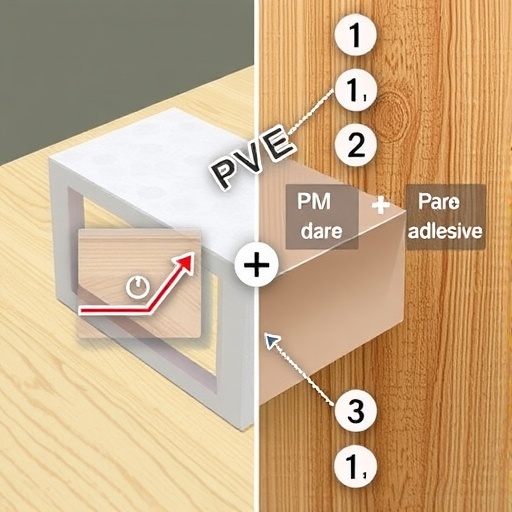
A groundbreaking development in the realm of sustainable materials science has emerged from a recent study published in the Journal of Bioresources and Bioproducts. Researchers have engineered an innovative water-triggered adaptive polyvinyl alcohol (PVA)-polysaccharide supramolecular film that exhibits remarkable switchable structural and adhesive capabilities. This advancement addresses one of the most longstanding challenges associated with PVA and similar bioplastics—mechanical degradation in humid or wet environments—by introducing a novel supramolecular strategy that stabilizes and enhances the polymer network in the presence of water.
At the core of this innovation lies the ultrasonic-assisted assembly of a hybrid polysaccharide composed of chitosan and pectin, two naturally abundant, biodegradable polymers with complementary chemical functionalities. Chitosan, containing protonated amino groups, and pectin, rich in carboxyl groups, form an electrostatically cross-linked hybrid network. This network is then intricately blended with PVA, producing a composite film with an orchestrated supramolecular architecture. The interplay of these interactions results in a locally ordered network within the PVA matrix that reinforces crystalline domains, effectively impeding water molecules from penetrating and disrupting the polymer chains.
Mechanical characterization of the optimized PVA-chitosan-pectin (PVA-CP) film, in a 7:3 ratio, revealed exceptional tensile strength values reaching 77 MPa, coupled with a highly flexible elongation at break of 322%. Impressively, this mechanical robustness is largely retained even after 48 hours of water immersion, with strength measurements as high as 46 MPa, underscoring superior water resistance compared to conventional biopolymer films. Following a heat treatment regimen at 200°C, the film underwent further structural enhancement, achieving tensile strengths up to 125 MPa while simultaneously improving its resistance to organic solvents.
The material’s adhesive properties present another remarkable feature. Upon water activation and subsequent hot pressing, the supramolecular film transitions into a chemically cross-linked network integrated with covalent ether bonds in addition to hydrogen bonding. This dual cross-linking mechanism enables strong, durable adhesion to wood substrates. Adhesion measurements conducted on various lap joint configurations demonstrated dry shear strengths of 5.4 MPa for poplar, 3.3 MPa for eucalyptus, and an impressive 7.7 MPa for bamboo, rivaling and in some cases surpassing industry-standard adhesives derived from petroleum-based resins.
A further testament to the film’s industrial viability is its successful application in the fabrication of multilayer plywood structures. The material enabled the production of plywood with configurations ranging from three to eleven layers. Particularly, seven-layer eucalyptus plywood displayed outstanding mechanical performance, with bending strength values of 61 MPa and an elastic modulus of 7,750 MPa. These boards met and exceeded the stringent criteria of Class II panels under the Chinese standard GB/T 9846—2015, retaining wet strength values between 1.3 and 1.4 MPa even after hot water immersion tests, demonstrating exceptional durability and structural integrity in demanding environments.
One of the most compelling aspects of this film is its lifecycle and environmental footprint. A comprehensive life-cycle assessment (LCA) comparing the new biopolymer film with typically used petroleum-based plastics such as polyethylene, polypropylene, and PVC revealed markedly lower impacts across sixteen environmental indicators. These include reduced greenhouse gas emissions, lower energy consumption, minimized water usage, and less ecological toxicity. The film’s biodegradability and recyclability further amplify its sustainability profile; it can be dissolved and remolded multiple times, with regenerated films maintaining tensile strengths near 60 MPa, a testament to its resilience and potential for circular economy applications.
The scientific breakthrough is grounded in the supramolecular chemistry governing the chitosan-pectin-PVA composite’s behavior. Conventionally, PVA’s high hydrophilicity has been a double-edged sword, facilitating biodegradability but significantly compromising mechanical properties when exposed to moisture. By embedding the chitosan-pectin hybrid polymer network within the PVA matrix, researchers effectively crafted physical cross-linking points and heterogeneous nucleation sites, which stabilize the crystalline regions and limit water infiltration. This organization is essential to sustaining toughness and elasticity in wet conditions without sacrificing environmental ideals.
Water activation emerges as a pivotal step in the film’s adhesive performance. The process initiates dynamic reconfiguration of the supramolecular network, enabling the formation of new cross-links upon heat-induced curing. The necessity of both water exposure and thermal treatment, confirmed through comparative testing, underscores the sophisticated interplay of non-covalent and covalent bonding critical for achieving strong wood adhesion. By unlocking these mechanisms, the study not only offers insights into material design but also pioneers a practical path toward replacing traditional, fossil-fuel-derived adhesives with sustainable alternatives.
Beyond the laboratory, the implications of this technology are vast. The wood industry, long reliant on toxic, non-renewable adhesives, could transition toward bio-based bonding agents that align with global sustainability goals. Moreover, the modularity of the chitosan-pectin-PVA system suggests potential extensibility to other biopolymers or substrates, heralding a new class of multifunctional, adaptive bioplastic films. These could find applications in packaging, coatings, or flexible electronics, where performance under moist or varying environmental conditions is critical.
In summary, this study redefines the potential of polyvinyl alcohol-based bioplastics by integrating polysaccharide-derived supramolecular architectures. The resultant film exhibits an unprecedented combination of tensile strength, flexibility, water resistance, strong adhesive performance, and recyclability. Successfully demonstrating applications from lap joints to industrial-scale plywood, this innovation marks a significant leap towards eco-friendly, high-performance materials capable of supplanting less sustainable petrochemical products. As material science continues to bridge natural polymers with advanced supramolecular chemistry, such developments pave the way for greener, smarter, and more versatile polymers tailored to the challenges of the 21st century.
News Publication Date: 23-Jun-2026
Web References:
Journal of Bioresources and Bioproducts
DOI Link
Keywords
Plastics, Biomass, Organic matter, Surface science, Thin films, Materials engineering, Transport phenomena, Adhesives, Materials science, Chemistry
Cite Scienmag News
Bethany Barker. (June 24, 2026). Water-Activated PVA Film Transforms from Bioplastic to High-Performance Wood Adhesive. Scienmag. https://scienmag.com/water-activated-pva-film-transforms-from-bioplastic-to-high-performance-wood-adhesive/
Bethany Barker. "Water-Activated PVA Film Transforms from Bioplastic to High-Performance Wood Adhesive." Scienmag, 24 June 2026, https://scienmag.com/water-activated-pva-film-transforms-from-bioplastic-to-high-performance-wood-adhesive/. Accessed 5 September 2026.
Bethany Barker. "Water-Activated PVA Film Transforms from Bioplastic to High-Performance Wood Adhesive." Scienmag. June 24, 2026. https://scienmag.com/water-activated-pva-film-transforms-from-bioplastic-to-high-performance-wood-adhesive/


