


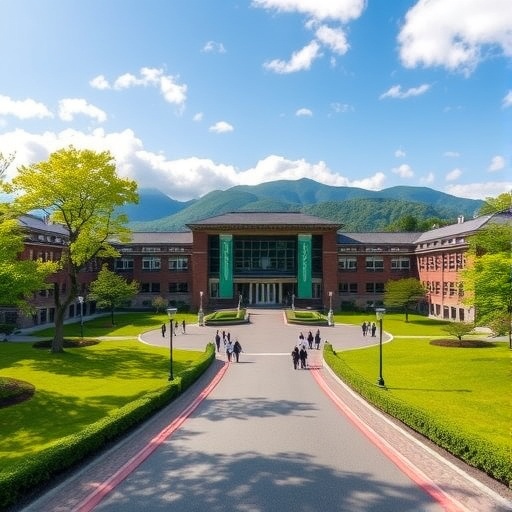
In a landmark achievement reflecting its commitment to sustainability and impactful research, Hokkaido University has soared to the 7th position globally in the Times Higher Education (THE) Sustainability Impact Ratings for 2026. This ranking, unveiled on June 24, 2026, represents a comprehensive evaluation of 1,603 universities worldwide, with the university standing as the highest-ranked institution in Japan for the seventh consecutive year. The accolade not only underlines Hokkaido University’s sustained excellence in aligning academic endeavors with the United Nations’ Sustainable Development Goals (SDGs) but also highlights its evolving role as a global leader in incorporating sustainable practices into its educational and research frameworks.
Hokkaido University’s exceptional performance is prominently showcased in its critical contribution to SDG 2: Zero Hunger. Ranking second globally among 731 universities, the university has been recognized for its innovative research and fieldwork that addresses food security, agricultural sustainability, and nutritional science. This global second-place standing for the second consecutive year underscores the university’s dedication to pioneering solutions that combat hunger while promoting efficient and sustainable agricultural practices. Its focus on integrating agrarian sciences with advanced technologies exemplifies a strategic approach to overcoming complex global challenges related to food systems in the context of climate change and population growth.
Beyond its specialization in food security, Hokkaido University maintains a distinguished presence within the global top 100 institutions for several other SDG categories. These include SDG 9 (Industry, Innovation, and Infrastructure), where it ranks 36th, spotlighting its contributions to resilient infrastructure development and technological innovation. The university’s efforts in sustainable urbanization and development strategies are reflected in its 41st rank in SDG 11 (Sustainable Cities and Communities). In ecological stewardship, the university is positioned 21st for SDG 14 (Life Below Water) and 18th for SDG 15 (Life on Land), demonstrating a balanced commitment to both marine and terrestrial ecosystem protection.
The university’s influence extends into governance and societal frameworks as well, with a 21st global ranking for SDG 16 (Peace, Justice, and Strong Institutions) and 31st for SDG 17 (Partnerships for the Goals). These rankings manifest Hokkaido’s multidisciplinary approach that transcends the natural sciences, fostering a strong institutional culture of transparency, justice, and collaborative international partnerships. Domestically, the university dominates in six SDG categories, securing the top national spot in areas quintessential to sustainable development, including those focused on food security, urban development, environmental protection, institutional integrity, and international cooperation.
Founded in 1876 as Sapporo Agricultural College, Hokkaido University has evolved across nearly one and a half centuries into a comprehensive institution combining rigorous academic traditions with a strong emphasis on applied and field sciences. Its geographical advantage, situated in a richly biodiverse and natural environment, facilitates unparalleled opportunities for empirical research in agriculture, forestry, fisheries, and environmental sciences. This synergy has bolstered its unique capacity for groundbreaking research that often translates directly into policies and practices conducive to sustainability on regional, national, and global scales.
Integral to the university’s strategic sustainability successes are its pioneering initiatives, including the Campus Master Plan 96 introduced in 1997, the Hokkaido University Initiative for Sustainable Development launched in 2005, and a decade-long series of Sustainability Weeks from 2007 to 2017. Collectively, these programs signified early institutional recognition of global sustainability as both an academic priority and a social imperative. They laid the groundwork for an ingrained culture where sustainability is embedded in governance, curriculum design, and community engagement.
Advancing this legacy, the Institute for the Advancement of Sustainability, established in 2021, has become the nerve center responsible for spearheading green campus initiatives and fostering university-wide coordination of SDG activities. The institute’s role has been pivotal in integrating sustainability into the operational and academic fabric of the university, creating impactful collaborations among faculty, students, and external stakeholders. Through this centralized coordination, Hokkaido University enhances its research capabilities, strengthens community ties, and promotes a unified vision for long-term sustainability transformation.
Hokkaido University’s ambitious HU VISION 2030 and its international strategy for sustainability toward 2040 articulate an expansive roadmap aimed at amplifying its contributions toward global sustainable development. This vision aligns with contemporary scientific paradigms that recognize the critical role of higher education institutions not only as knowledge creators but as proactive agents of social and environmental change. By investing in innovative research areas and forging robust international cooperation, the university anticipates addressing emergent global challenges, including climate change mitigation, sustainable energy transitions, biodiversity conservation, and social equity.
President Kiyohiro Houkin articulated the significance of this prestigious recognition in a statement reflecting both pride and a forward-looking commitment. He emphasized that the university’s distinct competencies in food production, environmental sciences, and field research have been fundamental to securing their status among the world’s foremost institutions in sustainability. Furthermore, he highlighted that contemporary efforts, including contributions to Japan’s Green Transformation (GX) initiative and participation in the J-PEAKS consortium of research-focused Japanese universities, have reinforced the university’s capacity to foster innovation and societal transformation towards a carbon-neutral future.
Moreover, Hokkaido University views this global acknowledgment as both a testament to its historical legacy and a catalyst inspiring continued innovation. The university’s comprehensive education and research programs operate at the intersection of scientific inquiry and applied societal solutions, positioning its graduates to become influential leaders in sustainability across diverse sectors. This holistic approach ensures that academic excellence synergizes with pragmatic engagements that nurture resilient communities and healthy ecosystems on a global scale.
With its sustained high national and international rankings, Hokkaido University exemplifies how academic institutions can effectively internalize and operationalize the principles embedded in the Sustainable Development Goals. Its achievements in diverse domains—from agricultural innovation and sustainable urban planning to marine and terrestrial ecosystem conservation—demonstrate a multidimensional model of university-led sustainability. As challenges surrounding resource scarcity, climate change, and social equity intensify, the university’s integrated strategies provide a compelling blueprint for other research institutions striving to maximize their societal impact.
In summary, the 2026 THE Sustainability Impact Ratings reaffirm Hokkaido University’s role as a global leader in sustainability research and education. The university’s consistent top-tier performance across multiple SDG domains highlights its comprehensive and integrated approach to solving pressing global problems through cutting-edge science, collaboration, and forward-thinking governance. As it continues to build on more than 150 years of academic excellence enriched with practical field science expertise, Hokkaido University stands poised to make transformative contributions to creating a sustainable, equitable future for generations to come.
Cite Scienmag News
Sloane Callahan. (June 24, 2026). Hokkaido University Secures 7th Globally and Tops Japan in THE Sustainability Impact Ratings 2026. Scienmag. https://scienmag.com/hokkaido-university-secures-7th-globally-and-tops-japan-in-the-sustainability-impact-ratings-2026/
Sloane Callahan. "Hokkaido University Secures 7th Globally and Tops Japan in THE Sustainability Impact Ratings 2026." Scienmag, 24 June 2026, https://scienmag.com/hokkaido-university-secures-7th-globally-and-tops-japan-in-the-sustainability-impact-ratings-2026/. Accessed 3 September 2026.
Sloane Callahan. "Hokkaido University Secures 7th Globally and Tops Japan in THE Sustainability Impact Ratings 2026." Scienmag. June 24, 2026. https://scienmag.com/hokkaido-university-secures-7th-globally-and-tops-japan-in-the-sustainability-impact-ratings-2026/


