


A University of Warwick astronomer has been awarded £3 million to develop a ‘digital telescope’ that will be capable of producing a highly sensitive continuous movie of the night sky.

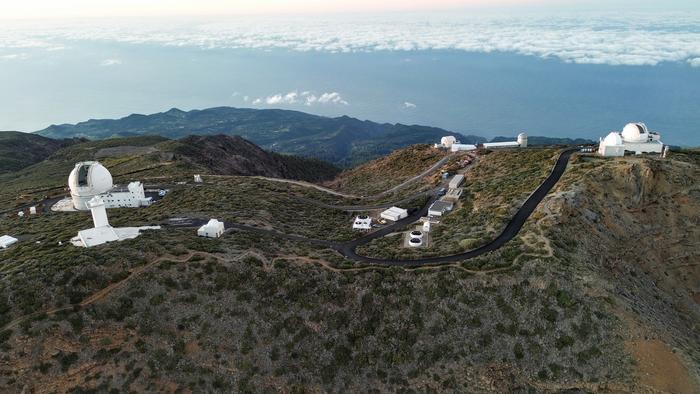
Credit: Credit Professor Danny Steeghs, University of Warwick.
A University of Warwick astronomer has been awarded £3 million to develop a ‘digital telescope’ that will be capable of producing a highly sensitive continuous movie of the night sky.
The new telescope will be used to detect explosive astrophysical events in real time, such as explosions of stars and merging of black holes. It will also be able to detect satellites, asteroids and hazardous space debris in orbit around the Earth.
A typical astronomical facility involves a telescope attached to a sophisticated mount, which moves to track the Earth’s rotation. This digital telescope, however, will include dozens of small stationary telescopes, each equipped with a state-of-the-art sensor. The stationary telescopes do not track the sky, so as the Earth rotates the stars drift through the fields of view of the telescopes.
Computers can then be used to correct for the Earth’s rotation and produce highly sensitive images of the sky. More sophisticated computer algorithms can be used to detect objects moving in any direction with any speed. This will typically include satellites and space debris, but potentially also include solar system objects approaching the Earth, such as asteroids and comets.
Professor Don Pollacco will lead the project which is funded by the European Research Council (ERC) in partnership with the University of Warwick (contributing an additional £600K).
The prototype digital telescope will include data from 52 telescopes and will most likely be located in the Canary Islands near the University of Warwick’s other facilities on the island of La Palma.
Professor Pollacco said: “It is incredible that in this day and age we do not have such technology to pick up explosive space events in real-time. Instead, we rely on nightly and weekly surveys to find new objects and then observe them again with more powerful facilities. Unfortunately, most of the important physics can only be observed near the time of the initial explosion, so early detection is vital.
“Typical objects we are looking to detect include Supernova, which are explosions of stars at the end of their lives, and the merging of black holes and neutron stars, known as Gravitation Wave merger systems.
“The movie data can also be used to detect small pieces of space debris helping to alleviate the growing threat they pose to our satellites in near-Earth orbit. Knowing accurate orbits for debris and satellites allows us to record and remove them from the movie, hence giving a clearer astronomical view, as well as cataloguing the orbits of the debris itself.
“If the Digital Telescope works as we expect then its contribution will be transformational to both the study of astrophysical explosions and the population of artificial objects in near space. Furthermore, its data will have many uses in quite diverse astronomical research areas such as interstellar asteroids and long period exoplanets, amongst others.
“The main challenges of this project will be around the real-time data processing of enormous datasets, required for continuous observations of a large area of the sky.”
The funding, announced today (11th April), is part of the EU’s Horizon Europe programme. Professor Pollacco is announced as one of 255 outstanding research leaders in Europe set to be awarded ERC Advanced Grants.
Notes to Editors
About the ERC
The ERC, set up by the European Union in 2007, is the premier European funding organisation for excellent frontier research. It funds creative researchers of any nationality and age, to run projects based across Europe. The ERC offers four core grant schemes: Starting Grants, Consolidator Grants, Advanced Grants and Synergy Grants. With its additional Proof of Concept Grant scheme, the ERC helps grantees to bridge the gap between their pioneering research and early phases of its commercialisation. The ERC is led by an independent governing body, the Scientific Council. Since November 2021, Maria Leptin is the President of the ERC. The overall ERC budget from 2021 to 2027 is more than €16 billion, as part of the Horizon Europe programme, under the responsibility of European Commissioner for Innovation, Research, Culture, Education and Youth, Iliana Ivanova.
Media contact:
Annie Slinn, Communications Officer, University of Warwick.
Tel: +44 (0)7392 125 605 Email: annie.slinn@warwick.ac.uk
Cite Scienmag News
Courtney Benton. (April 11, 2024). Warwick astronomer awarded £3 million to transform observations of the sky. Scienmag. https://scienmag.com/warwick-astronomer-awarded-3-million-to-transform-observations-of-the-sky/
Courtney Benton. "Warwick astronomer awarded £3 million to transform observations of the sky." Scienmag, 11 April 2024, https://scienmag.com/warwick-astronomer-awarded-3-million-to-transform-observations-of-the-sky/. Accessed 4 September 2026.
Courtney Benton. "Warwick astronomer awarded £3 million to transform observations of the sky." Scienmag. April 11, 2024. https://scienmag.com/warwick-astronomer-awarded-3-million-to-transform-observations-of-the-sky/

