


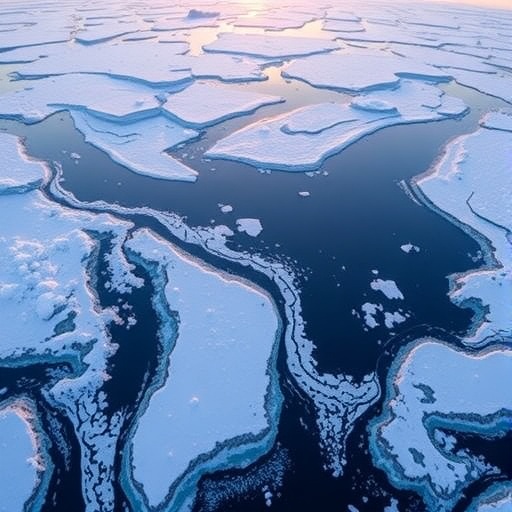
As the Arctic Ocean undergoes unprecedented warming due to climate change, scientists have identified a striking transformation in the western sector of this fragile marine ecosystem. Recent research published in Nature Communications reveals that this region is evolving into a dynamic hub of drifting matter, reshaping the physical and biological landscape in ways previously unanticipated. This phenomenon holds profound implications for our understanding of Arctic oceanography, the cycling of organic material, and the broader impacts of a warming planet.
For decades, the Arctic Ocean has been recognized as a critical component of Earth’s climate system, but warming temperatures have accelerated ice melt and altered circulation patterns at an alarming pace. The study by Wang, Liu, Shu, et al., delves deeply into how these changes manifest in the transport of particulate and dissolved matter. The western Arctic Ocean, once characterized by more stable, ice-influenced conditions, is increasingly influenced by warmer water masses that mobilize large quantities of drifting organic and inorganic material.
The researchers combined extensive observational data with advanced modeling techniques to investigate these transformations. Their findings paint a complex picture: as sea ice retreats, the dynamics of water flow shift, creating conduits that concentrate drifting matter in specific zones. Unlike the traditional view of the Arctic as a static ice-dominated environment, this new approach highlights its emerging role as a corridor and collector of chemical and biological detritus, redistributing materials across vast distances.
One of the most surprising discoveries is the emergence of the western Arctic Ocean as a hotspot for organic matter transport. Previously, particulate organic carbon was thought to be sequestered primarily near ice margins or continental shelves, but warming has altered circulation patterns, enhancing lateral movement. This has significant implications for nutrient cycles, as carbon and other elements hitch rides on ocean currents or floating debris, influencing biological productivity far beyond their origin points.
This drifting matter includes microplastics, phytoplankton remains, and detrital fragments, all contributing to the changing ecological fabric. The research underscores the intricate coupling between warming temperatures, ice dynamics, and biogeochemical fluxes. As warming continues, the region transitions from a repository of static ice-bound materials into an active zone of dispersal, affecting phytoplankton blooms and food web dynamics in the Arctic basin.
Moreover, the western Arctic’s role as a hub for drifting matter modifies the interactions between marine organisms and their environment. Nutrient distribution patterns affect microbial communities, which in turn regulate carbon cycling through respiration and remineralization processes. Thus, the ecological consequences ripple outward, influencing Arctic biodiversity and potentially feedback loops relevant to global climate regulation.
The authors point out that these changes could impact the delivery of terrestrial and marine-derived nutrients and pollutants. Melting permafrost and coastal erosion, exacerbated by warming, release terrestrial organic material and contaminants that then enter ocean currents. The western Arctic Ocean collects and transports these materials, serving as a conveyor belt to downstream environments, including the North Atlantic.
In terms of physical oceanographic features, the study reveals intensified flow regimes and modified eddy formation that promote retention and accumulation zones for drifting matter. This revises previous assumptions about particle dispersal and suggests that dynamic physical processes are integral to understanding carbon sequestration pathways and pollutant transport in the Arctic.
The findings also raise concerns about the fate of microplastics and other anthropogenic debris in the Arctic environment. As the region warms, increased shipping traffic and resource extraction activities add to the influx of pollutants. The western Arctic Ocean’s role as a collector of drifting matter raises the stakes for environmental monitoring and contamination assessments.
Further complicating this picture, seasonal changes in ice cover alter the timing and magnitude of drift events. Snow and ice melt can trigger pulses of organic and inorganic material movement, influencing the timing of biological productivity and ecosystem responses. These seasonal dynamics are critical to forecasting future Arctic productivity under continued climate change scenarios.
From a methodological perspective, the integration of satellite data, in situ observations, and sophisticated hydrodynamic models enabled the discovery of these patterns over spatial and temporal scales previously unattainable. This multi-disciplinary approach sets a new standard for studying complex polar systems under rapid environmental change.
The implications of this research extend beyond the Arctic itself. By altering carbon cycling and material transport, the western Arctic Ocean may influence global biogeochemical cycles and climate feedbacks. These shifts underscore the interconnectedness of Earth systems and the need for comprehensive monitoring of polar regions.
Looking forward, the study calls for increased international cooperation to monitor drifting matter and its ecological consequences. Understanding how warming reshapes Arctic oceanography will be crucial for predicting future ecosystem services, including fisheries and climate regulation.
In summary, this breakthrough research reveals the western Arctic Ocean’s emerging identity as a hub of drifting matter—a dynamic and shifting landscape shaped by warming temperatures and retreating ice. This transformation represents a paradigm shift in our understanding of Arctic ocean processes, with broad implications for carbon cycling, pollution transport, and ecosystem health in a rapidly changing world.
Cite Scienmag News
Violet Maxwell. (June 16, 2026). Warming Turns Western Arctic Ocean into Drifting Hub. Scienmag. https://scienmag.com/warming-turns-western-arctic-ocean-into-drifting-hub/
Violet Maxwell. "Warming Turns Western Arctic Ocean into Drifting Hub." Scienmag, 16 June 2026, https://scienmag.com/warming-turns-western-arctic-ocean-into-drifting-hub/. Accessed 5 September 2026.
Violet Maxwell. "Warming Turns Western Arctic Ocean into Drifting Hub." Scienmag. June 16, 2026. https://scienmag.com/warming-turns-western-arctic-ocean-into-drifting-hub/


