


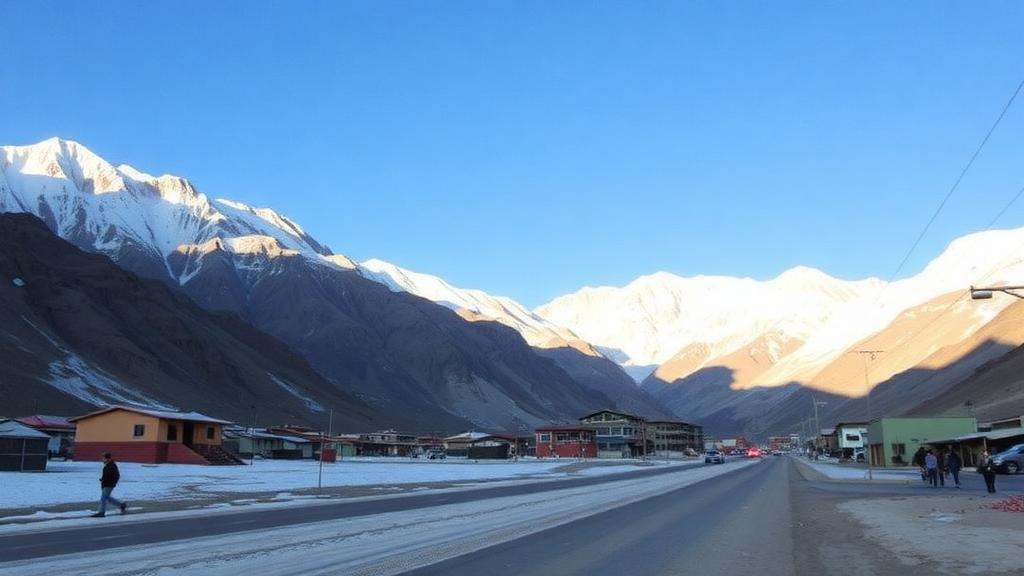
High in the trans-Himalayan rain shadow, the town of Leh sits at roughly 3,500 metres above sea level in one of the driest, coldest inhabited landscapes on Earth. A new study published in Environmental Monitoring and Assessment has now assembled a 74-year record of temperature and precipitation for this cold-arid corner of Ladakh, spanning the years 1951 to 2024, and subjected it to rigorous statistical scrutiny. The findings paint a picture of a fragile high-altitude environment where the clearest climate signal is a slow but steady warming, driven disproportionately by rising minimum temperatures, while precipitation remains stubbornly erratic, swinging wildly from year to year without any statistically significant long-term trend.
The research team, led by Anurag Saxena of the ICAR-National Dairy Research Institute in Karnal and including researchers based in Leh itself, relied on gridded meteorological datasets rather than a single weather station record. This choice matters in a region as topographically extreme as Ladakh, where the western Himalaya and Karakoram ranges collide and station coverage has historically been sparse. Gridded products interpolate observations across a regular spatial grid, allowing analysts to build continuous time series even where instrumentation is limited. The team examined both annual and seasonal breakdowns of temperature and precipitation, looking for departures from long-term climatological normals as well as directional trends.
To detect those trends, the researchers deployed two of the most widely used tools in hydro-climatology: the Mann-Kendall test and Sen’s slope estimator. The Mann-Kendall test, first formulated by Henry Mann in 1945 and refined by Maurice Kendall, is a non-parametric method that assesses whether a time series shows a monotonic upward or downward tendency without assuming any particular data distribution. Sen’s slope estimator complements it by providing a robust estimate of the magnitude of that trend, calculated from the median of all pairwise slopes in the data. Together, the methods were applied at the 90 percent and 95 percent confidence levels, meaning the authors only flagged a trend as statistically significant when the probability of it arising by chance fell below those thresholds.
The headline result is an asymmetric warming pattern. Rather than maximum and minimum temperatures rising in lockstep, the study found a gradual warming tendency concentrated particularly in minimum temperatures, the nighttime and winter lows. This kind of asymmetric warming is characteristic of high-altitude cold deserts and has been documented across the broader Himalayan region and the Tibetan Plateau. Elevation-dependent warming, the phenomenon whereby mountain regions warm faster than surrounding lowlands, has been attributed to a suite of feedbacks, including snow-albedo changes as reflective snow and ice give way to darker surfaces that absorb more solar radiation, shifts in cloud cover, and changes in atmospheric water vapour. Warmer nights in a cold desert may sound benign, even welcome, but they carry cascading consequences for snowpack persistence, glacier mass balance, and the timing of spring melt.
That last point is where the precipitation findings become consequential. Leh’s agriculture and its entire hydro-social system depend on meltwater from winter snow and glaciers feeding the streams that irrigate barley fields, vegetable plots, and the famous groves of apricot and willow. The study found that seasonal precipitation exhibits substantial inter-annual variability, with no statistically significant long-term trend across the full 1951 to 2024 record. In other words, some years are wet, some are parched, and the record does not yet show a consistent direction of change when the whole period is considered. However, the authors highlight a more troubling recent signal: declining winter and pre-monsoon precipitation in recent decades. Because winter snowfall and spring rains are precisely the inputs that sustain snowmelt-driven hydrology into the growing season, a decline in these seasons could tighten agricultural water availability even if annual totals appear stable.
The hydrological stakes extend far beyond Leh’s district boundaries. The Indus basin, into which Ladakh’s meltwaters drain, sustains hundreds of millions of people downstream in India and Pakistan, and research has repeatedly identified snow- and glacier-fed Asian river systems as among the most climate-vulnerable water towers on the planet. Studies of the upper Indus have long noted that its hydrological regime is dominated by cryosphere inputs rather than direct rainfall, making the timing and volume of snow accumulation in any given winter a first-order determinant of summer water supply. A warming signal that preferentially raises minimum temperatures can shorten the snow accumulation season, increase mid-winter melt events, and shift the peak of the meltwater pulse earlier in the year, desynchronising it from the irrigation calendar that Ladakhi farmers have refined over centuries.
The study’s statistical caution is itself instructive. In trend analysis of hydro-climatic data, serial correlation, the tendency of one year’s value to influence the next, can inflate the apparent significance of trends, and methods such as prewhitening or effective sample size corrections have been developed to address this. The authors’ decision to report trends at two confidence levels and to emphasise departures from normals alongside formal trend tests reflects a broader recognition that in highly variable cold-desert climates, a lack of statistical significance does not mean a lack of physical consequence. Declining winter precipitation that fails to cross a 95 percent significance threshold can still push a water system closer to its limits, particularly when it compounds with other stressors.
Those compounding stressors are well documented in the wider literature on Ladakh. The region’s glaciers have retreated measurably over the past five decades, satellite analyses have shown accelerating ice loss across the Himalayas in recent decades, and the 2010 cloudburst and flash flood that struck Leh killed hundreds and underscored the region’s exposure to hydro-meteorological extremes. At the same time, the town of Leh has urbanised rapidly, transforming traditional hydro-social relations and increasing demand on groundwater and surface irrigation networks. Pastoralist communities such as the Changpa face their own climate vulnerabilities on the high plateaus where they herd pashmina goats. Against this backdrop, a 74-year quantification of the underlying climatic trends provides an essential baseline for separating long-term directional change from the noise of natural variability.
The research was conducted under a Department of Science and Technology project aimed at developing climate-resilient and sustainable agriculture-based systems for the cold-arid region of Ladakh, and the authors’ framing reflects that applied mandate. They argue that their findings underscore the importance of climate-resilient water management, agriculture, and monitoring strategies for the district. In practice, that means investments in water storage that can buffer against erratic snowmelt, continued support for adaptive innovations such as the artificial glaciers that have been pioneered in Ladakh to store winter water as ice, and sustained meteorological monitoring to track whether the recent declines in winter and pre-monsoon precipitation harden into statistically robust trends.
For a region often described as a sentinel of global climate change, Leh’s record offers a nuanced message. The warming signal is real and detectable, and it is strongest in the minimum temperatures that govern snow survival and winter ecology. The precipitation signal, by contrast, is dominated by variability, and the most actionable recent development, a possible decline in the winter and spring moisture that feeds the meltwater economy, remains on the edge of statistical certainty. What the study makes clear is that in a cold desert where every drop of water arrives either as snow on the peaks or as a carefully timed irrigation turn, even subtle shifts in the timing and form of precipitation can matter as much as headline warming numbers. As the Himalayan cryosphere continues to change, long-term analyses of this kind will be indispensable for the farmers, herders, and town planners of Ladakh who must adapt to a climate that is warming asymmetrically and raining, and snowing, on its own unpredictable schedule.
Subject of Research: Long-term trends and variability in temperature and precipitation extremes in the high-altitude cold desert of Leh, Ladakh, India
Article Title: Trends and variability of temperature and precipitation extremes in Leh (Ladakh), India
Article References: Saxena, A., Ram, H., Meena, R. K., Pandey, S., Yadav, A., Bhattarchjee, S., Rajkumari, P., Sonkusale, L., Raghuwanshi, M. S., Stanzin, J., & Landol, S. (2026). Trends and variability of temperature and precipitation extremes in Leh (Ladakh), India. Environmental Monitoring and Assessment, 198(10), Article 1127. https://doi.org/10.1007/s10661-026-15964-0
Image Credits: AI Generated
DOI: 10.1007/s10661-026-15964-0
Keywords: climate change, Ladakh, Leh, Himalaya, temperature trends, precipitation variability, Mann-Kendall test, Sen's slope estimator, cold desert, snowmelt hydrology, elevation-dependent warming, water resources
Cite Scienmag News
Violet Maxwell. (October 2, 2026). Warming Nights and Fickle Snow: A 74-Year Look at Climate Extremes in Leh, Ladakh. Scienmag. https://scienmag.com/warming-nights-and-fickle-snow-a-74-year-look-at-climate-extremes-in-leh-ladakh/
Violet Maxwell. "Warming Nights and Fickle Snow: A 74-Year Look at Climate Extremes in Leh, Ladakh." Scienmag, 2 October 2026, https://scienmag.com/warming-nights-and-fickle-snow-a-74-year-look-at-climate-extremes-in-leh-ladakh/. Accessed 4 October 2026.
Violet Maxwell. "Warming Nights and Fickle Snow: A 74-Year Look at Climate Extremes in Leh, Ladakh." Scienmag. October 2, 2026. https://scienmag.com/warming-nights-and-fickle-snow-a-74-year-look-at-climate-extremes-in-leh-ladakh/


