


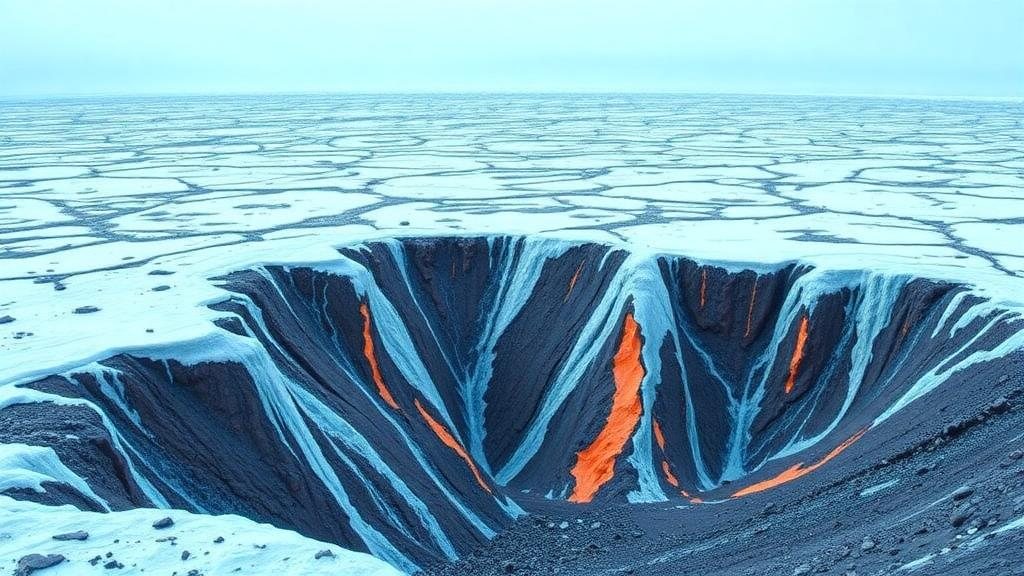
On 10 March 2025, a magnitude 6.5 earthquake struck near Jan Mayen, a remote volcanic island in the North Atlantic, and within minutes a steep slope above the Kjerulf Glacier gave way. A massive rock avalanche tumbled down the flank of the Beerenberg volcano, spreading volcanic rock and frozen debris across the glacier surface and burying the ice almost to the shoreline. The event, documented by an international research team led by the GEOMAR Helmholtz Centre for Ocean Research Kiel, is now the focus of a study published in the Proceedings of the National Academy of Sciences, and it carries a message that extends far beyond one Arctic island: climate change may be quietly making earthquakes more dangerous.
Jan Mayen is an unlikely stage for a natural experiment in cascading hazards. The island lies roughly 500 kilometres east of Greenland and 550 kilometres north of Iceland, is politically part of Norway, and is uninhabited apart from the crew of a weather station. Like Iceland, it was forged by volcanic activity along the Mid-Atlantic Ridge, the undersea mountain chain where the Eurasian and North American tectonic plates pull apart. It hosts the world’s northernmost active volcano, Beerenberg, which last erupted in the 1980s. From the volcano’s crater rim, glaciers descend approximately 2,000 metres down to the coast, draped over steep volcanic slopes that have been locked in place by permafrost for millennia.
Permafrost, the permanently frozen ground that underlies much of the polar world, is far more than frozen soil. Within fractured rock, ice acts as a kind of geological cement, much as concrete binds aggregate in a building. When that ice thaws, the binding agent disappears and the rock mass becomes weak and unstable. Scientists have long warned that permafrost degradation can destabilize mountain slopes in Alaska, the Alps and the Himalayas. What the Jan Mayen event demonstrates is how this slow, climate-driven weakening can intersect with a sudden geophysical trigger, an earthquake, to produce a hazard cascade that neither process would likely have produced alone.
The earthquake itself was not unusual for the region. Jan Mayen sits in a seismically active zone, and earthquakes are a routine feature of life along the ridge system. What was extraordinary was the slope response. Satellite observations spanning the past 40 years show no evidence of an earthquake-triggered rock avalanche with a comparable debris extension anywhere on the island. The main shock of 10 March 2025 triggered a rock avalanche on the slope above the Kjerulf Glacier within minutes, and the resulting debris formed distinctive conical mounds known as molards, scattered across the ice roughly seven kilometres from the epicentre. Satellite data also documented earthquake-induced calving, the breaking off of ice, at the neighbouring Weyprecht Glacier.
To reconstruct what happened, the international team combined an unusually broad set of data. Local and regional seismic records pinned down the timing and energy of the main shock. Ground-shaking modelling estimated how strongly the slopes near the epicentre would have been shaken. High-resolution satellite imagery mapped the extent of the rock avalanche and the changes to both affected glaciers. Infrasound measurements, which detect low-frequency acoustic waves generated by large mass movements, helped determine the exact timing of the slope failure. Air temperature and long-term climate records completed the picture, allowing the researchers to place the event in its climatic context. This integration of methods enabled the team to reconstruct the sequence of events in remarkable detail for a site so remote that no human witnessed the failure.
The researchers’ central question was deceptively simple: why did this particular earthquake, in a region long accustomed to seismic shaking, produce such pronounced slope instability? Their answer points to an additional factor that has been accumulating for decades. As the climate continues to warm, permafrost degradation weakens the ice that helps bind fractures within the volcanic rock. The frozen water within those fractures, which helped stabilize the steep slopes for thousands of years, is gradually losing its binding effect. In effect, the geological glue holding Beerenberg’s flanks together is melting out from the inside, so that the same shaking that the slopes once shrugged off can now push them past the point of failure.
Lead author Dr Guilherme W. S. de Melo, a postdoctoral researcher in the Marine Geodynamics research unit at GEOMAR, described the 2025 earthquake as a striking example of cascading natural hazards. According to the study, this is the first documented earthquake-triggered rock avalanche on Jan Mayen island, and the volcanic slope may have become increasingly unstable due to permafrost degradation. The phrasing matters: the researchers do not claim the earthquake was caused by climate change, but rather that long-term warming likely made the rock more susceptible to earthquake shaking, amplifying the consequences of a hazard that has always existed in the region.
The implications reach well beyond the Arctic. De Melo drew a direct comparison with the recent disaster on the Nepal-China border, where the immediate trigger was a glacier and ice-rock collapse rather than an earthquake. In both cases, he noted, the broader context is the same: global warming and permafrost degradation can progressively destabilize slopes and glaciers, increasing the potential for cascading hazards. In high mountain Asia, tens of millions of people live in the path of glacial lakes and landslide-prone valleys, so the same weakening process documented on an uninhabited Arctic island could translate into far greater human consequences where steep, ice-cemented terrain sits above populated areas.
The study also highlights how hazard assessment may need to change in a warming world. Traditional seismic hazard maps consider ground shaking, distance to faults and local geology, but they rarely account for the slow climatic preconditioning of slopes. If permafrost degradation progressively lowers the threshold at which rock fails, then earthquakes of a given magnitude may produce landslides, avalanches and glacier destabilization that historical records would suggest were impossible. The Jan Mayen event provides a rare, cleanly documented case study: a seismically active region, four decades of satellite monitoring showing no comparable failures, and a single earthquake that suddenly produced one. That combination makes a strong argument that the baseline for slope stability has shifted.
Beyond GEOMAR, the research involved scientists from the Geological Survey of Norway, the GFZ Helmholtz Centre for Geosciences, the Universidade Federal do Rio Grande do Norte, the University of Bergen and NORSAR, reflecting the range of expertise needed to disentangle seismic, cryospheric and climatic signals. For glacier and permafrost regions worldwide, from the Andes to the Himalayas to the Arctic archipelagos, the message of the study is that climate change can act as a silent amplifier of natural hazards, weakening the frozen infrastructure of steep terrain long before any trigger arrives. When the shaking finally comes, the slopes may no longer be able to hold.
Subject of Research: Climate-driven permafrost degradation amplifying earthquake-triggered cascading hazards in the Arctic
Article Title: How climate change may amplify earthquake impacts in the Arctic
Article References: How climate change may amplify earthquake impacts in the Arctic. (n.d.). Original publication
Image Credits: AI Generated
DOI: Not provided
Keywords: permafrost, earthquake, rock avalanche, Jan Mayen, Arctic, climate change, glaciers, cascading hazards, GEOMAR, Beerenberg, slope stability, PNAS
Cite Scienmag News
Violet Maxwell. (October 6, 2026). Warming Arctic Permafrost May Turn Earthquakes Into Far Larger Disasters. Scienmag. https://scienmag.com/warming-arctic-permafrost-may-turn-earthquakes-into-far-larger-disasters/
Violet Maxwell. "Warming Arctic Permafrost May Turn Earthquakes Into Far Larger Disasters." Scienmag, 6 October 2026, https://scienmag.com/warming-arctic-permafrost-may-turn-earthquakes-into-far-larger-disasters/. Accessed 6 October 2026.
Violet Maxwell. "Warming Arctic Permafrost May Turn Earthquakes Into Far Larger Disasters." Scienmag. October 6, 2026. https://scienmag.com/warming-arctic-permafrost-may-turn-earthquakes-into-far-larger-disasters/


