


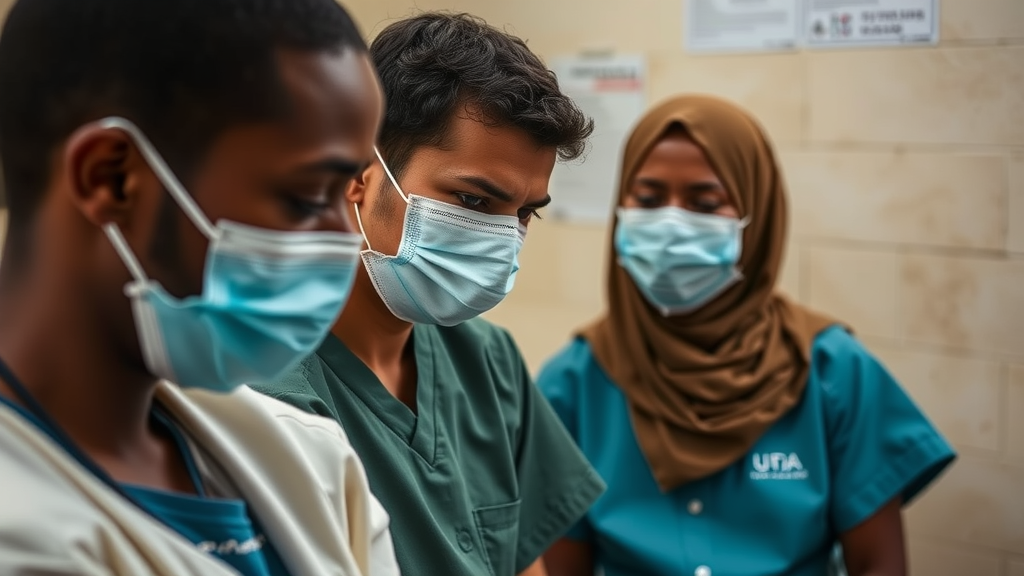
When war erupted in Khartoum, the lives of thousands of dental students were upended almost overnight. Lectures stopped, clinics closed, and the structured rhythm of clinical training—one of the most demanding components of any dental education—collapsed into uncertainty. A new study published in Discover Psychology offers one of the most detailed portraits yet of what that collapse meant for the mental health of students caught in the crossfire, documenting high levels of depression, anxiety, and stress alongside a striking variability in resilient coping.
The research team, led by Nada Hashim of RAK College of Dental Sciences at RAK Medical & Health Sciences University in the United Arab Emirates, together with colleagues from the University of Khartoum, the University of Illinois Chicago, Nile University, and other institutions, surveyed dental students enrolled in universities affected by the Khartoum conflict. The study, which received ethical approval from the Ethical Committee of the Faculty of Dentistry at the University of Khartoum, was conducted in accordance with the Declaration of Helsinki, with informed consent obtained from every participant and participation kept strictly voluntary.
Methodologically, the study relied on a cross-sectional online survey, a design chosen out of necessity in a setting where physical data collection was impossible. Psychological distress was measured with the Depression, Anxiety and Stress Scale, universally known in psychiatric research as the DASS-21, a validated twenty-one-item instrument that yields separate dimensional scores for depression, anxiety, and stress rather than a single blended index. Resilient coping was assessed with the Brief Resilient Coping Scale, or BRCS, a compact four-item measure that classifies individuals along a spectrum from low, or fragile, coping through moderate coping to high, or transformational, coping.
Beyond the two psychometric instruments, the survey captured a wide array of sociodemographic variables and conflict-related circumstances: whether students had been displaced from their homes, whether their academic progression had been interrupted, and the broader context of insecurity in which they were living. The researchers then applied multivariable logistic regression models to explore how these circumstances were associated with psychological outcomes, an approach that allows multiple predictors to be weighed simultaneously while adjusting for the influence of the others.
The results were sobering. The students reported high levels of depression, anxiety, and stress, a pattern the authors attribute to the combined weight of ongoing insecurity, disruption of education, and forced displacement. Dental students occupy a particularly vulnerable position in any crisis of this kind because their training depends so heavily on structured clinical immersion and uninterrupted academic progression. Unlike some disciplines, where theoretical study can be more readily transferred online or deferred, dental education requires hands-on practice in clinics under supervision, and severing that continuity severs a core thread of professional identity formation.
Resilient coping, by contrast, varied considerably from one participant to another. This heterogeneity is itself informative. It suggests that even within a population exposed to the same broad conflict, individual differences—whether in personal resources, social support networks, prior trauma exposure, or the specific nature of each student’s losses—shape how coping capacity is expressed. The BRCS findings indicate that while some students retained a capacity for adaptive, transformational responses to adversity, others had drifted toward fragile coping, leaving them psychologically exposed at precisely the moment when external support systems had also collapsed.
Among the conflict-related factors examined, displacement and interruption of education stood out as the variables most consistently associated with increased psychological distress. Displacement strips individuals not only of physical safety and material stability but also of the social scaffolding—family proximity, peer networks, familiar routines—that buffers stress in ordinary times. Academic interruption adds a second layer: for students on the cusp of professional qualification, each halted semester represents a receding horizon and an uncertain future, a form of anticipatory stress that compounds the acute stressors of the present.
The authors were careful about what their models can and cannot claim. The regression models demonstrated modest discriminative ability, with area under the curve, or AUC, values ranging from 0.57 to 0.66. In practical terms, an AUC of 0.5 corresponds to chance-level prediction, while 1.0 reflects perfect discrimination; values below roughly 0.7 are considered weak for individual-level prediction. The team therefore frames these models as suitable for identifying group-level associations rather than forecasting which individual student will experience severe distress—a distinction that matters enormously for how the findings should inform policy.
The researchers also ran exploratory moderation and mediation analyses, frameworks designed to test whether displacement and academic interruption might not merely accompany distress but actively transmit or amplify its effects. The results hinted at such roles, but the authors are explicit that these findings were not statistically robust and should be interpreted with caution. In a cross-sectional design, with data collected at a single point in time, it is impossible to establish temporal sequence, and pathway claims about cause and effect must await longitudinal follow-up.
What the study does establish with confidence is that dental students in Khartoum carried a significant psychological burden during the conflict, one shaped by intersecting academic, social, and environmental stressors. The authors argue that this burden demands targeted mental health support and deliberate strategies for preserving educational continuity in conflict-affected settings—interventions that address both the psychological and the academic dimensions of the crisis rather than treating them as separate problems. They also call for future research using longitudinal or pathway-based designs to clarify how conflict-related stressors, coping resources, and academic instability interact over time, so that the tentative signals uncovered in this survey can be tested against the richer evidence only time can provide.
Subject of Research: Psychological distress and resilient coping among dental students during the armed conflict in Khartoum, Sudan
Article Title: Psychological distress and resilient coping among dental students during the Khartoum conflict
Article References: Hashim, N., Ahmed, A., Elsheikh, M., Ahmed, S. F., Babiker, R., Ahmed, A., Mohammed, R., Padmanabhan, V., Islam, M. S., Chaitanya, N. C. S. K., Rahman, M. M., & Gismalla, B. G. (2026). Psychological distress and resilient coping among dental students during the Khartoum conflict. Discover Psychology. https://doi.org/10.1007/s44202-026-00893-3
Image Credits: AI Generated
DOI: 10.1007/s44202-026-00893-3
Keywords: psychological distress, dental students, Khartoum conflict, DASS-21, resilient coping, armed conflict, displacement, academic interruption, mental health, Sudan, Brief Resilient Coping Scale, depression anxiety stress
Cite Scienmag News
Glenn Wilkins. (September 12, 2026). War on Campus: Dental Students in Khartoum Show High Distress but Surprising Resilience. Scienmag. https://scienmag.com/war-on-campus-dental-students-in-khartoum-show-high-distress-but-surprising-resilience/
Glenn Wilkins. "War on Campus: Dental Students in Khartoum Show High Distress but Surprising Resilience." Scienmag, 12 September 2026, https://scienmag.com/war-on-campus-dental-students-in-khartoum-show-high-distress-but-surprising-resilience/. Accessed 17 October 2026.
Glenn Wilkins. "War on Campus: Dental Students in Khartoum Show High Distress but Surprising Resilience." Scienmag. September 12, 2026. https://scienmag.com/war-on-campus-dental-students-in-khartoum-show-high-distress-but-surprising-resilience/


