


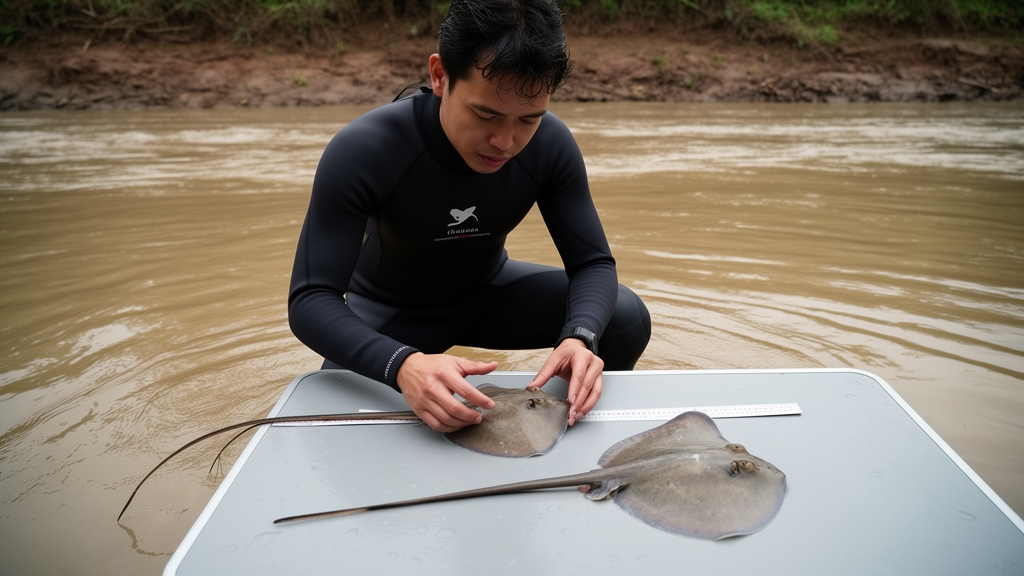
Along the coasts of Thailand, small stingrays of the genus Brevitrygon slip almost unnoticed out of bottom trawl nets. They arrive at fishing ports as bycatch, a proportion destined for local consumption, and for years researchers have suspected that at least two species swim in Thai waters: the dwarf whipray Brevitrygon heterura and a puzzling morphotype provisionally labeled Brevitrygon cf. imbricata. A new study, published in Acta Ichthyologica et Piscatoria, has now put that suspicion to the test with a combined morphological and genetic analysis of 148 specimens, and the verdict is clear. Every ray examined, regardless of its outward appearance, belongs to a single species, B. heterura, though its populations on either side of the Malay Peninsula carry distinct genetic signatures.
The genus Brevitrygon comprises small to medium-sized benthic stingrays inhabiting shallow coastal waters of the Indo-West Pacific. Members of the group share a strongly depressed, suboval disc, an elongate and angular snout, reduced or rudimentary tail folds, and a well-defined secondary band of denticles running along the dorsal disc. The tail is slender and shows marked sexual dimorphism: adult females develop a characteristic bulbous expansion on the distal portion, a structure absent in males. Five species are currently recognized, but species-level identification remains notoriously difficult because the diagnostic characters are subtle, the features limited, and the geographic distributions overlap. B. heterura typically exhibits an oval disc slightly longer than wide and a pointed, forward-projecting snout, whereas B. imbricata displays a more rounded disc of nearly equal width and length and a blunter snout. Thai checklists had listed both species, and recent observations of individuals resembling B. imbricata in the Andaman Sea had raised the prospect that the Indian Ocean species might extend into Thai territory.
To resolve the question, researchers from King Mongkut’s Institute of Technology Ladkrabang collected specimens from fishing ports and vessels between May 2022 and January 2024, sampling both the Gulf of Thailand and the Andaman Sea. The 148 rays were weighed and sexed on site, and small tissue samples from the right pelvic fins were preserved in 95% ethanol for later genetic work. Based on key external characters, the team assigned the specimens to two morphotypes: B. heterura and B. cf. imbricata, the latter being the ambiguous form resembling B. imbricata. The collection sites spanned nine locations, from Chon Buri and Songkhla in the Gulf to Phuket and Satun on the Andaman coast, with disc widths ranging from 9.9 to 26.5 centimeters and sex ratios close to parity at most sites.
The morphometric component of the study was exhaustive. Following methods established in recent taxonomic revisions, the researchers recorded 41 morphological characteristics for each specimen, 40 of them expressed as ratios relative to disc width, using calipers and rulers accurate to 0.1 centimeter. Two additional measurements, the length and width of the mid-shoulder denticle, were introduced specifically for this study. Fourteen morphometric traits were then compared against published reference data for B. heterura and B. imbricata. The result was unambiguous: specimens of both morphotypes more closely resembled B. heterura than B. imbricata, although some individual ratios differed. Notably, the Thai rays exhibited a relatively greater interorbital width to orbit length than either reference species, and the B. cf. imbricata morphotype aligned more closely with B. heterura on the basis of these measurements.
Statistical analysis reinforced the impression of morphological continuity. Principal component analysis performed on 14 size-normalized morphometric ratios showed that the first two components accounted for nearly all morphological variation, with PC1 explaining 66.63% and PC2 16.95% of the variance. Yet the ordination revealed no clear separation or distinct clustering between the two morphotypes or across geographic locations, indicating substantial overlap in body proportions. A multivariate analysis of variance added nuance: geographic location significantly influenced morphological variation, whereas morphotype and sex had no significant effect. Individuals of both sexes were more similar within the same location than across locations, suggesting that geographic separation exerts a stronger influence on ray morphology than sexual differentiation, even though sexual dimorphism is documented in other stingray genera such as Dasyatis.
The molecular evidence came from DNA barcoding of the cytochrome c oxidase I gene, the workhorse mitochondrial marker for species discrimination in cartilaginous fishes. Budget constraints limited the genetic sample to 39 specimens, randomly drawn from both morphotypes across both seas: 12 from the Gulf of Thailand and 27 from the Andaman Sea. DNA was extracted from pelvic fin tissue, and partial COI sequences were amplified by polymerase chain reaction with the primers FishF1 and FishR1, yielding final alignments of 512 base pairs. All sequences were deposited in NCBI, and BLASTn searches against the nucleotide database showed that every specimen matched B. heterura with high identity values exceeding 98%. No specimen matched B. imbricata or any other congeneric taxon more closely.
Phylogenetic reconstruction using the maximum likelihood method, applying the HKY+G substitution model with 1000 bootstrap replicates, confirmed the picture. All Thai specimens clustered within the B. heterura clade with strong bootstrap support and were clearly distinct from other Brevitrygon species, particularly B. imbricata. Within that clade, however, two well-supported subgroups emerged: one comprising specimens from the Gulf of Thailand and the eastern side of the Malay Peninsula, representing the Pacific Ocean, and the other from the Andaman Sea, in the eastern Indian Ocean. Genetic distance analysis using the Kimura-2-Parameter model showed intraspecific divergences within the B. heterura clade ranging from 0.0% to 2.88%, with a mean of 1.08%. Each regional subgroup exhibited divergences of roughly 0.0% to 1.40% in the Gulf and 0% to 1.19% in the Andaman Sea, while interspecific divergences between B. heterura and other congeners ranged from 9.28% to 10.66%.
The interpretation hinges on scale. A mean intraspecific divergence of 1.08% falls squarely within the expected range for population-level variation in elasmobranchs, whereas the more than 9% gap separating B. heterura from B. imbricata is the kind of distance that reliably distinguishes species. In other words, the two genetic subgroups represent population structuring rather than cryptic diversity. Similar patterns have been observed elsewhere: Neotrygon kuhlii in the Indo-West Pacific displays sharp genetic differentiation attributed to its sedentary benthic habits, and Rhinoptera species in the western Atlantic show genetically distinct populations across regions despite minimal morphological differences and no evidence of hidden species. Such structuring has been attributed to factors including benthic temperature, current patterns, philopatry, and site fidelity, which limit gene flow and reinforce regional differentiation.
Behavioral traits of the rays themselves likely contribute to the observed structure. Brevitrygon species are recorded as ovoviviparous benthic animals with potential site fidelity, and several coastal stingrays exhibit seasonal residency and spatially restricted movements. Bathytoshia brevicaudata, for example, demonstrates strong seasonal residency in a marine protected area in New Zealand. Low mobility, a demersal habitat preference, and natal homing all restrict dispersal, and the Malay Peninsula forms a formidable barrier between the Gulf of Thailand and the Andaman Sea, separating two ocean basins whose coastal environments differ in temperature, salinity, and current regimes. The combination of sedentary life history and geographic isolation is a classic recipe for regional genetic differentiation without speciation.
The findings carry practical consequences for conservation and fisheries management. B. heterura has been identified as highly vulnerable to bottom trawl fisheries in the Gulf of Thailand and is listed as globally vulnerable on the IUCN Red List, so accurate species identification is essential for biodiversity assessments and effective management strategies. Recognizing geographically structured populations, rather than overlooking them as taxonomic noise, allows managers to account for environmental heterogeneity and limited gene flow when setting conservation priorities. The study also underscores the value of integrating morphological and molecular data: external measurements alone suggested continuity, but the genetic analysis revealed the population structure that morphology could not detect. The authors acknowledge limitations, noting that their sampling does not encompass the species’ full distribution and that reliance on a single mitochondrial marker reflects only maternal inheritance. Future work incorporating nuclear markers such as microsatellites or single nucleotide polymorphisms, and broader sampling across Southeast Asia and the eastern Indian Ocean, will be needed to determine whether the observed structuring holds across the range of this vulnerable little whipray.
Subject of Research: Integrative morphological and COI barcoding assessment of Brevitrygon stingray diversity in Thai waters
Article Title: Morphological and molecular insights into diversity of Brevitrygon ( Elasmobranchii , Myliobatiformes , Dasyatidae ) in Thai waters
Article References: Wongmanee, P., Khudamrongsawat, J., Krajangdara, T., Senanan, W., Panithanarak, T., Karuwancharoen, R., & Klangnurak, W. (2026). Morphological and molecular insights into diversity of Brevitrygon (Elasmobranchii, Myliobatiformes, Dasyatidae) in Thai waters. Acta Ichthyologica et Piscatoria, 56, 117-126. https://doi.org/10.3897/aiep.56.177135
Image Credits: AI Generated
Keywords: Brevitrygon heterura, stingrays, DNA barcoding, COI gene, Thailand, Andaman Sea, Gulf of Thailand, morphometrics, cryptic species, bycatch fisheries, Morphological, molecular
Cite Scienmag News
Juliet Wilcox. (October 17, 2026). Thai stingray study finds one species where two were suspected. Scienmag. https://scienmag.com/thai-stingray-study-finds-one-species-where-two-were-suspected/
Juliet Wilcox. "Thai stingray study finds one species where two were suspected." Scienmag, 17 October 2026, https://scienmag.com/thai-stingray-study-finds-one-species-where-two-were-suspected/. Accessed 17 October 2026.
Juliet Wilcox. "Thai stingray study finds one species where two were suspected." Scienmag. October 17, 2026. https://scienmag.com/thai-stingray-study-finds-one-species-where-two-were-suspected/


