


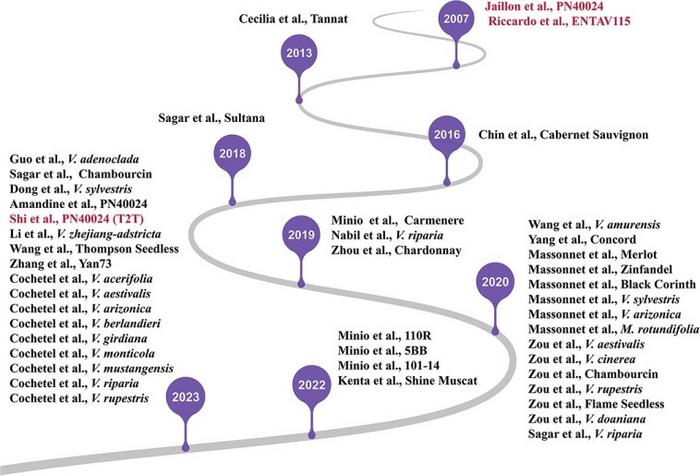
Recent advancements in grape genomics have significantly enhanced our understanding of grapevine biology and breeding. By sequencing over 44 grape genomes, researchers have identified key genes related to disease resistance, berry quality, and stress tolerance. These discoveries are crucial for developing high-quality, climate-adaptive grape varieties, benefiting both grape studies and the global grape industry.

Credit: Horticulture Research
Recent advancements in grape genomics have significantly enhanced our understanding of grapevine biology and breeding. By sequencing over 44 grape genomes, researchers have identified key genes related to disease resistance, berry quality, and stress tolerance. These discoveries are crucial for developing high-quality, climate-adaptive grape varieties, benefiting both grape studies and the global grape industry.
Grapes are economically and culturally significant worldwide, but climate change has posed substantial challenges to grape production in recent decades. This has necessitated breeding new varieties that are both high in quality and adaptable to changing environmental conditions. To address these challenges, comprehensive research into grape genomics is crucial. By understanding the genetic basis of traits such as disease resistance and berry quality, scientists can develop improved grape varieties that meet the demands of both growers and consumers. Based on these challenges, in-depth genomic studies are essential for advancing grape breeding efforts.
A team of researchers from the State Key Laboratory of Plant Diversity and Specialty Crops at the Chinese Academy of Sciences published their findings (DOI: 10.1093/hr/uhae128) on May 7, 2024, in Horticulture Research. The study reviews the progress made in grape genomics, highlighting significant advancements and their implications for the grape industry.
The study details the sequencing of over 44 grape genomes, including Vitis vinifera and wild Vitis species, leading to significant discoveries in grape biology. Researchers have gained critical insights into the mechanisms of biotic and abiotic resistance, berry quality formation, and grape domestication history. Genome-wide association studies have identified over 900 genes related to essential traits, enhancing genomic selection and breeding strategies. A notable milestone was the 2023 release of the high-quality telomere-to-telomere genome of Pinot Noir, offering comprehensive data for future research. These advancements allow breeders to develop grape varieties with improved disease resistance, environmental stress tolerance, higher berry quality, and better yields, significantly impacting the grape industry.
Dr. Zhenchang Liang, the lead researcher, stated, “These genomic advancements provide a robust foundation for future grape breeding and research. The detailed insights into grape genetics will facilitate the development of varieties that can withstand environmental stresses and produce high-quality yields.”
The extensive genomic data from these studies is set to revolutionize grape breeding. By leveraging these insights, breeders can develop grape varieties with enhanced disease and environmental stress resistance, improved berry quality, and better yields. This genomic approach will significantly impact the grape industry, ensuring sustainable production and meeting the growing demand for high-quality grapes.
###
References
Original Source URL
Funding information
This study was supported by the National Science Foundation of China (32025032), the National Key Research and Development Program (2022YFE0116400), the Agricultural Breeding Project of Ningxia Hui Autonomous Region (NXNYYZ202101), and the Youth Innovation Promotion Association CAS (2023087).
About Horticulture Research
Horticulture Research is an open access journal of Nanjing Agricultural University and ranked number one in the Horticulture category of the Journal Citation Reports ™ from Clarivate, 2022. The journal is committed to publishing original research articles, reviews, perspectives, comments, correspondence articles and letters to the editor related to all major horticultural plants and disciplines, including biotechnology, breeding, cellular and molecular biology, evolution, genetics, inter-species interactions, physiology, and the origination and domestication of crops.
Journal
Horticulture Research
Subject of Research
Not applicable
Article Title
Biography of Vitis genomics: recent advances and prospective
Article Publication Date
7-May-2024
COI Statement
The authors declare that they have no competing interests.
Cite Scienmag News
Drew Townsend. (August 7, 2024). Vitis genomics: charting the path to resilient grape varieties. Scienmag. https://scienmag.com/vitis-genomics-charting-the-path-to-resilient-grape-varieties/
Drew Townsend. "Vitis genomics: charting the path to resilient grape varieties." Scienmag, 7 August 2024, https://scienmag.com/vitis-genomics-charting-the-path-to-resilient-grape-varieties/. Accessed 5 September 2026.
Drew Townsend. "Vitis genomics: charting the path to resilient grape varieties." Scienmag. August 7, 2024. https://scienmag.com/vitis-genomics-charting-the-path-to-resilient-grape-varieties/

