


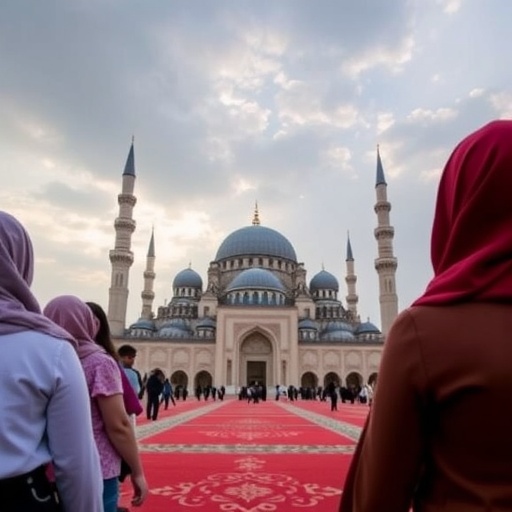
In recent years, the visibility of Islamic symbols in Western urban spaces has sparked intense debate. Opinions are sharply divided over whether such public expressions foster belonging or fuel alienation among Muslim immigrants. While much discourse has centered on ideological or political arguments, empirical investigations grounded in rigorous methodology have remained scarce. Now, an innovative study published in Nature Cities has shattered this void, providing compelling causal evidence on how in situ exposure to Islamic symbols influences the complex process of place-based integration for Muslim immigrants living in major European cities.
The research team, led by Ben-Nun Bloom, Birenboim, Mayer, and colleagues, embarked on a methodologically groundbreaking approach by combining digital technology, behavioral science, and urban sociology. They developed an augmented reality (AR) mobile application that allowed them to systematically expose participants to either Islamic symbols or secular, non-religious cues embedded into identical urban routes. This innovative experimentation took place amidst two cosmopolitan hubs often regarded as emblematic cases for navigating religious pluralism in public spaces: Paris and London.
The core conceptual framework underpinning the study rests on the understanding of place integration as an immediate, perceptual process. Specifically, integration is framed as a form of person-environment attunement that unfolds through approach-oriented behavior, such as movement patterns, as well as through attitudinal and perceptual attachment to the neighborhood environment. This perspective departs from traditional views that tend to focus chiefly on cognitive or identity dimensions and instead highlights how physical proximity to symbolic elements can shape feelings of belonging.
To this end, the researchers recruited a total of nearly 300 Muslim immigrants—151 participants in Paris and 147 in London—for the experimental phase. Participants were randomly assigned routes displayed through the AR app, exposing them either to Islamic symbols, such as crescent moons and traditional calligraphy, or to neutral architectural elements designed to serve as control stimuli. While participants humbly walked the pre-designated urban paths, their movement was meticulously recorded via GPS sensors embedded in the app. This technology unlocked a treasure trove of behavioral data including walking pace, acceleration patterns, and the duration spent lingering near the symbolic cues.
The findings were striking. Across both cities, exposure to Islamic symbols led to clear increases in approach-oriented behaviors, quantified by meaningful effect sizes (d = 0.51 in Paris and d = 0.63 in London), with statistical significance firmly below the conventional threshold (P < 0.05). In essence, participants slowed down, lingered, or moved more attentively around areas where Islamic symbols were presented, signaling comfort, engagement, or heightened spatial recognition. This behavior contrasts strongly with the more hurried and non-receptive movements observed in the control conditions.
In parallel with behavioral insights, the study also collected attitudinal measures through self-reported surveys. Participants exposed to Islamic cues reported elevated levels of place attachment, indicating a stronger emotional and psychological connection to the urban environment. These survey results were bolstered by complementary cross-sectional data gathered from broader samples exceeding 800 Muslim residents in total across Paris and London. This survey corroborated that everyday visibility of Islamic symbols in one’s immediate neighborhood was positively correlated with feelings of belonging and neighborhood attachment, thus reinforcing the ecological validity of the experimental implications.
One of the study’s most compelling aspects is the replication of findings across two cities with contrasting policies and social climates regarding religious visibility. Paris has traditionally adopted a more secular public space framework, often limiting explicit religious symbols, whereas London exemplifies a more pluralistic and accommodating stance. The fact that the observed positive effects persisted in both contexts points to a robust, cross-national psychological phenomenon that transcends particular urban policies or cultural idiosyncrasies.
This research carries deep implications for urban governance and multicultural coexistence in democratic societies. Critics of public Islamic expression often argue that visible religion fragmentizes urban communities and impedes immigrant integration. However, these findings suggest the opposite: that visible Islamic symbols may serve as anchoring cues which reinforce Muslim immigrants’ sense of belonging and place integration. Far from promoting withdrawal, these symbols appear to signal inclusiveness and recognition in the urban landscape, fostering positive spatial and social orientations.
Technically speaking, the deployment of augmented reality in field experiments marks a significant advance in urban social science research. It bridges the gap between traditional survey methods laden with bias and the challenge of randomizing real-world environmental stimuli. This digital overlay technique creates controlled yet naturalistic settings where participants’ immediate sensory and behavioral responses can be measured with exquisite precision. By doing so, it opens new vistas for exploring how physical environments interact with social identities in real time.
The study also highlights the importance of micro-geographic scale analysis in understanding integration processes. Large-scale demographic or opinion data often smooth over the nuanced ways in which symbolic environments influence everyday experiences. By zooming into pedestrian movements and neighborhood-level affective ties, the research unpacks the subtle dynamics through which public space becomes a canvas for inclusion or exclusion.
Moreover, the implications of this work extend beyond Muslim immigrant communities to broader discussions about the role of religious symbols in pluralistic societies. Visible religion, when thoughtfully incorporated into urban landscapes, can function as a means of cultural expression and social cohesion rather than division. This challenges prevailing assumptions in integration paradigms that often treat religious expression as a private matter divorced from spatial belonging.
The findings also have relevance for policy initiatives aimed at urban social integration. City planners, policymakers, and community leaders might consider the strategic visibility of minority cultural and religious symbols as an asset, promoting urban designs that accommodate diverse identities visibly and symbolically. Public spaces that reflect the cultural mosaic of their inhabitants could thus reinforce mutual recognition and reduce social alienation among immigrant populations.
In addition, the digital methodology pioneered here holds promise for future interdisciplinary research. Similar AR-based experiments could assess the effects of other identity-related environmental cues, such as language signage, cultural art, or group-specific architecture, on various marginalized groups. This tool can enrich the toolkit for empirical social science, fostering a more dynamic understanding of how built environments mediate human experiences of belonging and exclusion.
Ultimately, this study not only uncovers the psychological and behavioral mechanisms linking visible religious expression to immigrant integration but also invites broader reflection on the meanings of diversity and visibility in contemporary urban life. As cities become increasingly global and multicultural, the visibility of different cultural and religious identities emerges as a crucial dimension of equitable urban coexistence.
The research therefore arrives at a timely juncture when debates surrounding urban public space, immigration, and social cohesion are intensifying across the globe. By moving beyond anecdote and ideological rhetoric, it provides actionable insights grounded in data and experimentation. It offers a hopeful vision wherein public visibility of minority cultures contributes positively to integration and collective belonging.
In sum, the novel combination of augmented reality technology, precise behavioral tracking, and attitudinal surveys affords a powerful lens onto how Muslim immigrants navigate and attach to their urban surroundings in the presence of their own cultural symbols. This evidence confronts long-standing assumptions and advances a new understanding of place integration as a situated, sensory process elicited by environmental cues. It reshapes the discourse around religion in public space, affirming that visible Islam can be a bridge rather than a barrier for immigration and urban inclusion.
Cite Scienmag News
Denise Maddox. (April 17, 2026). Visible Islam Influences Muslim Immigrants’ Integration. Scienmag. https://scienmag.com/visible-islam-influences-muslim-immigrants-integration/
Denise Maddox. "Visible Islam Influences Muslim Immigrants’ Integration." Scienmag, 17 April 2026, https://scienmag.com/visible-islam-influences-muslim-immigrants-integration/. Accessed 3 September 2026.
Denise Maddox. "Visible Islam Influences Muslim Immigrants’ Integration." Scienmag. April 17, 2026. https://scienmag.com/visible-islam-influences-muslim-immigrants-integration/


