


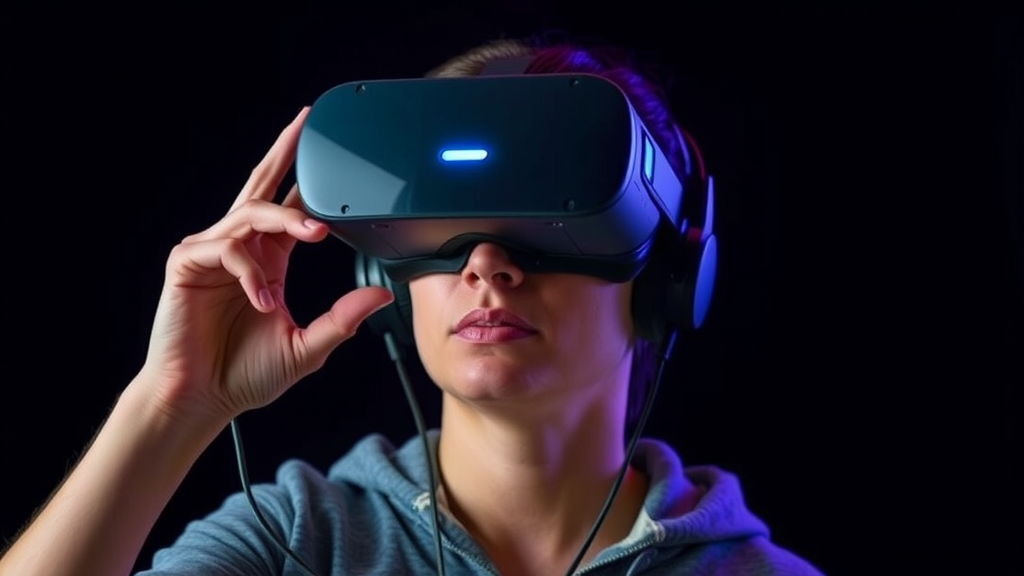
Virtual reality has quietly become one of the most effective ways to make people genuinely stressed in the laboratory, and a new systematic scoping review suggests it may soon play a central role in testing whether the smartwatches and fitness rings on our wrists can actually measure that stress accurately. Published in Behavior Research Methods, the review by Magdalena Sikora of the University of Twente and colleagues systematically mapped the landscape of VR stress induction, synthesizing evidence from 110 studies published between 1997 and 2024, encompassing a pooled sample of 5,967 participants aged 15 to 82. The central finding is striking: while VR has proven itself a reliable and flexible platform for evoking real physiological stress responses, not a single study to date has used VR stress induction to formally validate a wearable device against a gold-standard reference. The authors argue that this represents an enormous, untapped opportunity at the intersection of two rapidly growing fields.
The review organized the sprawling universe of VR stress tasks into three core categories based on the primary stressor involved: social-evaluative threat, environmental threat, and cognitive demand. Social-evaluative stressors, in which participants feel judged by virtual others, dominated the field, appearing in nearly half of all studies. Environmental stressors, such as virtual heights, fires, and floods, formed a surprisingly rich second category, while cognitive challenges like the Stroop color-word test made up the third. This classification was grounded in established stress theory, which holds that acute stress typically arises from uncontrollability and demands imposed by social judgment, physical threat from the environment, or extensive mental effort. Many tasks blend these elements, but the researchers classified each by its dominant stressor, providing the field with its first coherent taxonomy of virtual stress induction.
One task towered above all others in both popularity and proven effectiveness: the virtual reality version of the Trier Social Stress Test, or VR-TSST. In this paradigm, participants deliver a speech and perform mental arithmetic in front of a panel of judgmental virtual judges, closely replicating the original laboratory protocol developed by Kirschbaum and colleagues in 1993. The review found that VR-TSST produced moderate to predominantly large effect sizes for heart rate, skin conductance level, salivary cortisol, and alpha-amylase, activating both the autonomic nervous system and the hypothalamic-pituitary-adrenal axis. Across 21 studies that measured subjective stress alongside physiology, every single one reported significant increases. The task also showed the largest pooled sample and the widest range of physiological measures of any VR stressor, cementing its status as the gold standard of virtual stress induction.
Crucially, seven studies directly compared VR-TSST with its in vivo counterpart, and the results reveal a nuanced picture. The virtual version consistently induced significant physiological stress responses and replicated the characteristic temporal profiles of the traditional test, such as heart rate peaking during the speech phase. However, cortisol responses were typically attenuated in VR. In one comparison, the virtual test raised salivary cortisol by an average of 70 percent from baseline while the real-life version produced a 90 percent increase; another study reported a gap of 30 percent versus 90 percent. Yet for heart rate and skin conductance, several studies found no significant differences between conditions, and one even recorded a stronger skin conductance response in VR. Subjectively, participants did not report more stress in the real condition, and one study found VR-TSST actually felt more challenging. The authors conclude that the virtual test remains an effective multimodal stressor despite the somewhat dampened endocrine response.
The second standout performer was the high-altitude task, in which participants confront extreme virtual heights, often standing on a narrow plank or watching floor tiles fall away to reveal a dizzying drop. This environmental stressor exploits VR’s unique capacity to simulate physical danger safely, something impossible or unethical to recreate in a conventional laboratory. Studies that systematically manipulated height found greater physiological reactivity at higher elevations, and one comprehensive investigation combining virtual height with a physically elevated plank found the most extreme combination produced the strongest physiological and subjective stress. Interestingly, task design mattered: studies using narrow plank structures at altitude often produced large effect sizes for heart rate and cortisol, whereas open platform designs yielded smaller effects. The task worked regardless of whether participants reported fear of heights, and remarkably, one study found it induced stress responses comparable to real-life climbing, with participants reporting even higher subjective stress in the virtual condition.
Cognitive stressors told a more complicated story. The VR Stroop task, in which participants name the ink color of conflicting color words, produced measurable physiological changes but weaker and less consistent responses than the social and environmental tasks. Four of the studies measuring subjective stress found participants described states of enjoyment or focus rather than stress, suggesting that pure cognitive demand alone may be insufficient as a VR stressor. However, researchers who added distressing elements, such as judgmental avatars or uncontrolled environmental rotation, saw markedly stronger cardiovascular and electrodermal reactivity. One creative adaptation, the VR Stroop Room, translated the task into a spatial environment where participants select correctly colored walls, producing an average heart rate increase of 19 percent, a 63 percent rise in skin conductance level, and a striking 135 percent jump in non-specific skin conductance responses. Comparisons with in vivo Stroop tests showed comparable or even slightly heightened physiological responses in VR conditions.
The review’s most consequential finding concerns wearables. Although twelve studies used wearable devices, including the Empatica E4 wristband and Polar H10 chest strap, to record physiological signals during stressful VR tasks, none explicitly set out to validate those devices against gold-standard references. Several studies came close: one investigation of VR climbing used a standard ECG system and a wearable chest strap concurrently, producing visually comparable heart rate data, while another assessed wearable sensors against subjective stress reports during height exposure. Four studies using the Empatica E4 reported significant variations in heart rate and electrodermal activity caused by stress-inducing tasks. These results demonstrate the feasibility of wearable recording in VR environments, but the formal validation step, assessing construct and convergent validity under controlled stress induction, has never been taken. Given that current laboratory validation protocols can involve up to 26 experimental conditions and that an umbrella review found existing validation practices cover only 3.5 percent of potential validation needs, the authors see VR as a way to dramatically accelerate the pipeline.
The argument for VR-based validation rests on two prerequisites the review says VR can satisfy. First, a validation protocol must subject a person wearing a device to conditions that produce sufficient, detectable, and relevant physiological variation, and the consistent reactivity across VR stress paradigms shows this is achievable. Second, researchers must be able to capture those changes with both the wearable and a gold-standard reference simultaneously, which the review found highly viable given that most studies already used laboratory-grade equipment and at least one successfully paired a wearable with a reference device. The measures that respond most robustly to VR stress, namely heart rate, electrodermal activity, and heart rate variability, overlap precisely with the parameters current wearables are designed to measure and that existing validation frameworks assess. VR could also bridge the persistent gap between rigid laboratory protocols and the messy reality of daily life, offering immersive, context-rich scenarios that preserve more of the situational factors that shape real-world stress while retaining experimental control.
The review is candid about the field’s shortcomings. Technological limitations such as cybersickness can degrade data quality, VR’s novelty itself may influence physiological signals, and the sense of presence depends on complex factors that should not be equated with ecological validity. Perhaps more troubling, task selection across studies was driven mostly by pragmatic considerations rather than stress theory, with fewer than a third of investigations anchoring their designs in established psychophysiological frameworks. Design decisions often lacked evidential support: enlarging virtual audiences beyond three judges did not increase stress reactivity, replicating the physical laboratory in VR added nothing, and every high-altitude study included a physical plank without ever testing whether it was necessary. Openly available, research-grade VR stress applications remain scarce, with only a handful of exceptions such as the open-source VR Stroop Room and a recently published open version of the VR-TSST. The authors call for standardized, open-access tools, more transparent reporting of VR development, and theoretically grounded task design. If the field answers that call, the humble smartwatch may soon earn its scientific credentials inside a virtual world.
Subject of Research: The effectiveness of virtual reality stress induction tasks for evoking physiological stress reactivity and their potential for validating wearable devices
Article Title: A systematic scoping review identifying effective virtual reality stress tasks inducing physiological reactivity for future wearables validation
Article References: Sikora, M., Zhao, X., van ’t Klooster, J.-W., Koyuncu, Z., de Geus, E., & Noordzij, M. (2026). A systematic scoping review identifying effective virtual reality stress tasks inducing physiological reactivity for future wearables validation. Behavior Research Methods, 58(10), Article 294. https://doi.org/10.3758/s13428-026-03161-3
Image Credits: AI Generated
DOI: 10.3758/s13428-026-03161-3
Keywords: virtual reality, stress induction, wearable devices, Trier Social Stress Test, physiological reactivity, heart rate, electrodermal activity, cortisol, high-altitude task, Stroop test, validation, autonomic nervous system
Cite Scienmag News
Glenn Wilkins. (September 20, 2026). Virtual Reality Stress Tests Emerge as Powerful New Tool for Validating Wearable Health Devices. Scienmag. https://scienmag.com/virtual-reality-stress-tests-emerge-as-powerful-new-tool-for-validating-wearable-health-devices/
Glenn Wilkins. "Virtual Reality Stress Tests Emerge as Powerful New Tool for Validating Wearable Health Devices." Scienmag, 20 September 2026, https://scienmag.com/virtual-reality-stress-tests-emerge-as-powerful-new-tool-for-validating-wearable-health-devices/. Accessed 5 October 2026.
Glenn Wilkins. "Virtual Reality Stress Tests Emerge as Powerful New Tool for Validating Wearable Health Devices." Scienmag. September 20, 2026. https://scienmag.com/virtual-reality-stress-tests-emerge-as-powerful-new-tool-for-validating-wearable-health-devices/


