


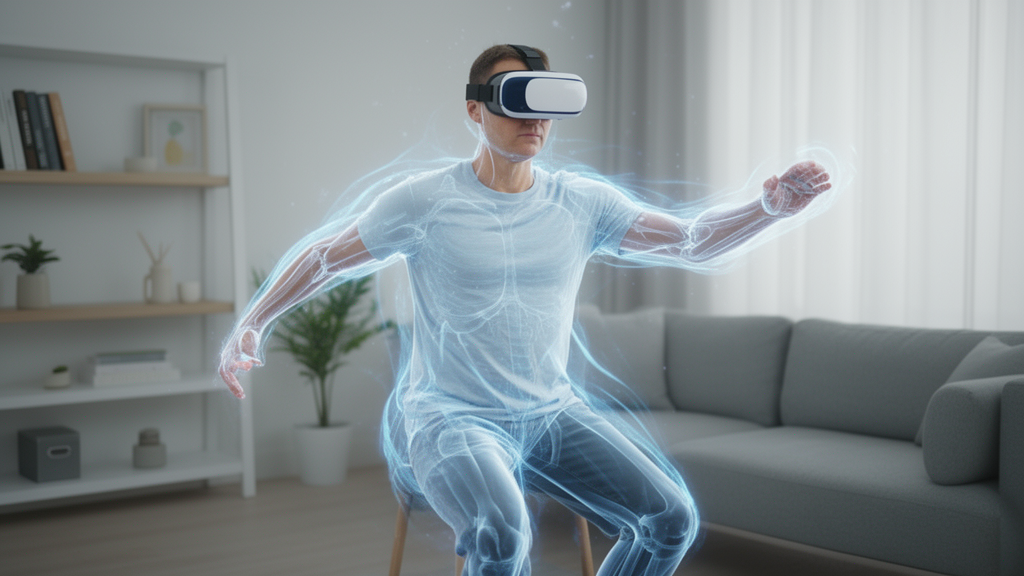
Patients recovering from stroke, Parkinson’s disease, and other neurological conditions are increasingly prescribed therapy that looks like a video game: virtual reality headsets, motion-tracked exergames, and tablet-based drills promise thousands of repetitions that no clinic could ever deliver. Yet a new Mini Review published in Frontiers in Neurology argues that one of the field’s most persistent blind spots is what happens, or fails to happen, after the headset comes off. Improvements achieved inside virtual environments, rehabilitation games, or technology-based assessments, the authors contend, do not necessarily translate into meaningful changes in everyday function. Success within a trained task should never be assumed to represent a real improvement in daily life.
The review, led by Mohammad Alimoradi of Shahid Bahonar University of Kerman and colleagues at institutions across Türkiye, Iran, and the United Arab Emirates, examines what they call the transfer problem in digital neurorehabilitation. Transfer refers to whether skills learned in one setting, such as a virtual obstacle-avoidance game, carry over to another, such as navigating a busy sidewalk. Near transfer describes generalization to similar tasks, while far transfer involves tasks with substantially different motor, cognitive, or contextual demands. The review uses the term broadly, encompassing functional changes in daily activities and ecological performance in real-world environments.
The stakes are considerable. Neurological disorders are a major cause of long-term disability and frequently produce persistent impairments in gait, balance, coordination, and upper-limb control, substantially restricting independence and quality of life. Conventional rehabilitation relies on repetitive, task-specific practice to drive experience-dependent neuroplasticity, but clinical resources, mobility restrictions, and waning engagement often limit its intensity and duration. Digital technologies, including virtual reality, augmented reality, exergaming, wearable sensors, and telerehabilitation platforms, can deliver intensive, interactive practice while adjusting difficulty and feedback to individual performance, and gamification may sustain engagement. Across neurological populations, such interventions have been investigated for upper-limb function, gait, balance, mobility, and activities of daily living.
But the evidence on generalization is uneven. The authors cite a study of people with Parkinson’s disease by Mendes and colleagues showing that transfer from virtual reality training to an untrained functional task depended on the motor and cognitive demands of the games themselves. A separate review found that virtual reality reduces activity limitations after stroke, yet did not establish improvements in free-living performance or participation. Importantly, the authors caution that insufficient evidence of real-world transfer should not be interpreted as proof of transfer failure, because many studies simply fail to measure it. Clinical measures often capture what individuals can do under structured conditions rather than what they actually do in daily life, a distinction wearable technologies may help to quantify.
A central obstacle the review identifies is the specificity paradox. Task-specific practice is a cornerstone of neurorehabilitation, and digital systems excel at structuring repetitions, delivering immediate feedback, and progressively adjusting difficulty. However, highly specific practice can promote learning that remains dependent on the trained task or context. A patient may improve substantially during repeated virtual reaching, gait, or obstacle-avoidance exercises yet struggle when movement, sensory, or environmental demands change. The authors argue that transfer-oriented rehabilitation should define specificity not as repeating a single movement, but as preparing individuals for the range of functional demands they will actually encounter, for example by progressively varying speed, direction, environmental constraints, and attentional demands in community mobility training.
A second barrier is the sensory and perception-action gap. Successful movement depends on integrating visual, proprioceptive, vestibular, tactile, and auditory information, which digital systems cannot fully reproduce. A virtual obstacle differs from a physical one in depth cues, haptic feedback, physical consequences, and perceived affordances, and motor strategies developed during virtual practice may not carry over to comparable real-world situations. The authors point to evidence of limited transfer and retention of locomotor adaptations from virtual to physical obstacle avoidance. Improving sensory fidelity through physical interaction, haptic feedback, or real-world movement constraints may help, but they stress that greater technological realism does not automatically guarantee better transfer and requires direct evaluation.
Real-world cognitive and contextual complexity compounds the problem. Community ambulation may demand obstacle avoidance while monitoring traffic, holding a conversation, or responding to distractions, whereas rehabilitation tasks are typically performed under predictable, controlled conditions. Prolonged practice in simplified environments may leave patients poorly prepared for that complexity, and although cognitive-motor and dual-task training can increase ecological relevance, improvements may remain specific to the trained task. Relatedly, the review notes that repetition without variability is another trap: highly repetitive, predictable practice may polish performance within the trained context while limiting adaptation, whereas variable and random practice can better promote retention and transfer by exposing individuals to a broader range of movement solutions. Increasing difficulty, the authors emphasize, is not the same as increasing adaptability.
Individual and environmental factors further shape whether learning generalizes. Motor control, sensory processing, cognition, fatigue, and adaptability all influence transfer, as do impairment severity, technological familiarity, fluctuating symptoms, and cognitive or sensory impairments. Environmental and social variables, including caregiver support, home accessibility, opportunities for daily activities, confidence, digital access, and adherence, may determine real-world performance. Limited improvements in daily activities, the authors warn, may therefore reflect environmental barriers or restricted opportunities rather than failed transfer. To organize these considerations, they propose a transfer-oriented framework of five interconnected stages: skill acquisition in controlled environments, adaptive variability, cognitive-motor integration, contextualized real-world practice, and ecological evaluation. Each stage poses a distinct question, from whether an individual can perform a movement under controlled conditions to whether an intervention has produced a meaningful change in real-world behavior.
Critically, the authors describe the framework not as a linear pathway but as an adaptive rehabilitation loop, in which contextualized practice and ecological evaluation reveal situations where performance deteriorates, and those challenges are then reintroduced into controlled or digital environments for targeted retraining. Within this cycle, virtual reality may provide controlled environments for repeated practice and progressive manipulation of task demands; augmented reality may bridge digital practice and real-world activity by integrating digital cues with actual movement; and wearables may extend assessment and feedback into home and community settings, distinguishing between capacity and performance. Technology, in this vision, functions not simply as a delivery tool for exercises but as part of a system supporting continuous assessment, adaptation, and progression of learning across contexts, complementing rather than replacing conventional rehabilitation.
The authors are candid about the limitations of their own analysis. As a narrative Mini Review, it involved no formal risk-of-bias assessment or meta-analysis, and the authors acknowledge that narrative source selection may have introduced selection bias. Heterogeneity across neurological populations, interventions, and outcome measures limited comparisons, evidence on real-world transfer was sometimes indirect, and the proposed framework remains conceptual and unvalidated. Their future research priorities include directly evaluating transfer to untrained activities using outcome frameworks that distinguish trained-task performance, near and far transfer, functional outcomes, and daily-life activity; combining clinical assessments with wearable and mobile monitoring to clarify whether capacity gains translate into daily performance changes; and empirically testing the framework’s feasibility, clinical utility, and effectiveness. The broader message is a shift from technology-centered rehabilitation toward transfer-oriented design: rather than building ever more elaborate virtual environments, the field should design interventions that promote generalization, long-term retention, and meaningful improvements in everyday function, and then measure whether those improvements actually appear where patients live.
Subject of Research: The transfer problem limiting generalization from digital neurorehabilitation training to real-world function
Article Title: From virtual practice to real-world function the transfer problem in digital neurorehabilitation
Article References: Karadag, M., Ercis, M. B., Alimoradi, M., Karadağ, D., Kabal, C., Karakulak, I., Bayansalduz, M., Ceylan, L., Iranmanesh, M., & Alghosi, M. (2026). From virtual practice to real-world function the transfer problem in digital neurorehabilitation. Frontiers in Neurology, 17, Article 1976066. https://doi.org/10.3389/fneur.2026.1976066
Image Credits: AI Generated
DOI: 10.3389/fneur.2026.1976066
Keywords: digital neurorehabilitation, virtual reality, transfer of learning, motor learning, stroke rehabilitation, Parkinson's disease, augmented reality, wearable sensors, ecological validity, task specificity, dual-task training, telerehabilitation
Cite Scienmag News
April Hart. (October 23, 2026). Virtual Gains That Fail at Home: The Transfer Problem in Digital Neurorehabilitation. Scienmag. https://scienmag.com/virtual-gains-that-fail-at-home-the-transfer-problem-in-digital-neurorehabilitation/
April Hart. "Virtual Gains That Fail at Home: The Transfer Problem in Digital Neurorehabilitation." Scienmag, 23 October 2026, https://scienmag.com/virtual-gains-that-fail-at-home-the-transfer-problem-in-digital-neurorehabilitation/. Accessed 23 October 2026.
April Hart. "Virtual Gains That Fail at Home: The Transfer Problem in Digital Neurorehabilitation." Scienmag. October 23, 2026. https://scienmag.com/virtual-gains-that-fail-at-home-the-transfer-problem-in-digital-neurorehabilitation/


