


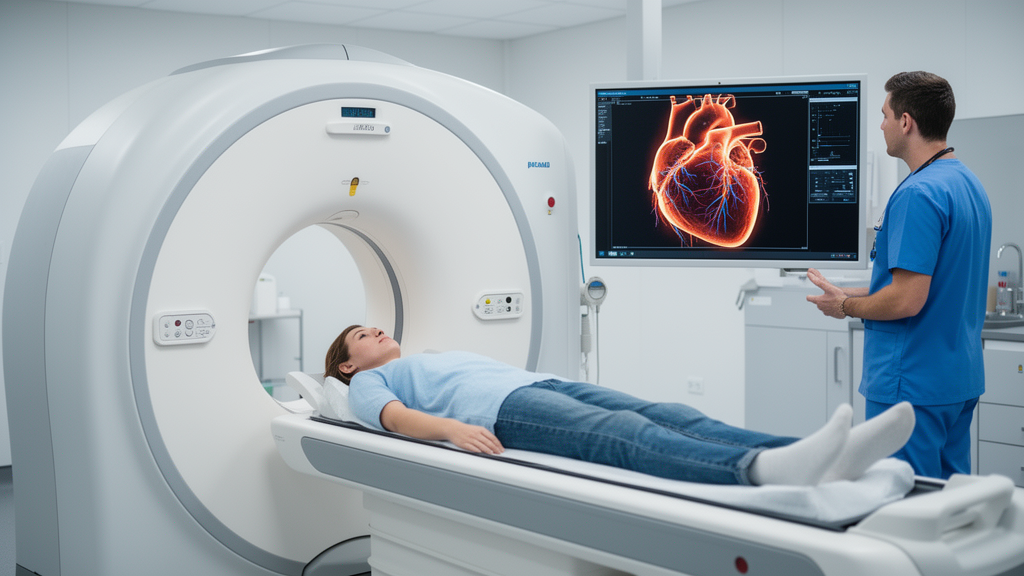
When a patient arrives at the emergency department with acute chest pain, every minute counts. Coronary computed tomography angiography, or CCTA, has become a first-line tool for rapidly assessing whether blocked coronary arteries are the culprit, offering a noninvasive view of the entire coronary tree with high spatial resolution. Yet conventional CCTA carries a hidden bottleneck: it depends on electrocardiogram gating, a process that requires sticking electrodes on the patient’s chest, acquiring a real-time ECG signal, waiting for it to stabilize, and synchronizing image acquisition to precise phases of the heartbeat. A new prospective study from researchers at the First Affiliated Hospital of Kunming Medical University and Yunnan Cancer Hospital in China suggests that this bottleneck can be removed almost entirely, with surprising benefits for both speed and image clarity.
The research, published in Frontiers in Radiology, enrolled 254 patients with acute chest pain and suspected coronary artery disease between February and April 2026. Patients were alternately assigned by examination date to two groups: 126 received virtual ECG-gated CCTA, which dispenses with surface electrodes altogether, and 128 received conventional true ECG-gated CCTA. The two groups were well matched in age, sex, body mass index, heart rate, and cardiovascular risk factors, and no patient received beta-blockers or nitroglycerin before scanning, ensuring that any differences in outcome stemmed from the gating strategy itself rather than from patient preparation.
The technology behind virtual ECG gating is elegantly counterintuitive. Instead of recording the patient’s actual electrical cardiac activity, the scanner generates a simulated, perfectly regular ECG signal based on a heart rate measured beforehand with a simple finger pulse oximeter, deliberately set slightly below the measured value to account for heart rate fluctuations during the scan. Data are then acquired over one complete cardiac cycle using a 256-row CT scanner with a 16-centimeter detector, wide enough to cover the entire heart in a single rotation. The simulated signal never represents the patient’s true ECG waveform and its R-R intervals are not temporally aligned with the real heartbeat; it serves purely as a temporal framework to trigger the scan and organize the reconstruction.
Two intelligent algorithms then do the heavy lifting. SmartPhase technology automatically selects, from among all available cardiac phases, the image with the least motion artifact based on image-based assessment rather than fixed phase assumptions. The chosen images are then processed with SnapShot Freeze, a coronary motion-correction algorithm that integrates data from adjacent cardiac phases, even across different heartbeats, to compensate for residual coronary motion. This combination allows the system to find the diagnostically best moment in the cardiac cycle without ever knowing where that moment truly fell in the patient’s real heartbeat.
The results were striking on the workflow side. Total examination time, measured from the patient lying on the table to the completion of image acquisition, dropped from an average of 4.15 minutes with true ECG gating to 2.83 minutes with virtual gating, a statistically significant reduction driven almost entirely by positioning time, which fell from 2.03 minutes to 0.89 minutes. Scan time itself did not differ significantly between groups, confirming that the time savings came from eliminating electrode attachment, signal adjustment, and signal stabilization. The researchers note that electrode placement can also require exposing private body areas, particularly in female patients, causing anxiety and discomfort that the virtual approach avoids altogether.
Image quality told an equally compelling story. Contrary to what might be expected from removing real-time cardiac synchronization, the virtual ECG-gated group actually showed lower image background noise and significantly higher signal-to-noise and contrast-to-noise ratios across the aortic root and all coronary artery segments studied. CT attenuation values, which reflect the contrast enhancement of the vessels, were comparable between groups. On the five-point subjective scale used by two blinded radiologists, scores for every major coronary artery and branch, from the left main artery to the ramus intermedius, were effectively identical between groups, with both achieving median scores of 5, indicating excellent image quality.
The researchers attribute the favorable quantitative parameters partly to protocol optimization: the noise index, a parameter that drives automatic tube current modulation, was set at 18 HU in the virtual group versus 20 HU in the conventional group, trading higher radiation output for lower image noise. Subjective evaluability, however, remained equivalent, suggesting the optimization did not distort the diagnostic appearance of the images. The authors caution that the improved objective metrics should be interpreted as the combined effect of gating strategy and protocol tuning rather than a benefit of virtual gating alone.
Diagnostic performance against invasive coronary angiography, the reference standard, provided the most clinically significant finding. Fifty-one patients underwent invasive angiography within 30 days of their CCTA, allowing vessel-level comparison across the four major coronary arteries of each patient, analyzed with cluster bootstrap resampling and mixed-effects models to account for multiple vessels per patient. Virtual ECG-gated CCTA achieved a diagnostic agreement rate of 92.00 percent with an area under the ROC curve of 0.89, compared with 85.58 percent and 0.82 for conventional gating, indicating that the electrode-free approach did not compromise, and numerically slightly exceeded, diagnostic accuracy.
The trade-off was radiation. The virtual approach delivered an effective dose of 3.58 millisieverts versus 3.18 millisieverts for true gating, an increase of roughly 13 percent, attributable to the wider acquisition window needed to capture the entire cardiac cycle. Still, the authors point out that this dose remains within the range of modern low-dose CCTA protocols and is comparable to or lower than figures reported for some third-generation dual-source systems. Prior work cited in the study suggests that narrowing the acquisition window could erase much of this dose difference, and the team advocates combining virtual gating with dose-reduction strategies such as low tube voltage, individualized windowing, and deep-learning-based reconstruction.
The clinical implications extend well beyond shaving a minute off the schedule. Reliable ECG signal acquisition can be difficult or impossible in patients with severe chest pain and poor cooperation, extensive chest burns or scars, cardiac tamponade, or those on life-support equipment, and conventional gating remains challenging in arrhythmias such as atrial fibrillation or in patients who cannot tolerate heart-rate-lowering drugs. By making CCTA independent of real-time ECG signals, virtual gating could expand access to rapid, accurate coronary imaging precisely in the emergency scenarios where it matters most. The authors acknowledge limitations, including the single-center design, modest sample size, date-based rather than truly random allocation, and the fact that invasive angiography was performed only in clinically indicated patients, but they conclude that virtual ECG-gated CCTA stands as a feasible, efficient strategy for selected patients with acute chest pain, particularly where speed and workflow simplicity are paramount.
Subject of Research: Comparison of virtual and true ECG-gated coronary CT angiography for diagnosing coronary artery disease in acute chest pain
Article Title: Comparison of virtual and true ECG-gated coronary CT angiography in patients with acute chest pain: a prospective cohort study
Article References: Wei, W., Lu, L., Wu, Y., Fang, Q., Li, Y., Zhou, J., Li, R., Han, D., Ke, T., & Zhao, W. (2026). Comparison of virtual and true ECG-gated coronary CT angiography in patients with acute chest pain: a prospective cohort study. Frontiers in Radiology, 6, Article 1893538. https://doi.org/10.3389/fradi.2026.1893538
Image Credits: AI Generated
DOI: 10.3389/fradi.2026.1893538
Keywords: coronary CT angiography, virtual ECG gating, acute chest pain, coronary artery disease, image quality, radiation dose, emergency radiology, invasive coronary angiography, ECG-independent imaging, motion correction, diagnostic accuracy, wide-detector CT
Cite Scienmag News
Ophelia Keating. (October 16, 2026). Virtual ECG Gating Speeds Up Heart Scans for Chest Pain Patients Without Losing Diagnostic Power. Scienmag. https://scienmag.com/virtual-ecg-gating-speeds-up-heart-scans-for-chest-pain-patients-without-losing-diagnostic-power/
Ophelia Keating. "Virtual ECG Gating Speeds Up Heart Scans for Chest Pain Patients Without Losing Diagnostic Power." Scienmag, 16 October 2026, https://scienmag.com/virtual-ecg-gating-speeds-up-heart-scans-for-chest-pain-patients-without-losing-diagnostic-power/. Accessed 16 October 2026.
Ophelia Keating. "Virtual ECG Gating Speeds Up Heart Scans for Chest Pain Patients Without Losing Diagnostic Power." Scienmag. October 16, 2026. https://scienmag.com/virtual-ecg-gating-speeds-up-heart-scans-for-chest-pain-patients-without-losing-diagnostic-power/


