


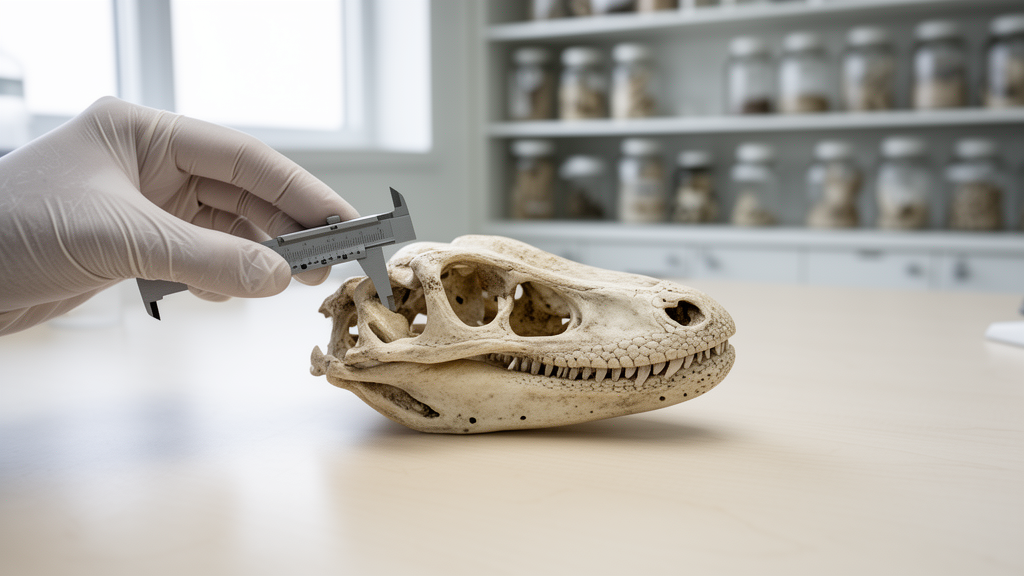
The Canary Islands have long been a natural laboratory for evolution, home to a remarkable radiation of lizards that range from palm-sized insect hunters to extinct giants more than half a metre long. A new study published in the Swiss Journal of Palaeontology has now peered inside the skulls of these reptiles at a scale measured in nanometres, revealing surprising patterns in how bone stiffness varies with body size, diet and predation risk. By combining an ultra-fine mechanical testing technique with computer simulations of biting, the research offers palaeontologists a practical new way to reconstruct the biology of animals that vanished thousands of years ago, including the giant lizard Gallotia goliath.
The technique at the heart of the study is nanoindentation, a method borrowed from materials science in which a pyramid-shaped diamond tip is pressed into a polished surface with exquisite precision. The instrument records how deeply the tip penetrates under a known load and how the material pushes back during unloading. From these measurements, researchers calculate Young’s modulus, a quantity that describes how stiff a material is: the higher the value, the more the material resists elastic deformation. Using a Berkovich tip under a load of just two millinewtons, with indentation points spaced eight micrometres apart, the team produced detailed maps of skull stiffness across regions barely wider than a human hair.
The study focused on three living species of the endemic genus Gallotia: the small Atlantic lizard G. atlantica from Lanzarote and Fuerteventura, the intermediate-sized Tenerife lizard G. galloti, and the larger Gran Canaria giant lizard G. stehlini. Five specimens were analysed, including two juveniles of G. stehlini, each embedded in cold-curing epoxy resin and polished to a mirror finish with progressively finer abrasive papers and colloidal silica. The researchers probed eleven areas on each skull, covering seven bone regions such as the premaxilla, parietal, quadrate, pterygoid and dentary, two cranial sutures, and two tooth-related zones of dentine and enamel.
The results were strikingly patterned. Tooth enamel, unsurprisingly, was by far the stiffest material tested, with values often exceeding sixty gigapascals, while the cranial sutures consistently registered the lowest values, highlighting their role as flexible joints within an otherwise rigid frame. More intriguing was the finding that bone stiffness did not differ significantly across the seven cranial regions examined. A statistical analysis using linear mixed models, which properly accounted for the many repeated measurements nested within each skull, found no meaningful differences among bone areas. In effect, the skull bone of these lizards behaves as a broadly uniform material, at least at the scale relevant to whole-skull mechanics.
Yet when the researchers compared species, a clear trend emerged: the smaller the skull, the stiffer the bone. The tiniest specimen, an adult G. atlantica with a skull only about nineteen millimetres long, showed the highest average stiffness at roughly 24 gigapascals, while the largest, an adult G. stehlini with a skull of 61 millimetres, averaged around 17 gigapascals. The statistical model confirmed a significant negative relationship between skull length and stiffness. The team proposes that this pattern reflects diet. G. atlantica, living in arid islands near the African coast, feeds heavily on hard-shelled prey such as beetles and snails, demanding robust cranial bone. G. stehlini, by contrast, is largely herbivorous, eating leaves and seeds that require less skull reinforcement.
Predation pressure may add a second layer of explanation. Small lizards face attacks from a wider array of predators, including shrikes, kestrels, hedgehogs and cats, whereas the giants of the genus evolved in a world with few threats. Intriguingly, the finite element simulations showed that G. galloti, which is not the species eating the hardest food, nonetheless displayed the lowest stress values under identical biting loads, suggesting its skull geometry makes it the most structurally resistant of the group. The authors suggest that protection against predation may have shaped its comparatively robust cranium, possibly helping explain why this species thrives across several islands and occupies a broad range of ecological niches.
The simulations themselves represent a substantial technical achievement. Each lizard skull was micro-CT scanned, digitally segmented and converted into computer models containing up to two and a half million nodes. Muscle forces were calculated from the physiological cross-sectional areas of ten major jaw muscles and applied along vectors running from each muscle’s origin to its insertion. The models then simulated bilateral biting, comparing two scenarios: one in which bone was assigned a single averaged stiffness value, and another in which the experimentally measured regional values were smoothly interpolated across the skull. The verdict was clear. Both approaches produced nearly identical patterns of stress and strain, meaning a simple homogeneous model captures the global biomechanics of these skulls just as well as a complex heterogeneous one.
This finding matters far beyond the Canary Islands. Biomechanical models of extinct animals have long been handicapped by uncertainty about the material properties of fossil bone, which is rarely preserved in a state that allows direct testing. Palaeontologists typically borrow stiffness values from cows, birds or crocodiles, introducing potentially large errors. The new study demonstrates an elegant workaround: because stiffness varies predictably with skull length within Gallotia, the researchers could use their statistical model to estimate bone stiffness in the extinct giants G. goliath and G. auaritae from skull measurements alone. The predicted values, between roughly 14.6 and 16.2 gigapascals, sit at the soft end of the spectrum observed in living relatives.
Applied to a finite element model of G. goliath, these estimates painted a revealing picture. The extinct giant showed low stress in the front of the skull but high stress concentrated in the vomer, palatal bones and lateral pterygoids, a pattern consistent with a shift toward herbivory as body size increased under the so-called island rule. This ecological principle holds that island animals often evolve extreme body sizes when resources are abundant and predators and competitors are scarce, as was the case in the pre-human Canary Islands. The comparatively less reinforced skull of G. goliath fits the expectation that large herbivorous lizards simply do not need the bone strength required to crush hard-shelled invertebrates.
The broader significance of the work lies in its methodological message. For researchers modelling the functional morphology of extinct vertebrates, the study provides evidence that averaged material properties can be adequate when the biological question concerns overall mechanical performance, while regionally specific data remain valuable when local stress details are the focus. It also opens a window onto conservation biology: several living Gallotia species, including G. simonyi and G. bravoana, are critically endangered, and understanding how their skulls evolved under island conditions may inform how they are protected today. By connecting nanometre-scale measurements to evolutionary patterns spanning millions of years, the study shows that even the smallest poke can illuminate the biggest questions about how life diversifies on islands and why some of its most spectacular experiments, like the giant lizards of the Canaries, ultimately failed to survive the arrival of humans.
Subject of Research: Skull bone stiffness and biting biomechanics in living and extinct Canary Island lizards
Article Title: Lizards under pressure: skull nanoindentation in an insular reptile for palaeobiological inference
Article References: Garcia-Escolà, L., Marcé-Nogué, J., de Celis, A., Cuadrado, N., Vidales, E., Cruzado-Caballero, P., Serrano-Martínez, A., Castillo-Ruiz, C., & Fortuny, J. (2026). Lizards under pressure: skull nanoindentation in an insular reptile for palaeobiological inference. Swiss Journal of Palaeontology, 145, 881-900. https://doi.org/10.3897/sjp.145.193019
Image Credits: AI Generated
Keywords: Gallotia, Canary Islands, nanoindentation, finite element analysis, biomechanics, lizards, palaeontology, Young's modulus, island rule, cranial bone, extinct giant lizard, functional morphology
Cite Scienmag News
Gavin Prescott. (October 15, 2026). Tiny Indents, Big Answers: Lizard Skulls Reveal How Island Giants Evolved. Scienmag. https://scienmag.com/tiny-indents-big-answers-lizard-skulls-reveal-how-island-giants-evolved/
Gavin Prescott. "Tiny Indents, Big Answers: Lizard Skulls Reveal How Island Giants Evolved." Scienmag, 15 October 2026, https://scienmag.com/tiny-indents-big-answers-lizard-skulls-reveal-how-island-giants-evolved/. Accessed 15 October 2026.
Gavin Prescott. "Tiny Indents, Big Answers: Lizard Skulls Reveal How Island Giants Evolved." Scienmag. October 15, 2026. https://scienmag.com/tiny-indents-big-answers-lizard-skulls-reveal-how-island-giants-evolved/


