


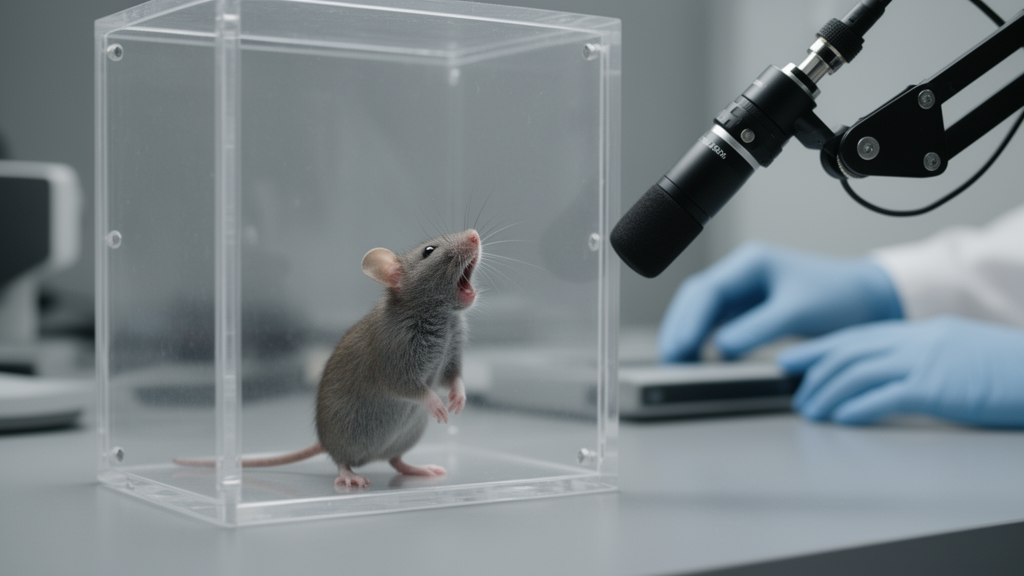
Voice disorders are among the most socially isolating consequences of dystonia, a neurological movement disorder that causes involuntary muscle contractions. In genetic forms of the disease, vocal symptoms can appear in childhood, sometimes before any limb problem is visible, and yet the brain circuits responsible have remained largely opaque. A new study from the Fralin Biomedical Research Institute at Virginia Tech Carilion School of Medicine, published in the journal Dystonia on 27 March 2026, takes a direct swing at the problem by listening to baby mice—and what the researchers heard is striking. In a cerebellum-specific mouse model of generalized dystonia, newborn pups produced dramatically fewer, simpler, and acoustically weaker ultrasonic calls than their healthy littermates, providing the first detailed spectral portrait of how a dystonic cerebellum distorts vocal-motor output.
The team, led by Meike E. van der Heijden together with first authors Austin L. Fitzgerald, Jonathan A. Coello, Alyssa M. Lyon, and Breanne L. Dao, studied mice carrying the genotype Ptf1aCre/+;Vglut2fl/fl. In these animals, a conditional genetic knockout eliminates all glutamatergic climbing-fiber signals from the inferior olive to cerebellar Purkinje cells. The consequence is that the deep cerebellar nuclei can no longer be effectively suppressed, producing a severe generalized dystonia. Crucially, the model already carries strong scientific credentials: it shows visible muscle contractions resembling those of patients (face validity), it rests on cerebellar dysfunction documented in human and rodent dystonia (construct validity), and its postural and limb symptoms improve with cerebellar deep brain stimulation, mirroring patient outcomes (predictive validity). The open question was whether this circuit lesion also touches the voice.
To find out, the researchers turned to ultrasonic vocalizations, or USVs—the high-frequency calls that mouse pups emit when separated from their mothers. Although mice do not speak, their USVs are far from random noise. Each call is a structured acoustic signal generated by precisely coordinated laryngeal and respiratory muscles, and its quality depends on intact cerebellar circuitry and audio-motor feedback loops. Across species, from songbirds to humans, the cerebellum has been increasingly implicated in pitch control, timing, and fine modulation of vocal output, suggesting these contributions are evolutionarily conserved. That makes the pup’s tiny squeaks, inaudible to human ears, a surprisingly faithful analog for the machinery of phonation.
The experimental setup was elegantly simple. Fifty pups from nine litters—23 dystonic animals and 27 healthy Vglut2fl/fl controls, both sexes represented—were individually placed in a sound-isolated Metris SmartChamber for 120 seconds at postnatal day 9 (P9), a developmental stage at which cerebellar circuits are actively maturing and pups vocalize reliably. A gold-foil electrostatic transducer digitized the sounds at 250 kilohertz, and spectrograms were analyzed with Metris Sonotrack software. Investigators were blinded to genotype, and animals producing ten or fewer calls, along with five statistical outliers, were excluded under pre-established criteria. Every call was sorted into categories—short, flat, up, down, chevron, U-shape, step, and multi-syllable complex calls—and scored for dozens of parameters spanning duration, frequency, power, and frequency modulation.
The results were unambiguous. Dystonic pups emitted significantly fewer total USVs than controls (p = 0.0005), and every syllable category, from simple one-syllable calls to elaborate five-plus-syllable sequences, was reduced in absolute number, with large effect sizes throughout. More telling was what happened to the proportions. When call counts were expressed as percentages, only the most complex category—calls with five or more syllables—shrank disproportionately (p = 0.0089). Complex calls demand precise audio-feedback modulation to assemble multiple syllables into a coherent sweep, so their selective loss points to a degraded feedback loop rather than a simple throttle on vocal effort. The team likened this to the loss of spectrally rich, harmonic vocal structure seen in human disordered phonation.
The spectral analysis went deeper, and here the translational ambition of the study becomes clear. In human voice clinics, disordered phonation is quantified with three classic metrics: jitter, the cycle-to-cycle instability of pitch; shimmer, the instability of loudness; and the harmonic-to-noise ratio, a marker of vocal clarity. Mouse USVs cannot reproduce these measures directly, but frequency modulation and acoustic power are their closest functional analogues. On precisely those parameters, the dystonic pups diverged from controls: their short calls showed significantly reduced maximum power (p = 0.0347) and reduced maximum upward frequency modulation (p = 0.0031), while their long calls showed a reduced mean rate of frequency change (p = 0.0314). Mean frequency itself was unaffected, which matters, because a mere shift in tonality is not a hallmark of laryngeal dystonia in patients—impaired pitch regulation and reduced intensity are.
Interestingly, the direction of change differed from adult human studies, which typically report increased jitter and shimmer, meaning greater instability. The authors offer a thoughtful reconciliation: adult patients have lived with longstanding disease, whereas P9 pups are caught at the very dawn of vocal development, a stage more characterized by under-activation and failure to launch complex vocal gestures than by erratic, unstable circuitry. The mouse system also captures a narrower slice of phonatory dynamics than spoken language, and the model reflects diffuse cerebellar dysfunction rather than isolated laryngeal pathology. Notably, one pediatric study found that the harmonic-to-noise ratio is the most sensitive acoustic indicator of voice disorders in children, the population this developmental timepoint most closely mirrors.
Perhaps the most conceptually rich finding came from the temporal analysis. The researchers defined vocal clusters as sequences of two or more calls in which each call began within half a second of the previous call’s end—an acoustic proxy for vocal planning, effort, and feedback-driven sequencing. The internal architecture of clusters was essentially preserved: average calls per cluster, cluster duration, and inter-call intervals were statistically indistinguishable between groups. But dystonic pups initiated far fewer clusters overall (p = 0.0001, the largest effect size in the study). In other words, the cerebellum appears essential not for fine-tuning the timing of calls within a bout, but for initiating and sustaining patterned vocal behavior itself—a dissociation that aligns with emerging human evidence that laryngeal dystonia involves abnormal neural oscillations during phonatory events and fragmented speech initiation.
The study is candid about its limits. USVs remain an indirect proxy for laryngeal biomechanics, a generalized dystonia model cannot fully recapitulate the task-specific character of human vocal dystonias, and whether these P9 deficits persist into adulthood is unknown—the authors flag longitudinal adult recordings as the critical next step. Still, the platform this creates is powerful. Because the model’s motor symptoms respond to cerebellar deep brain stimulation, the same intervention logic, along with transcranial magnetic stimulation and pharmacological approaches, could now be tested against vocal endpoints. Given that laryngeal symptoms in DYT6 (THAP1) dystonia often dominate the initial phenotype, and that current treatments such as botulinum toxin injections are temporary and variable, a preclinical model with quantifiable vocal biomarkers fills a genuine therapeutic gap.
What makes this work resonate beyond the specialty is the sheer elegance of the readout. Nobody can ask a nine-day-old mouse how its voice feels, yet a microphone and a spectrogram can detect, with large effect sizes, the fingerprint of a broken cerebellar circuit in the animal’s calls. By establishing that cerebellar dysfunction alone can produce vocal-motor abnormalities—distinct from the slurred, irregular speech of ataxic dysarthria—the study opens a circuit-level window onto one of dystonia’s most burdensome and least understood symptoms. It is a reminder that in modern neuroscience, sometimes the most revealing data are the sounds we cannot even hear.
Subject of Research: Cerebellar contributions to vocal impairment in a dystonia mouse model assessed through spectral analysis of ultrasonic vocalizations
Article Title: Assessing vocal changes through spectral analyses of vocalizations in a cerebellar-specific dystonia mouse model
Article References: Fitzgerald, A. L., Coello, J. A., Lyon, A. M., Dao, B. L., & van der Heijden, M. E. (2026). Assessing vocal changes through spectral analyses of vocalizations in a cerebellar-specific dystonia mouse model. Dystonia, 5, Article 15530. https://doi.org/10.3389/dyst.2026.15530
Image Credits: AI Generated
Keywords: dystonia, cerebellum, ultrasonic vocalizations, mouse model, laryngeal dystonia, frequency modulation, vocal-motor control, spectral analysis, deep brain stimulation, DYT6, THAP1, neurodevelopment
Cite Scienmag News
Cassandra Pierce. (October 15, 2026). Mouse Ultrasonic Calls Reveal How Cerebellar Dystonia Silences the Voice. Scienmag. https://scienmag.com/mouse-ultrasonic-calls-reveal-how-cerebellar-dystonia-silences-the-voice/
Cassandra Pierce. "Mouse Ultrasonic Calls Reveal How Cerebellar Dystonia Silences the Voice." Scienmag, 15 October 2026, https://scienmag.com/mouse-ultrasonic-calls-reveal-how-cerebellar-dystonia-silences-the-voice/. Accessed 15 October 2026.
Cassandra Pierce. "Mouse Ultrasonic Calls Reveal How Cerebellar Dystonia Silences the Voice." Scienmag. October 15, 2026. https://scienmag.com/mouse-ultrasonic-calls-reveal-how-cerebellar-dystonia-silences-the-voice/


