


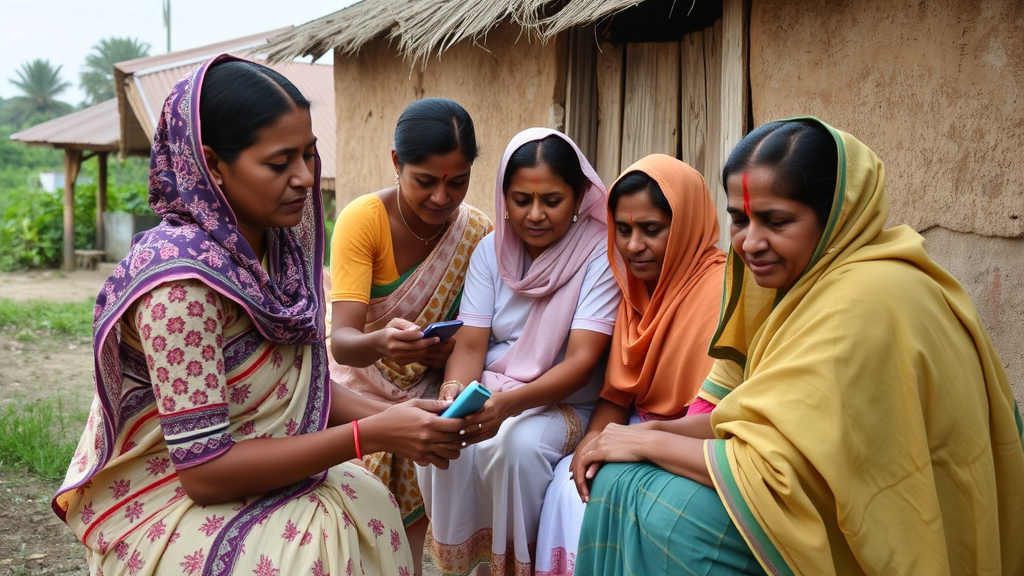
In the rolling hills of Meghalaya, one of India’s northeastern states, a quiet experiment in community-led health governance is underway, and a new study offers one of the most detailed assessments yet of whether it is actually working. Village Health Councils, known as VHCs, were designed to serve as a bridge between the formal state health system and the villagers they are meant to serve. A research team spanning the All India Institute of Medical Sciences in New Delhi, the Indian Institute of Public Health Shillong, the Public Health Foundation of India, and the Johns Hopkins Bloomberg School of Public Health set out to answer a deceptively simple question: do these councils actually advance health equity, or do they exist mainly on paper? Their findings, published in the International Journal for Equity in Health, reveal a picture of genuine promise shadowed by persistent structural constraints.
The stakes of this question extend far beyond a single district. Despite global commitments to Universal Health Coverage, an estimated 4.5 billion people worldwide still lack adequate health coverage, a figure that underscores how far the world remains from the ambitious targets set under the United Nations Sustainable Development Goals. India’s own Universal Health Coverage index stands at just 43.9 percent, with deep disparities between districts, states, and socioeconomic groups. Researchers have long argued that policy commitments alone cannot translate into better health outcomes without meaningful community engagement, particularly in rural and remote areas where the nearest functioning health facility may be hours away and where trust in formal institutions is unevenly distributed.
Meghalaya offers a distinctive setting for studying this problem. The state, predominantly rural and home to numerous Indigenous communities with strong traditions of local self-governance, has embedded Village Health Councils into its health system architecture as institutional links between communities and public health services. To understand how these councils operate in practice, the research team conducted a qualitative study across nine villages and seven health centres in three blocks of West Garo Hills District. The villages and centres were purposively selected by the district health team, a sampling strategy intended to capture the range of conditions under which VHCs function rather than to produce statistically representative estimates.
The methodology was rigorous and multi-layered. The team carried out 13 in-depth interviews and 9 focus group discussions, engaging a total of 85 participants. These included VHC members themselves, ordinary community members, and frontline health workers, allowing the researchers to triangulate perspectives across the different actors whose interactions determine whether community engagement succeeds or stalls. All sessions were audio recorded and transcribed, and the researchers applied thematic analysis to identify codes, subcategories, and emerging themes. Crucially, they also analysed their data through the lens of the Assessing Community Engagement Conceptual Model, a framework that allows researchers to evaluate the depth and quality of community participation in health systems rather than simply noting its presence or absence.
The findings on the positive side are striking. The study found that VHCs have real potential to advance health equity through several distinct mechanisms. First, the councils foster community mobilization and build trust, two ingredients that health systems researchers consistently identify as prerequisites for marginalized populations to seek care. Second, VHCs maintain strong linkages with frontline health workers, creating channels through which information, referrals, and accountability can flow in both directions. Third, the councils cultivate a shared sense of responsibility toward community members, embedding health within existing social networks rather than treating it as an external service delivered from above. Finally, VHC members are actively involved in community health education, spreading awareness about preventive practices, immunization, maternal health, and the services to which villagers are entitled.
These mechanisms matter because health equity is not produced by clinics alone. A well-stocked primary health centre achieves little for a woman who does not know she is entitled to antenatal care, or for a family that distrusts the medical establishment, or for a household that cannot navigate the bureaucratic steps required to access benefits. By anchoring health system outreach in local institutions composed of villagers themselves, VHCs address the demand side of the equity equation. When councils mobilize communities and vouch for health services, they effectively lower the social and informational barriers that keep the most vulnerable from using care that technically exists for everyone. In theory and increasingly in practice, this is what community engagement for equity looks like on the ground.
Yet the study is equally clear about the constraints, and these are where the findings become most useful for policymakers. The effectiveness of VHCs remains limited by unclear member roles, with many council members uncertain about what their responsibilities actually entail. Capacity gaps compound this problem: members often lack the training needed to plan activities, manage resources, or advocate effectively with health authorities. Coordination between VHCs and AAMs, the Accredited Social Health Activists and allied community structures, is weak, producing duplication in some areas and gaps in others. Perhaps most tellingly, unmet expectations at health facilities erode the credibility that councils work so hard to build. When a VHC encourages a villager to seek care and that villager encounters absent staff, stockouts, or disrespectful treatment, the council’s social capital takes the damage.
One dependency stands out as particularly consequential. The researchers found that most VHCs cannot yet function independently and rely heavily on the ASHA worker, the accredited social health activist who serves as India’s frontline community health worker, for their basic operation. This dependence creates a paradox: the very institution designed to give communities an independent collective voice is, in many villages, effectively an extension of a single overburdened health worker. ASHAs are themselves often underpaid and stretched thin, so a governance structure that leans on them for convening, record-keeping, and liaison with the health system is building on a fragile foundation. Until councils develop their own organizational capacity, their contribution to equity will remain tethered to the bandwidth of one person per village.
The authors’ conclusion is measured but hopeful. VHCs, they write, have the potential to contribute to health equity in rural Meghalaya if they are supported by role clarity, capacity building, and sustained handholding. That final phrase is important. The study suggests these institutions are not failures to be abandoned nor successes to be celebrated uncritically, but young organizations in need of deliberate nurturing. Clear job descriptions, structured training programmes, and ongoing mentorship from health officials could convert latent potential into consistent performance. Conversely, leaving councils to sink or swim on their own risks reproducing the very inequities they were created to combat, since villages with stronger social cohesion and more educated members will thrive while others fall further behind.
The implications reach well beyond Meghalaya. As countries worldwide pursue Universal Health Coverage, community engagement structures of various kinds, from village health committees in Africa to ward health committees in South Asia, have become standard features of health system reform. Yet evidence on whether these bodies actually shift equity outcomes has been mixed, and the Meghalaya study adds valuable nuance by specifying the conditions under which engagement works. Trust, connection to frontline workers, shared responsibility, and health education emerge as the active ingredients, while role ambiguity, capacity deficits, and poor coordination act as brakes. For the 4.5 billion people still waiting for adequate coverage, the lesson is that participation cannot simply be decreed; it must be resourced, trained, and sustained. The hills of Garo may thus offer a lesson in humility and in hope for health systems everywhere.
Subject of Research: The role of Village Health Councils in advancing health equity in rural Meghalaya, India
Article Title: Are village health councils advancing health equity? A case from the northeastern region of India
Article References: Verma, P., Nongrum, M. S., Pathak, A., Dhaliwal, B. K., Na, Y., Jamir, T., Bairwa, M., Rao, K. D., Closser, S., & Albert, S. (2026). Are village health councils advancing health equity? A case from the northeastern region of India. International Journal for Equity in Health. https://doi.org/10.1186/s12939-026-02969-x
Image Credits: AI Generated
DOI: 10.1186/s12939-026-02969-x
Keywords: health equity, universal health coverage, community engagement, village health councils, Meghalaya, India, primary health care, ASHA workers, qualitative research, health systems, rural health, public health
Cite Scienmag News
Phoebe Ingram. (September 26, 2026). Village Health Councils in Rural India Show Promise for Health Equity, Study Finds. Scienmag. https://scienmag.com/village-health-councils-in-rural-india-show-promise-for-health-equity-study-finds/
Phoebe Ingram. "Village Health Councils in Rural India Show Promise for Health Equity, Study Finds." Scienmag, 26 September 2026, https://scienmag.com/village-health-councils-in-rural-india-show-promise-for-health-equity-study-finds/. Accessed 4 October 2026.
Phoebe Ingram. "Village Health Councils in Rural India Show Promise for Health Equity, Study Finds." Scienmag. September 26, 2026. https://scienmag.com/village-health-councils-in-rural-india-show-promise-for-health-equity-study-finds/


