


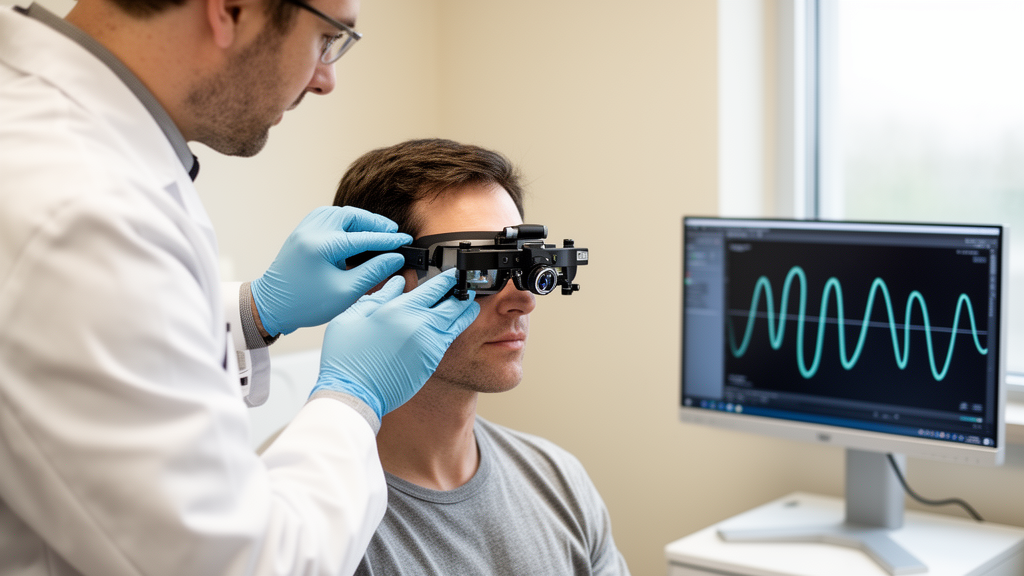
For decades, patients born with congenital nystagmus (CN) — a rhythmic, involuntary oscillation of the eyes that appears in infancy — have been among the most difficult people in whom to study the vestibular system. The constant eye movement that defines the condition masks the very signals clinicians rely on to probe the inner ear, and the semicircular canals (SCCs), the fluid-filled structures that sense head rotation, have been particularly resistant to conventional testing. Now, a long-term case report from a Madrid ear and vertigo unit, published in Frontiers in Audiology and Otology, shows that two modern tools — the video head impulse test (vHIT) and videonystagmoscopy (VNS) — can cut through that noise and reveal previously hidden vestibular dysfunction in a patient with CN and vertigo.
The report, authored by Antonio Denia-Lafuente and Belén Lombardero of the Unidad de Oído y Vértigo at Hospital Universitario Nuestra Señora del Rosario, follows a 56-year-old woman with a lifelong history of CN, migraine, and episodic vertigo across five years of clinical visits. The patient arrived at the emergency department after three days of severe headache followed by vertigo, persistent imbalance, nausea, and bilateral tinnitus that was more pronounced in the left ear, without hearing loss. A neurological workup, including brain computed tomography, revealed spontaneous left-beating nystagmus and findings consistent with episodic migraine. She received vestibular sedatives and rizatriptan benzoate and was referred for further evaluation.
Her history was striking. She had experienced episodes of vertigo lasting two to three days for approximately 27 years, sometimes while in bed, and tinnitus in the left ear for the previous three years. Since reaching menopause, these episodes had been associated with migraines, sometimes preceding them, with photophobia and phonophobia, and occasionally antedated by bilateral ear pressure and tinnitus, especially in the left ear. She described fluctuating, non-permanent hearing loss, frequent spatial disorientation in open spaces, and a history of childhood strabismus. Her Dizziness Handicap Inventory (DHI) score of 60 indicated a substantial impact on daily life.
Clinical and videonystagmography examination using an Interacoustics VN415 system revealed a high-frequency, horizontal, jerk, left-beating nystagmus in primary gaze, which intensified in left gaze and changed direction, decreasing in right gaze. The CN limited standard vestibular assessment, including observation of spontaneous nystagmus, head shaking, vibration-induced nystagmus, and head impulse tests, as well as videonystagmography. Despite this, the right Dix-Hallpike test with VNS elicited, after two to three seconds, intense mixed upbeat and right-torsional nystagmus lasting about 18 seconds with severe vertigo. The patient was diagnosed with CN, vestibular migraine, and right posterior canalolithiasis benign paroxysmal positional vertigo (BPPV) — a diagnosis of BPPV in a patient with CN that the authors report for the first time.
The technical heart of the report lies in the vHIT recordings. The video head impulse test measures the vestibulo-ocular reflex (VOR), the rapid eye movement that stabilizes gaze when the head turns, by tracking eye motion during brief, passive head rotations at high frequencies. Each of the six SCCs can be probed individually. In this patient, the CN waveform conditioned the recorded lateral VOR eye movements: with spontaneous nystagmus suppression disabled, the system registered a low acceptance rate and frequent rejections, so results were reported with suppression enabled, showing a normal acceptance and rejection rate. Lateral HIMP revealed reduced gain values and impaired bilateral horizontal VOR generation, while vertical canal VOR gains remained normal for each SCC, without refixation saccades.
Perhaps the most intriguing finding was the spectrum of compensatory saccades — rapid corrective eye movements that substitute for a deficient VOR — observed during passive head impulses. These included very early saccades with near-zero latency or occurring at the onset of head acceleration, early covert saccades during head acceleration, and covert saccades occurring during the deceleration phase of the impulse, at approximately 100 to 140 milliseconds. These responses were predominantly rightward and frequently exhibited a double-peaked saccadic pattern. To the authors’ knowledge, very early saccades during passive head impulses have not been specifically characterized in the literature, and only a few studies have reported early saccades in vestibular lesions under these conditions.
The authors believe that repeated use of the passive HIMP protocol trained this patient to detect and reduce retinal slip errors by gradually increasing the number of saccades, adjusting their latency during the deceleration phase, and improving gaze stability and functional recovery. Over the five-year follow-up, the saccadic response shifted from a dispersed pattern to a clustered organization of covert saccades, compatible with compensated vestibular deficits, with consistently low gains. The authors suggest that congenital nystagmus does not interfere with vertical VOR function, allowing normal and abnormal vestibular response patterns to be observed, which they emphasize as important for routine study.
The SHIMP protocol — the suppression head impulse test, which removes compensatory saccades and generates anticompensatory saccades instead — proved essential for accurate interpretation. SHIMP VOR gains were comparable on both sides at two visits but remained below HIMP values, and saccade analysis showed low bilateral anticompensatory amplitudes, greater to the left, with 5 percent rightward covert compensatory saccades at three months that were absent at two years nine months. The presence of SHIMP anticompensatory saccades in a difficult-to-assess lateral VOR can be a very useful sign of vestibular function, and anticompensatory saccade generation through training can promote vestibular compensation and functional recovery.
Functionally, the patient’s trajectory was one of gradual improvement. At three months, positional tests were normal; at two years nine months, they revealed left posterior canalolithiasis, which was resolved with an Epley maneuver after a mild COVID-19 infection. At four years three months, after another mild COVID-19 infection, a right Dix-Hallpike test revealed posterior canalolithiasis, again resolved with an Epley maneuver. At four years six months, her symptoms had improved, with a DHI score of 30. At four years eight months, she reported being satisfied using both pairs of glasses, with a DHI score of 28 and a Visual Function Questionnaire (VFQ-25) score of 91 percent. At five years, she reported better global steadiness, no vertigo, greater visual stability, and fewer headaches, with a DHI score of 20.
From the patient’s perspective, at two years nine months she reported that before coming to the office, she missed work at least twice a month on days when she had disabling vertigo and that, after treatment, she has not missed work again. At four years eight months and at five years, progressive improvement persisted, with a marked reduction in vertigo and greater visual stability, which contributed to improved balance and well-being. The authors conclude that vestibular function assessment in CN and vertigo using vHIT and VNS enables accurate diagnosis and successful management of the most common vertigo syndromes, and they recommend an updated binocular vision study in these patients. The findings support the value of vHIT and videonystagmoscopy, providing new perspectives for assessing and managing the most frequent vertigo syndromes in CN and vertigo.
Subject of Research: Vestibular function assessment with vHIT and videonystagmoscopy in congenital nystagmus and vertigo
Article Title: Vestibular function assessment using the video head impulse test and videonystagmoscopy in congenital nystagmus and vertigo: a long-term case report
Article References: Denia-Lafuente, A., & Lombardero, B. (2026). Vestibular function assessment using the video head impulse test and videonystagmoscopy in congenital nystagmus and vertigo: a long-term case report. Frontiers in Audiology and Otology, 4, Article 1917636. https://doi.org/10.3389/fauot.2026.1917636
Image Credits: AI Generated
DOI: 10.3389/fauot.2026.1917636
Keywords: congenital nystagmus, vertigo, video head impulse test, videonystagmoscopy, semicircular canals, vestibulo-ocular reflex, BPPV, vestibular migraine, saccades, vestibular rehabilitation, case report, Dix-Hallpike test
Cite Scienmag News
Ophelia Keating. (October 17, 2026). Video Head Impulse Test Reveals Hidden Vestibular Clues in Congenital Nystagmus. Scienmag. https://scienmag.com/video-head-impulse-test-reveals-hidden-vestibular-clues-in-congenital-nystagmus/
Ophelia Keating. "Video Head Impulse Test Reveals Hidden Vestibular Clues in Congenital Nystagmus." Scienmag, 17 October 2026, https://scienmag.com/video-head-impulse-test-reveals-hidden-vestibular-clues-in-congenital-nystagmus/. Accessed 17 October 2026.
Ophelia Keating. "Video Head Impulse Test Reveals Hidden Vestibular Clues in Congenital Nystagmus." Scienmag. October 17, 2026. https://scienmag.com/video-head-impulse-test-reveals-hidden-vestibular-clues-in-congenital-nystagmus/


