


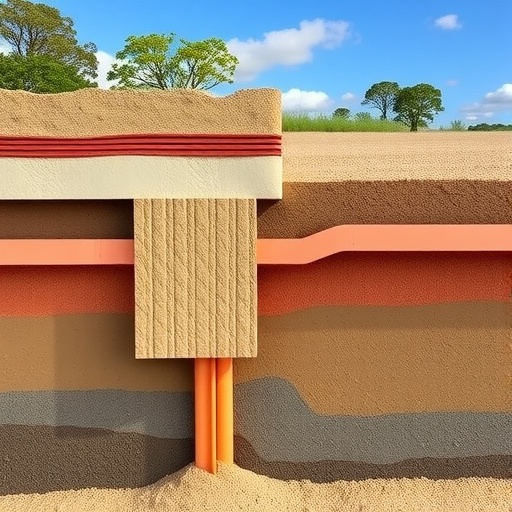
In the intricate world of geotechnical engineering, understanding the long-term behavior of soils presents challenges, especially in subsidence areas related to closed coal mines. A recent study sheds light on the vertical consolidation characteristics of heterogeneous and unsaturated soils in these regions, which are often overlooked. Researchers have documented the pressing need to investigate how these unique soil compositions respond to the complex interactions of their environment over extended periods.
The focus of this investigation is on the vertical consolidation behavior, a critical aspect that engineers must consider when evaluating land stability. Vertical consolidation refers to the gradual reduction of soil volume under compressive stress, a process fundamentally driven by the expulsion of pore water from the soil matrix. This is particularly pertinent in areas where mining activities have led to significant subsidence. Understanding the mechanics of this behavior can provide invaluable insights for land rehabilitation and infrastructure planning in former mining areas.
The researchers employed rigorous experimental methodologies to analyze soil samples taken from various coal mine subsidence zones. Their approach combined field observations with laboratory tests to create a comprehensive understanding of how different soil types behave under similar conditions. The study highlights that variability in soil composition can greatly influence consolidation rates, leading to significant deviations in expected outcomes if not considered during planning and rehabilitation efforts.
Heterogeneous soils, which consist of varying particle sizes and compositions, were particularly emphasized in the study. These soil types are prone to complex interactions that can complicate traditional consolidation predictions. For instance, finer particles may retain water more effectively, impacting the overall compressibility of the soil mass. Conversely, coarser particles may allow more rapid drainage, thereby altering the stress distribution patterns within the soil structure over time.
Additionally, the phenomenon of soil unsaturation was explored in depth. Unsaturated soils behave uniquely when subjected to load; they can exhibit both effective and total stress changes depending on moisture content. As water is gradually expelled, the soil can undergo significant changes in its shear strength and compressibility, factors that are key to understanding settlement characteristics in these problematic zones. This study takes a closer look at the relationship between moisture content and consolidation behavior under varying load conditions.
The implications of these findings extend beyond academic curiosity; they have practical ramifications for civil engineering and environmental management in post-mining landscapes. With mining operations leaving behind a legacy of unstable terrains, engineers must develop innovative solutions to address potential hazards. The insights from this research could aid in creating models that predict long-term soil behavior, helping to mitigate risks in construction and land use planning.
Moreover, the researchers drew connections between the consolidation behavior of these soils and the broader environmental impacts of closed coal mines. The ecological recovery of these areas is imperative, not only for restoring biodiversity but also for ensuring that the land can safely support agricultural or urban development in the future. This places added importance on understanding soil behaviors over time, particularly in relation to moisture dynamics and vegetation regrowth.
Significantly, the study raises awareness about the lack of existing comprehensive data on long-term soil responses in these unique environments. The researchers call for further explorations to develop standardized practices for assessing soil stability in post-mining landscapes. They advocate for a collaborative approach, merging soil science with engineering disciplines to foster solutions that are both scientifically sound and practically applicable.
The investigation’s outcomes suggest that more refined analytical tools are necessary to accurately characterize the behavior of unsaturated, heterogeneous soils. Current models fail to capture the nuanced responses of these soil types, adding layers of complexity to predict land stability accurately. Enhanced predictive capabilities will be crucial in crafting regulations and guidelines that effectively manage the rehabilitation of former mining sites.
In conclusion, the study conducted by Li et al. marks a significant stride in our understanding of soil behavior in closed coal mine subsidence areas. The nuances of soil consolidation, interlinked with varying environmental factors, stress the need for continuous research in this domain. These findings not only enrich the field of geotechnical engineering but also serve to inform strategies aimed at environmental restoration. As closed coal mines transition into new phases, the knowledge derived from this research must guide careful planning and innovative engineering practices.
The landscape of former coal mining sites is rife with challenges that necessitate a nuanced understanding of soil behavior. The insights gained from this study underscore the critical nature of interdisciplinary research in tackling these issues head-on. The evolving story of these once-active industrial sites is just beginning, and ongoing research will be vital in unlocking their potential for future use.
Li, Y., Ding, Z., Li, J. et al. Long-Term Vertical Consolidation Behavior of Heterogeneous and Unsaturated Soils in Subsidence Areas of Closed Coal Mines.
Nat Resour Res (2026). https://doi.org/10.1007/s11053-025-10624-5
Cite Scienmag News
Violet Maxwell. (January 9, 2026). Vertical Consolidation in Unsaturated Soils of Mine Subsidence. Scienmag. https://scienmag.com/vertical-consolidation-in-unsaturated-soils-of-mine-subsidence/
Violet Maxwell. "Vertical Consolidation in Unsaturated Soils of Mine Subsidence." Scienmag, 9 January 2026, https://scienmag.com/vertical-consolidation-in-unsaturated-soils-of-mine-subsidence/. Accessed 4 September 2026.
Violet Maxwell. "Vertical Consolidation in Unsaturated Soils of Mine Subsidence." Scienmag. January 9, 2026. https://scienmag.com/vertical-consolidation-in-unsaturated-soils-of-mine-subsidence/


