


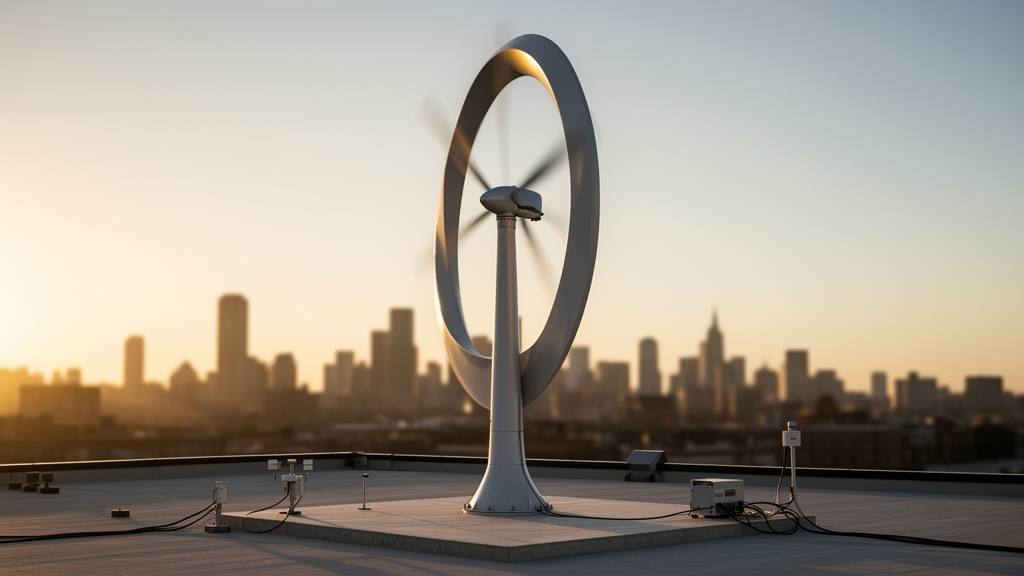
Vertical-axis wind turbines have long been promoted as a quieter, more compact alternative to the familiar propeller-style machines that dominate wind farms, but a new critical review argues that the field has been optimizing the wrong things in the wrong order. Writing in Frontiers in Mechanical Engineering, a team of researchers from Saudi Arabia, Pakistan and Canada concludes that aerodynamic performance, structural loading and noise in these turbines are governed by the same unsteady flow physics, and that treating them as separate design problems has produced designs that look excellent on paper yet may be unsuitable for the urban and offshore settings where they are most needed.
The review, led by Asad A. Zaidi and Sohaib Z. Khan of the Islamic University of Madinah, is a structured critical assessment of peer-reviewed literature published mainly between 2020 and 2026, with earlier foundational studies included where technically relevant. The authors screened studies from Scopus, Web of Science and publisher databases, deliberately combining search terms such as dynamic stall, flow control, aeroacoustics and multi-objective optimization to find work that connected two or more themes rather than summarizing each field in isolation. Quantitative values were retained only when they could be traced to the original article or publisher record, and greater weight was given to experimental studies and numerically validated work.
At the heart of the review is a phenomenon called dynamic stall, which dominates the behavior of lift-driven Darrieus-type vertical-axis turbines. Unlike a fixed aircraft wing, a blade on these rotors sees its effective angle of attack and relative wind speed change continuously as it sweeps around the circle. At low and intermediate tip-speed ratios, the instantaneous angle of attack can exceed the static stall limit, triggering leading-edge separation, the growth of a dynamic stall vortex, violent vortex shedding and eventual flow reattachment. The review emphasizes that this process should not always be treated purely as a loss mechanism. Experimental work cited in the review distinguished deep-, light- and no-stall regimes and found that the light-stall condition reduced load transients by roughly 75 percent compared with deep stall while still producing favorable torque. In other words, carefully timed and controlled vortex development can be a torque-producing asset rather than a defect to be eliminated.
The same unsteady flow structures that determine power extraction also generate noise. Fluctuating blade loading, separated flow, vortex shedding and blades slicing through the wakes of their neighbors all produce time-varying surface pressures that radiate sound. High-fidelity simulations reviewed in the paper, using delayed detached-eddy simulation and the Ffowcs Williams-Hawkings acoustic analogy, identified dipole-type loading noise as the dominant mechanism, with leading-edge noise closely tied to variations in effective angle of attack and blade-vortex interaction. Thickness and loading noise dominated in other studies, while quadrupole contributions grew with Mach number. The practical consequence is that a rotor running at a lower tip-speed ratio may suffer stronger impulsive stall-driven load swings, while one running faster generates more blade-passing noise and higher loading, so the quietest operating point is not necessarily the one that produces the most power.
Geometry choices made for aerodynamic reasons can carry hidden acoustic costs. One study using improved delayed detached-eddy simulation found that increasing rotor solidity, a parameter often tuned to improve starting behavior and torque smoothness, raised the sound pressure level at the blade-passing frequency. A wind-lens augmentation study reported a striking 82 percent increase in the power coefficient at a tip-speed ratio of 2.75, but the shrouded rotor also produced stronger impulsive loading noise than the bare turbine. Conversely, some modifications deliver genuine double wins: trailing-edge serrations tested on a wind-turbine-relevant airfoil improved lift-to-drag ratio, delayed stall and cut broadband noise by up to 5 decibels at Reynolds numbers above roughly 2 times 10 to the fifth, and a streamtube model predicted about a 10 percent increase in peak power coefficient near a tip-speed ratio of 3. The authors caution, however, that the noise was measured on an airfoil while rotor power was estimated, so full-rotor validation is still needed.
Active flow control shows even larger potential gains, along with subtler pitfalls. Optimized individual blade pitching, demonstrated experimentally with a genetic algorithm, produced roughly a three-fold increase in the power coefficient while cutting structure-threatening load fluctuations by up to 77 percent under off-design conditions. A combined blowing-and-suction strategy, optimized with an orthogonal design procedure and coupled to acoustic prediction, eliminated negative torque, reduced alternating loads and lowered predicted noise by up to 6.56 decibels in the 100 to 1,000 hertz range. But the review also highlights a synthetic-jet study in which peak power coefficient rose about 43 percent when actuator energy was ignored, yet the net power gain fell to about 17 percent once the piezoelectric actuators’ consumption was included. Gross aerodynamic improvement, the authors argue, is not the right metric for judging active control.
Perhaps the most consequential warning concerns how noise is measured and reported. Several reviewed studies found that a reduction in overall sound pressure level can conceal frequency-dependent or directional penalties. One machine-learning-assisted optimization of interacting Darrieus turbines produced a configuration that generated stronger low-frequency noise while its comparison design was louder above roughly 100 hertz. Another meta-model-based optimization reduced upstream noise but increased it downstream. Because blade-passing frequency has been identified experimentally as a major contributor to low-frequency noise from small urban turbines, and because that contribution grows with wind speed, a design that wins on a single overall noise number may still be undesirable next to homes. The review concludes that acoustic objectives must include spectral content and directivity, not just an overall level.
Numerical methodology adds its own uncertainty. One study of a 5-kilowatt turbine found that changing the turbulence model altered predicted torque by about 10 percent and predicted tip noise by roughly 2 decibels, a difference comparable to the acoustic improvements some optimizations claim. The authors stress that grid and time-step convergence based only on the power coefficient is insufficient for aeroacoustic work, because far-field noise predictions depend on the time-resolved surface-pressure field, which can appear converged while small-scale pressure fluctuations remain under-resolved. Low-fidelity actuator-cylinder acoustic models agreed reasonably with high-fidelity simulations at about 20 to 100 hertz but deteriorated at higher frequencies where airfoil self-noise matters, supporting a multi-fidelity workflow in which cheap models screen the design space and expensive simulations refine the finalists.
Data-driven methods are making coupled optimization feasible for the first time. Artificial neural networks trained on large-eddy simulation data for dual Savonius turbines achieved coefficients of determination of 0.995 for power and 0.971 for overall sound pressure level, and the selected design increased average power coefficient by up to 57.5 percent while reducing overall sound pressure level by about 5.2 percent. A meta-model combining validated simulations, an improved radial-basis-function surrogate, adaptive sampling and the NSGA-II algorithm achieved a maximum 22 percent power increase at a tip-speed ratio of 3.2 while attenuating higher-order tonal components. Yet the review cautions that high accuracy within a sampled design space does not guarantee generalization across Reynolds number, turbulence intensity or rotor scale, and that uncertainty in the underlying training data is rarely propagated through the optimization.
The review’s central proposal is a shift from power-only optimization toward simultaneous treatment of power, acoustic emission and fatigue-relevant cyclic loading, evaluated over a realistic operating envelope rather than a single design point, and supported by a multi-fidelity, physics-assisted, data-driven framework. It also identifies persistent gaps: synchronized experiments that measure flow structures, aerodynamic loads and acoustic radiation at the same time remain scarce; the contribution of structural vibration to radiated noise is largely unstudied; and no mature framework yet couples aerodynamic power, noise and fatigue-relevant loading in one optimization. Until those pieces come together, the authors argue, claims that vertical-axis turbines are inherently quiet or inherently optimal for cities rest on incomplete evidence, and the next generation of designs should be judged by how they manage the same vortices that make their power, their loads and their sound.
Subject of Research: Aerodynamic-aeroacoustic co-design and multi-objective optimization of vertical-axis wind turbines
Article Title: Aerodynamic-aeroacoustic co-design and multi-objective optimization of vertical-axis wind turbines: a critical review of dynamic stall, flow control, and data-driven methods
Article References: Zaidi, A. A., Asif, M., Jilani, A., Zaidi, A. A., & Khan, S. Z. (2026). Aerodynamic-aeroacoustic co-design and multi-objective optimization of vertical-axis wind turbines: a critical review of dynamic stall, flow control, and data-driven methods. Frontiers in Mechanical Engineering, 12, Article 2015276. https://doi.org/10.3389/fmech.2026.2015276
Image Credits: AI Generated
DOI: 10.3389/fmech.2026.2015276
Keywords: vertical-axis wind turbines, dynamic stall, aeroacoustics, flow control, multi-objective optimization, machine learning, surrogate modeling, computational fluid dynamics, blade-wake interaction, urban wind energy, noise reduction, fatigue loading
Cite Scienmag News
Audrey Campbell. (October 26, 2026). Vertical-Axis Wind Turbines Need Power, Noise and Load Designed Together, Review Finds. Scienmag. https://scienmag.com/vertical-axis-wind-turbines-need-power-noise-and-load-designed-together-review-finds/
Audrey Campbell. "Vertical-Axis Wind Turbines Need Power, Noise and Load Designed Together, Review Finds." Scienmag, 26 October 2026, https://scienmag.com/vertical-axis-wind-turbines-need-power-noise-and-load-designed-together-review-finds/. Accessed 26 October 2026.
Audrey Campbell. "Vertical-Axis Wind Turbines Need Power, Noise and Load Designed Together, Review Finds." Scienmag. October 26, 2026. https://scienmag.com/vertical-axis-wind-turbines-need-power-noise-and-load-designed-together-review-finds/


