

Tuesday, October 27, 2026
Science
No Result
View All Result
  • Login
  • HOME
  • SCIENCE NEWS
  • CONTACT US
  • HOME
  • SCIENCE NEWS
  • CONTACT US
No Result
View All Result
Scienmag
No Result
View All Result
Home Science News Biology

Vampire moths: a lifetime of night observations reveals how Calyptra drinks blood

October 27, 2026
in Biology
Gavin Prescott
By Gavin Prescott Scienmag Editorial Profile - Ecology and Ecosystem Dynamics
Reading Time: 3 mins read
0
Vampire moths: a lifetime of night observations reveals how Calyptra drinks blood

Vampire moths: a lifetime of night observations reveals how Calyptra drinks blood

65
SHARES
587
VIEWS
Share on FacebookShare on Twitter
ADVERTISEMENT

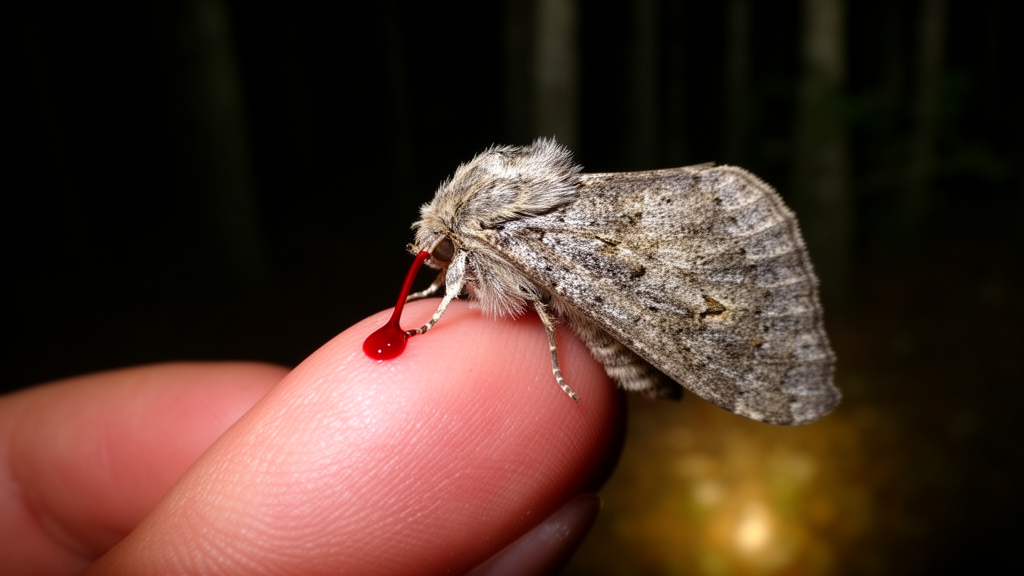
Some moths do more than sip nectar. Among the roughly 17 currently recognized species of the genus Calyptra (Erebidae) in Asia, eight are known to pierce the skin of mammals, including humans, with a specialized proboscis and drink fresh blood. A newly published book by Swiss entomologist Hans Bänziger, who has lived in Thailand and studied these insects in the wild since 1967, now summarizes decades of fieldwork on their behaviour, ecology and taxonomy.

The 232-page hardbound volume, published by Natural History Publications (Borneo) in Kota Kinabalu, Malaysia, is largely built on the author’s own observations across 545 nights in Papua New Guinea, West Malaysia, Thailand, Laos, Sri Lanka, India and Nepal. It is richly illustrated with 263 colour photographs, one black-and-white photo and 114 black-and-white drawings and diagrams, many of the images captured with analogue cameras, in some cases more than 30 years ago.

The book opens with three chapters describing how the author came to work in the region, his wide-ranging entomological activities and his field methods, interspersed with anecdotes. Bänziger, described in the publisher’s review as a field entomologist who spent countless hours alone at night watching tear-sucking and fruit-piercing moths, also studied caterpillars, tear-drinking bees and the pollinators of Paphiopedilum slipper orchids and flowers of Aristolochia, Rafflesia and Rhizanthes.

A substantial taxonomic section treats Calyptra and its close relatives, including an identification key to all species and subspecies, one lectotype designation, one generic synonymy and the reinstatement of two subspecies. Four tables supply additional morphological characters and measurements, and each taxon is presented in detail with lists of examined specimens, illustrations of male genitalia, photographs of adults and larvae, notes on their inconspicuous and often scarce food plants, and information on seasonality and habitat preferences.

The largest part of the book documents how and on what these moths feed, based on observations in the wild and in local zoos and enclosures for domestic animals. The specialized mechanism of skin-piercing by the modified proboscis is explained and illustrated, along with the proposed evolutionary pathway from fruit-piercing and sap-sucking to skin-piercing and blood-drinking. In every case where a human was the victim, that human was the author himself.

One of the book’s surprising findings concerns sex differences: only male Calyptra moths feed on blood, and, as the review notes, not for the reason that might seem most likely. Another notable argument concerns Calyptra thalictri, the only species of the genus occurring in Europe. The book presents the case that this species is not naturally haematophagous, although it may draw mammal blood under constrained conditions.

The volume closes with a topic that places these so-called vampire moths in a current spotlight: the potential transmission of pathogens. According to the review, such transmission is considered unlikely and remains unproven, so the book treats the question as an open one rather than a demonstrated risk.

Written in English and priced at 50 US dollars from the author or 250 Malaysian ringgit from the publisher, the book is recommended for lepidopterists and for entomologists, biologists, ecologists, veterinarians and medical doctors interested in exotic species and unusual animal behaviour. For anyone curious about how a lineage of moths moved from piercing fruit to piercing skin, it offers a rare, decades-deep record of direct field observation.

Subject of Research: Behaviour, ecology and taxonomy of the blood-sucking moth genus Calyptra

Article Title: Bänziger H (2021) Vampire moths. Behaviour, ecology and taxonomy of blood-sucking Calyptra .

Article References: Schwendinger, P. J., & Landry, B. (2021). Bänziger H (2021) Vampire moths. Behaviour, ecology and taxonomy of blood-sucking Calyptra.. Alpine Entomology, 5, 115-116. https://doi.org/10.3897/alpento.5.76016

Image Credits: AI Generated

DOI: 10.3897/alpento.5.76016

Keywords: Calyptra, vampire moths, Lepidoptera, Erebidae, haematophagy, proboscis, taxonomy, field entomology, Southeast Asia, book review, pathogen transmission, Calyptra thalictri

Cite Scienmag News

Gavin Prescott. (October 27, 2026). Vampire moths: a lifetime of night observations reveals how Calyptra drinks blood. Scienmag. https://scienmag.com/vampire-moths-a-lifetime-of-night-observations-reveals-how-calyptra-drinks-blood/


Gavin Prescott. "Vampire moths: a lifetime of night observations reveals how Calyptra drinks blood." Scienmag, 27 October 2026, https://scienmag.com/vampire-moths-a-lifetime-of-night-observations-reveals-how-calyptra-drinks-blood/. Accessed 27 October 2026.

Gavin Prescott. "Vampire moths: a lifetime of night observations reveals how Calyptra drinks blood." Scienmag. October 27, 2026. https://scienmag.com/vampire-moths-a-lifetime-of-night-observations-reveals-how-calyptra-drinks-blood/

Tags: Asian moth biodiversityblood-drinking mothsbook reviewCalyptraCalyptra genus behaviorCalyptra thalictrientomologist Hans Bänziger's researchentomology fieldwork in Southeast AsiaErebidaefield entomologyhaematophagyinsect feeding behaviors on mammalsLepidopteralong-term field study of mothsmoth feeding mechanisms and proboscis adaptationmoth species taxonomy and ecologynight-time insect research methodsnocturnal moth observationspathogen transmissionproboscisSoutheast Asiataxonomyvampire mothsvampire moths in Asia
Share26Tweet16
Previous Post

Receptor promiscuity in bat sarbecoviruses exposes conserved spike targets

Next Post

Scoping review finds REDs guidelines still inconsistently applied in sports research

Related Posts

Single Dose of Simparica Trio Clears Heartworm Microfilariae in Dogs for a Month
Biology

Single Dose of Simparica Trio Clears Heartworm Microfilariae in Dogs for a Month

October 27, 2026
Golgi protein GOLGA7 found to govern reticulocyte CD71 clearance and recovery from hemolytic stress in mice
Biology

Golgi protein GOLGA7 found to govern reticulocyte CD71 clearance and recovery from hemolytic stress in mice

October 27, 2026
Remembering Willi Sauter, One of Europe’s Most Universal Entomologists
Biology

Remembering Willi Sauter, One of Europe’s Most Universal Entomologists

October 27, 2026
African Nations Chart a Path to Sustain HPV Vaccination Beyond Donor Funding
Medicine

African Nations Chart a Path to Sustain HPV Vaccination Beyond Donor Funding

October 27, 2026
Loggerhead turtle scute patterns shaped by genes and nest temperature
Biology

Loggerhead turtle scute patterns shaped by genes and nest temperature

October 27, 2026
ZFX Drives T-cell Leukemia Growth Through m5C Methylation of PD1 mRNA
Biotechnology

ZFX Drives T-cell Leukemia Growth Through m5C Methylation of PD1 mRNA

October 27, 2026
Next Post
Scoping review finds REDs guidelines still inconsistently applied in sports research

Scoping review finds REDs guidelines still inconsistently applied in sports research

  • Mothers who receive childcare support from maternal grandparents show more optimized

    Mothers who receive childcare support from maternal grandparents show more parental warmth, finds NTU Singapore study

    27656 shares
    Share 11059 Tweet 6912
  • University of Seville Breaks 120-Year-Old Mystery, Revises a Key Einstein Concept

    1061 shares
    Share 424 Tweet 265
  • Bee body mass, pathogens and local climate influence heat tolerance

    682 shares
    Share 273 Tweet 171
  • Researchers record first-ever images and data of a shark experiencing a boat strike

    546 shares
    Share 218 Tweet 137
  • Groundbreaking Clinical Trial Reveals Lubiprostone Enhances Kidney Function

    531 shares
    Share 212 Tweet 133
Science

Embark on a thrilling journey of discovery with Scienmag.com—your ultimate source for cutting-edge breakthroughs. Immerse yourself in a world where curiosity knows no limits and tomorrow’s possibilities become today’s reality!

RECENT NEWS

  • Rebuilding Aghdam: how a destroyed city is testing sustainable urban recovery
  • Scientists can predict low birthweights in West Africa up to a year ahead using climate data
  • Explainable AI models track EV battery health over 6G networks
  • Nurses Emerge as Key Players in Taming Targeted Cancer Therapy Side Effects

Categories

  • Agriculture
  • Anthropology
  • Archaeology
  • Athmospheric
  • Biology
  • Biotechnology
  • Blog
  • Bussines
  • Cancer
  • Chemistry
  • Climate
  • Earth Science
  • Editorial Policy
  • Marine
  • Mathematics
  • Medicine
  • Pediatry
  • Policy
  • Psychology & Psychiatry
  • Science Education
  • Science News
  • Social Science
  • Space
  • Technology and Engineering

Subscribe to Blog via Email

Enter your email address to subscribe to this blog and receive notifications of new posts by email.

Join 5,151 other subscribers

© 2025 Scienmag - Science Magazine

Welcome Back!

Login to your account below

Forgotten Password?

Retrieve your password

Please enter your username or email address to reset your password.

Log In
No Result
View All Result
  • HOME
  • SCIENCE NEWS
  • CONTACT US

© 2025 Scienmag - Science Magazine

Discover more from Science

Subscribe now to keep reading and get access to the full archive.

Continue reading