


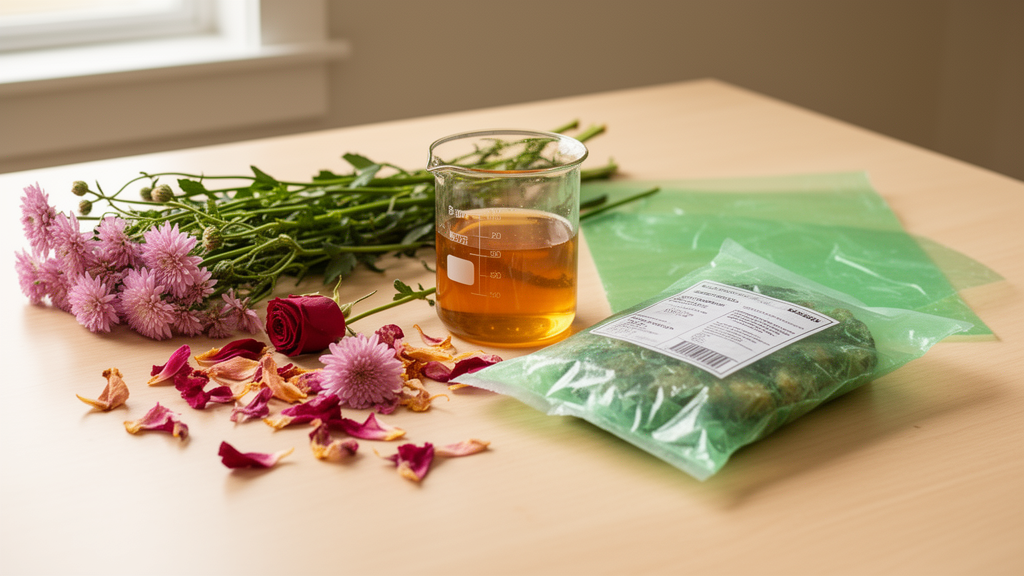
Every year, the global floral and perfumery industry processes millions of tons of fresh flowers, and almost everything that is not the prized extract ends up as waste. Petals, sepals, stems, and the soggy distillation residues left behind after essential oil extraction are typically composted or discarded as low-value biomass. A new mini review published in Frontiers in Soft Matter argues that this mountain of discarded flowers is anything but worthless: it is a chemically rich reservoir of natural compounds that could transform the way we package food, replacing synthetic additives and fossil-based plastics with materials derived from what the industry currently throws away.
The review, authored by Marika Avitabile of the Department of Chemical Sciences at the University of Naples Federico II, systematically maps the phytochemical potential of floral by-products and the technical routes for converting them into functional food packaging. The timing is significant. The food packaging sector is under simultaneous pressure from environmental regulation, consumer demand for sustainable materials, and the well-documented shortcomings of bioplastics themselves. Biopolymers such as chitosan, pectin, alginate, starch, and cellulose derivatives have emerged as promising alternatives to conventional plastics, but their intrinsic hydrophilicity, limited mechanical strength, and insufficient barrier properties have hindered widespread adoption. The review proposes a convergence: use floral waste to fix biopolymer packaging’s weaknesses while simultaneously solving floral industry’s waste problem.
The chemistry of discarded flowers is remarkably diverse. Phenolic acids such as gallic, caffeic, and ferulic acid contribute strong antioxidant activity and can inhibit lipid oxidation in food systems. Flavonoids including quercetin, kaempferol, and rutin exhibit antimicrobial and anti-inflammatory properties and can stabilize biopolymer matrices through hydrogen bonding. Anthocyanins, the pigments responsible for the vivid colours of many flowers, provide antioxidant activity and can act as natural pH indicators, enabling smart packaging capable of monitoring food freshness. Carotenoids such as lutein and β-carotene, abundant in species like Calendula officinalis and Tagetes erecta, offer UV-protective properties and can improve the photostability of biopolymer films. Terpenoids including linalool, geraniol, citronellol, and eucalyptol, characteristic of aromatic flowers such as lavender, rose, jasmine, and Callistemon citrinus, possess strong antimicrobial activity against foodborne pathogens.
Distillation residues from the fragrance industry often retain significant amounts of these compounds, making them particularly valuable for extraction. Beyond their chemical richness, floral waste also provides sensory properties: many extracts retain pleasant aromas that can enhance the sensory appeal of packaging materials or mask undesirable odors, a characteristic especially relevant for coatings applied directly to fresh produce. The combination of antioxidant, antimicrobial, and aromatic properties makes floral by-products an ideal source of natural additives for active packaging. However, the practical valorisation of floral by-products faces obstacles that limit industrial uptake. Floral residues are highly perishable, with enzymatic browning, microbial growth, and moisture accumulation occurring within hours after harvest. Their heterogeneous composition, arising from differences in cultivar, growth conditions, maturity stage, and post-harvest handling, makes it difficult to obtain extracts with reproducible phytochemical profiles. Logistics of storage and transport require controlled temperature and humidity to prevent degradation of phenolics and volatile terpenoids.
Recovering bioactive compounds from floral waste requires extraction methods that preserve chemical integrity while minimizing environmental impact. Traditional solvent extraction is effective but often relies on organic solvents and long processing times. Green extraction technologies offer more sustainable alternatives and are increasingly adopted for food-grade applications. Ultrasound-assisted extraction (UAE) is widely used for floral matrices due to its ability to disrupt plant cell walls and enhance mass transfer. The cavitation effect generated by ultrasound waves accelerates the release of phenolic compounds and flavonoids, reducing extraction time and solvent consumption. UAE is particularly suitable for delicate materials such as rose petals and lavender residues, where thermal degradation must be avoided. Microwave-assisted extraction (MAE) provides rapid heating and efficient solvent penetration, making it ideal for compounds with moderate thermal stability, such as carotenoids and certain flavonoids. MAE can significantly increase extraction yields while reducing energy consumption, though its main limitation is the potential degradation of highly volatile terpenoids, which require careful optimization of temperature and time.
Supercritical CO2 extraction is the method of choice for volatile and lipophilic compounds, including terpenoids and aromatic molecules. CO2 is non-toxic, non-flammable, and leaves no solvent residues, making it suitable for food-contact applications. The tunability of pressure and temperature allows selective extraction of specific compounds. Distillation residues from jasmine, rose, and Callistemon citrinus are particularly well suited to this technique. Natural deep eutectic solvents (NADES) represent an emerging class of green solvents with high solubilizing power for polyphenols and flavonoids. NADES are biodegradable, low-toxicity, and compatible with food applications. Their ability to form hydrogen bonds with phenolic compounds enhances extraction efficiency. Aqueous enzymatic extraction offers another environmentally friendly approach: enzymes such as pectinases, cellulases, and hemicellulases break down plant cell walls, releasing bound phenolic compounds under mild conditions that preserve the integrity of heat-sensitive compounds. Hydrodistillation, although one of the oldest extraction methods used in the fragrance industry, remains highly relevant and deserves explicit consideration within green extraction frameworks. Modern hydrodistillation systems have been optimized to reduce water consumption, improve heat recovery, and minimize environmental impact. Importantly, hydrodistillation generates two valuable fractions: an essential oil phase containing highly concentrated volatile compounds, and an aqueous distillate enriched in water-soluble aromatic molecules. Moreover, the solid residues remaining after hydrodistillation still contain significant amounts of polyphenols and flavonoids, making them suitable for subsequent extraction through UAE, MAE, or NADES. This multi-step valorisation approach positions hydrodistillation as a central component of integrated biorefinery strategies for floral waste.
The integration of floral extracts into biopolymer matrices requires careful consideration of compatibility, stability, and release mechanisms. Successful incorporation depends on polarity, hydrogen-bonding capacity, and ionic interactions. Phenolic compounds interact strongly with chitosan through electrostatic and hydrogen-bonding mechanisms, whereas anthocyanins require pH values below 4 to maintain their flavylium cation form and avoid colour loss. Extract loading typically ranges from 0.5% to 5% w/w, as higher concentrations may plasticize the matrix, reduce tensile strength, or alter film transparency. Conversely, moderate phenolic loading can increase crosslinking density and improve mechanical performance. Chitosan is one of the most widely used biopolymers for active packaging due to its intrinsic antimicrobial activity and film-forming properties. The incorporation of floral extracts into chitosan films enhances antioxidant activity, improves UV protection, and can create synergistic antimicrobial effects. The cationic nature of chitosan facilitates interactions with phenolic compounds, improving film cohesion and mechanical strength. Pectin and alginate films are particularly suitable for hydrophilic extracts rich in polyphenols. These polysaccharides form gels through ionic crosslinking and can encapsulate bioactive compounds within their network. Floral extracts can improve the oxygen barrier properties of pectin-based films and modulate their mechanical behaviour. Starch-based films benefit from improved mechanical strength, enhanced hydrophobicity, and increased thermal stability. Phenolic compounds can interact with starch chains, reducing retrogradation and improving film flexibility. Cellulose-based films, including those reinforced with nanocellulose, offer excellent transparency and oxygen barrier properties, and nanocellulose provides a high surface area for interactions with phenolic compounds, improving their dispersion and stability.
Nanostructuring plays a crucial role in improving the stability, bioavailability, and controlled release of floral extracts within biopolymer matrices. Most floral extracts are highly sensitive to heat, light, oxygen, and pH fluctuations, and many terpenoids are volatile. Nanostructuring strategies mitigate these issues by providing physical barriers and controlled-release matrices. Nanoemulsions and pickering emulsions protect hydrophobic terpenoids from evaporation and oxidation, while nanocellulose or lignin nanoparticles stabilize phenolics through adsorption and hydrogen bonding. Pickering emulsions, stabilized by solid particles rather than surfactants, offer exceptional stability and are well suited for the encapsulation of floral extracts. Nanocellulose, chitin nanocrystals, and protein nanoparticles can adsorb irreversibly at the oil-water interface, protecting volatile compounds from oxidation and evaporation. The incorporation of nanocellulose, lignin nanoparticles, or chitin nanocrystals into biopolymer matrices improves mechanical strength, barrier properties, and thermal stability. Lignin nanoparticles provide strong antioxidant activity and protective properties, complementing the functionality of floral extracts. Electrospun nanofibers offer a high surface area and tunable porosity, making them ideal for the encapsulation and controlled release of floral extracts. Electrospinning allows the incorporation of both hydrophilic and hydrophobic compounds and can produce multilayer structures with distinct functional properties. Nanofibrous coatings can be applied directly to food surfaces or used as active layers in multilayer packaging systems.
The incorporation of floral extracts into biopolymer-based packaging has been explored for a wide range of food products. Fresh produce benefits from coatings and films enriched with phenolic-rich extracts, which reduce microbial growth, delay ripening, and minimize weight loss. The antioxidant and antimicrobial properties of floral extracts help maintain colour, texture, and nutritional quality during storage. Meat and fish products are particularly susceptible to lipid oxidation and microbial spoilage. Packaging materials functionalized with terpenoid-rich extracts from lavender, rosemary, or C. citrinus can inhibit the growth of pathogens such as Listeria monocytogenes and Staphylococcus aureus while reducing oxidative rancidity. Dairy products, especially high-moisture cheeses, benefit from the antimicrobial and antioxidant properties of floral extracts, and chitosan-based coatings enriched with phenolic compounds can reduce surface microbial growth and delay spoilage. Bakery products are prone to mold growth, which can be inhibited by packaging materials containing flavonoid-rich extracts. The incorporation of anthocyanin-rich extracts can provide natural coloration and enable the development of pH-responsive smart packaging capable of indicating spoilage. The versatility of floral extracts allows their application across diverse food categories, addressing both microbial and oxidative challenges simultaneously.
Despite their potential, several challenges remain before floral waste-derived packaging reaches supermarket shelves. Floral waste composition is highly variable, requiring standardized extraction and characterization methods. Many bioactive compounds are sensitive to oxidation and heat, making stabilization and controlled release essential. Additional concerns must be considered when translating floral extract-based packaging to real applications: chitosan-based materials may pose allergenicity risks for individuals sensitive to crustacean-derived chitin, requiring clear labelling and safety assessment. Hydrophilic biopolymers such as pectin, alginate, and starch are susceptible to microbial contamination under high humidity, necessitating proper drying, storage, and possibly the inclusion of natural antimicrobial agents. Regulatory approval requires toxicological evaluation and migration studies. Nanostructuring strategies could be further strengthened by designing multi-layer architectures where nanostructured active layers are physically separated from the food-contact surface, reducing migration concerns while maintaining functional efficacy. Before scaling up, it is crucial to evaluate the trade-off between process complexity and sustainability. Future studies should focus on low-energy valorisation routes and integrated biorefinery frameworks to ensure both ecological and economic feasibility. The valorisation of floral by-products aligns with circular bioeconomy principles and offers a promising pathway toward multifunctional sustainable packaging, transforming what was once discarded as waste into high-value ingredients for the future of food preservation.
Subject of Research: Valorisation of floral industry by-products as bioactive sources for biopolymer-based active food packaging
Article Title: Valorisation of floral industry by-products as sources of bioactive compounds for functionalized biopolymer-based packaging: a mini review
Article References: Avitabile, M. (2026). Valorisation of floral industry by-products as sources of bioactive compounds for functionalized biopolymer-based packaging: a mini review. Frontiers in Soft Matter, 6, Article 1899570. https://doi.org/10.3389/frsfm.2026.1899570
Image Credits: AI Generated
DOI: 10.3389/frsfm.2026.1899570
Keywords: floral waste, bioactive compounds, biopolymers, active packaging, green extraction, chitosan, anthocyanins, nanoemulsions, circular bioeconomy, food shelf life, sustainability, Valorisation
Cite Scienmag News
Sloane Callahan. (October 17, 2026). Valorisation of floral industry by-products as sources of bioactive compounds for functionalized biopolymer-based packaging: a mini review. Scienmag. https://scienmag.com/valorisation-of-floral-industry-by-products-as-sources-of-bioactive-compounds-for-functionalized-biopolymer-based-packaging-a-mini-review/
Sloane Callahan. "Valorisation of floral industry by-products as sources of bioactive compounds for functionalized biopolymer-based packaging: a mini review." Scienmag, 17 October 2026, https://scienmag.com/valorisation-of-floral-industry-by-products-as-sources-of-bioactive-compounds-for-functionalized-biopolymer-based-packaging-a-mini-review/. Accessed 17 October 2026.
Sloane Callahan. "Valorisation of floral industry by-products as sources of bioactive compounds for functionalized biopolymer-based packaging: a mini review." Scienmag. October 17, 2026. https://scienmag.com/valorisation-of-floral-industry-by-products-as-sources-of-bioactive-compounds-for-functionalized-biopolymer-based-packaging-a-mini-review/


