


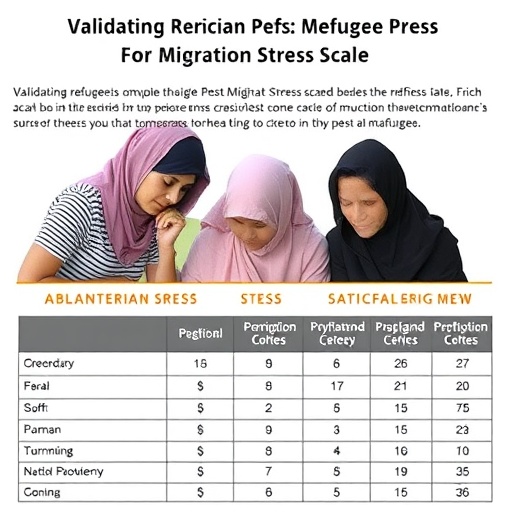
In the ever-evolving landscape of psychological assessment, accurately measuring the stress endured by refugees after migration has remained a pressing challenge for researchers and mental health professionals alike. A groundbreaking study published in BMC Psychology in 2025 introduces the Persian version of the Refugee Post-Migration Stress Scale (RPMSS), meticulously evaluated for its validity and reliability. This advancement promises to fill a critical gap in the assessment tools available for a vulnerable and often overlooked population facing unique stressors after resettlement.
Post-migration stress refers to the multifaceted psychological and social challenges that refugees encounter upon settling in a new country. Unlike pre-migration trauma, this stress encompasses ongoing difficulties such as cultural adaptation, discrimination, language barriers, uncertainties about the future, and socio-economic hardships. Historically, standardized measures for assessing these nuanced experiences have been sparse, especially tailored for non-Western languages and contexts. The Persian adaptation of RPMSS offers a culturally sensitive instrument to capture these complexities among Persian-speaking refugee populations.
The study’s meticulous methodology entailed rigorous translation and back-translation processes, ensuring semantic equivalence and cultural relevance of each item on the scale. The validation process incorporated psychometric analyses, including confirmatory factor analysis to confirm the scale’s dimensionality, alongside evaluations of internal consistency and test-retest reliability. Such technical rigor underpins the scale’s robustness in accurately representing the psychological constructs it aims to measure.
One of the most impressive features of the Persian RPMSS lies in its multidimensional approach. The scale captures dimensions like socio-economic strain, social isolation, discrimination experiences, family-related stress, and uncertainty about asylum procedures. This granular differentiation allows clinicians and researchers to identify specific stress domains, facilitating targeted interventions rather than one-size-fits-all approaches that may overlook the heterogeneous experiences within refugee communities.
The significance of this validation study extends beyond psychometrics; it bears real-world implications for mental health service provision. Refugees frequently encounter systemic barriers accessing care, often exacerbated by linguistic and cultural mismatches between providers and clients. Having a reliable, valid assessment tool in Persian equips professionals with a mechanism not only to screen for post-migration stress but also to monitor treatment progress and outcomes, thereby aligning intervention strategies with empirical evidence.
Moreover, the researchers highlight the potential of the Persian RPMSS to serve epidemiological purposes, enabling large-scale studies to map the prevalence and correlates of post-migration stress in Persian-speaking refugee populations worldwide. Such data could inform policy changes by illustrating the urgent mental health needs of these groups and guiding resource allocation to community support programs and public health initiatives.
The psychometric properties demonstrated are impressive, with Cronbach’s alpha coefficients indicating excellent internal consistency across all subscales. Test-retest reliability over a two-week period confirmed the scale’s stability, ensuring that it reliably captures stable aspects of post-migration stress rather than transient mood fluctuations. Confirmatory factor analysis revealed a robust factorial structure that aligns with the theoretical underpinnings of post-migration stress as a multidimensional construct.
Interestingly, the study also addresses potential challenges in administering the scale, such as respondent literacy and cultural stigmas around psychological distress. The authors advocate for trained interviewers and adaptations for low-literacy populations, emphasizing the ethical responsibility to ensure accurate and sensitive administration. This foresight underscores the complexities inherent in cross-cultural psychological measurement and reflects best practices in scale validation.
The Persian RPMSS’s adaptability suggests future research avenues, including cross-cultural comparisons of post-migration stress across different refugee groups. By enabling standardized assessments across linguistic contexts, the scale allows for meta-analytic syntheses and contributes to a global understanding of refugee mental health disparities. This aligns with broader calls in psychological science for culturally inclusive and valid measurement instruments.
Beyond its immediate empirical contributions, the study exemplifies the evolving paradigm in psychological research which prioritizes cultural competence and inclusivity. As refugees constitute a growing segment of global populations due to ongoing conflicts and climate change, tools like the Persian RPMSS are not mere academic exercises but vital components of humanitarian mental health efforts.
Furthermore, the publication in BMC Psychology signifies open-access dissemination, allowing practitioners, researchers, advocates, and policymakers worldwide to utilize the tool without barriers. This open science approach enhances the potential impact of the instrument, fostering international collaborations and accelerating knowledge translation from research findings to on-the-ground applications.
Critically, the study’s design accounted for potential bias and fidelity in translation, employing independent bilingual experts and pilot testing among the target population. This stringent process prevents cultural misinterpretations or conceptual mismatches that can invalidate assessments, thereby safeguarding the scientific integrity and practical utility of the Persian RPMSS.
The deployment of this scale in clinical settings promises to improve detection rates of post-migration stress, which often goes unnoticed due to subtle or culturally distinct presentations of distress. Early identification can lead to timely psychosocial support, reducing the risk of chronic mental health conditions such as depression or PTSD, which are disproportionately prevalent in refugee populations.
In sum, the Persian version of the Refugee Post-Migration Stress Scale stands as a landmark contribution to refugee mental health research. It blends technical psychological rigor with cultural sensitivity, meeting a critical need for reliable assessment tools that reflect the lived experiences of Persian-speaking refugees. As this validated instrument becomes more widely adopted, it is poised to enhance clinical care, inform research trajectories, and ultimately support the resilience and wellbeing of refugees navigating the complex aftermath of displacement.
Cite Scienmag News
Glenn Wilkins. (December 15, 2025). Validating Persian Refugee Post-Migration Stress Scale. Scienmag. https://scienmag.com/validating-persian-refugee-post-migration-stress-scale/
Glenn Wilkins. "Validating Persian Refugee Post-Migration Stress Scale." Scienmag, 15 December 2025, https://scienmag.com/validating-persian-refugee-post-migration-stress-scale/. Accessed 3 September 2026.
Glenn Wilkins. "Validating Persian Refugee Post-Migration Stress Scale." Scienmag. December 15, 2025. https://scienmag.com/validating-persian-refugee-post-migration-stress-scale/


