

Sunday, July 12, 2026
Science
No Result
View All Result
  • Login
  • HOME
  • SCIENCE NEWS
  • CONTACT US
  • HOME
  • SCIENCE NEWS
  • CONTACT US
No Result
View All Result
Scienmag
No Result
View All Result
Home Science News Space

USTC uncovers nitrogen’s origin and early evolution on Earth

June 17, 2024
in Space
Reading Time: 2 mins read
0
USTC uncovers nitrogen’s origin and early evolution on Earth
67
SHARES
612
VIEWS
Share on FacebookShare on Twitter
ADVERTISEMENT

A research team led by Prof. WANG Wenzhong from the School of Earth and Space Sciences of the University of Science and Technology of China (USTC), in collaboration with international scholars, studied the fractionation behavior of nitrogen isotopes during the accretionary evolution of terrestrial planets. The study was published in Nature Communications.

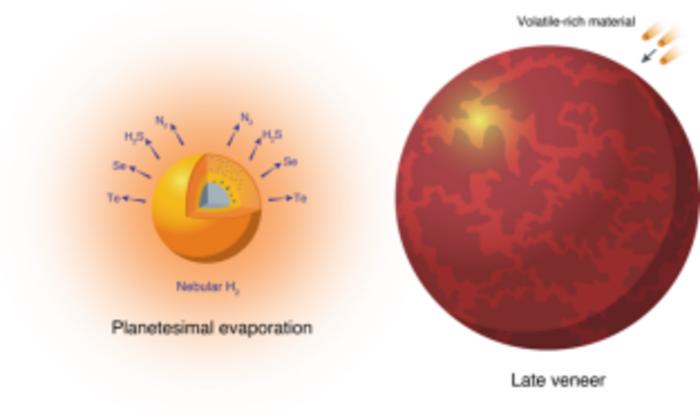
USTC Uncovers Nitrogen's Origin and Early Evolution on Earth

Credit: ustc

A research team led by Prof. WANG Wenzhong from the School of Earth and Space Sciences of the University of Science and Technology of China (USTC), in collaboration with international scholars, studied the fractionation behavior of nitrogen isotopes during the accretionary evolution of terrestrial planets. The study was published in Nature Communications.


Currently, the academic community primarily holds two models regarding the accretion of volatiles on Earth: the “Late Veneer” model and the “Early Evolution” model.


As nitrogen is one of the fundamental building blocks of life on Earth, a thorough examination of its accretionary and evolutionary history holds immense significance in comprehending the origin of life-related elements and the evolution of habitability on our planet.


Researchers employed first-principles calculation methods to delve into the fractionation mechanism of nitrogen isotopes (14N and 15N) during the condensation of nebula materials into planetary embryos. The primary focus was on the two stages of melting-volatilization and core-mantle differentiation.


Researchers discovered that under the condition where hydrogen gas had not yet fully dissipated in the early solar nebula, melting-volatilization caused the enrichment of 14N in the planetary embryos, while core-mantle differentiation led to the enrichment of 15N in the silicate melt.


By combining first-principles calculations and observational data, researchers found that the evolution of early planetary embryos alone cannot fully explain the nitrogen isotope composition of the silicate Earth. It is necessary to consider the late-stage addition of volatile-rich materials (such as carbonaceous chondrites). The nitrogen abundance of the silicate Earth is a result of both early evolution and late-stage accretion, but the contribution of late-stage accretion to the abundance of other volatiles is limited.


This research sheds light on the fact that the two crucial stages of early planetesimal melting-volatilization and late accretion of volatile-rich materials jointly determine the nitrogen abundance in the silicate Earth, offering fresh perspectives on the understanding of the origin of volatiles on Earth.


Journal

Nature Communications

DOI

10.1038/s41467-024-48500-0

Article Publication Date

16-May-2024

Share27Tweet17
Previous Post

Researchers discover potential mole reversal therapy in rare condition

Next Post

New initiative aims to help tens of thousands with recurrent pericarditis

Related Posts

Multimessenger Universe Advances Frontier AI Training Techniques
Space

Multimessenger Universe Advances Frontier AI Training Techniques

July 10, 2026
Isotopic Evidence Reveals Late Molecular Cloud Infall in Outer Solar System
Space

Isotopic Evidence Reveals Late Molecular Cloud Infall in Outer Solar System

July 10, 2026
Near-Earth Object Shows Comet-Like Non-Gravitational Acceleration
Space

Near-Earth Object Shows Comet-Like Non-Gravitational Acceleration

July 10, 2026
ASU Astronomers Uncover Cloud Effects on Common Exoplanet Interiors
Space

ASU Astronomers Uncover Cloud Effects on Common Exoplanet Interiors

July 9, 2026
Satellites Track Penguin Poo Color to Reveal Climate Change Impact
Space

Satellites Track Penguin Poo Color to Reveal Climate Change Impact

July 9, 2026
Uncovering the Mysterious Presence Within Orion’s Nebula Shell
Space

Uncovering the Mysterious Presence Within Orion’s Nebula Shell

July 9, 2026
Next Post

New initiative aims to help tens of thousands with recurrent pericarditis

  • Mothers who receive childcare support from maternal grandparents show more

    Mothers who receive childcare support from maternal grandparents show more parental warmth, finds NTU Singapore study

    27656 shares
    Share 11059 Tweet 6912
  • University of Seville Breaks 120-Year-Old Mystery, Revises a Key Einstein Concept

    1061 shares
    Share 424 Tweet 265
  • Bee body mass, pathogens and local climate influence heat tolerance

    682 shares
    Share 273 Tweet 171
  • Researchers record first-ever images and data of a shark experiencing a boat strike

    546 shares
    Share 218 Tweet 137
  • Groundbreaking Clinical Trial Reveals Lubiprostone Enhances Kidney Function

    531 shares
    Share 212 Tweet 133
Science

Embark on a thrilling journey of discovery with Scienmag.com—your ultimate source for cutting-edge breakthroughs. Immerse yourself in a world where curiosity knows no limits and tomorrow’s possibilities become today’s reality!

RECENT NEWS

  • Clinicopathologic Study Reveals Amyloid Clearance in Alzheimer’s Disease
  • Long-Term Kidney Outcomes After Living Donation in Older Adults Explored
  • Living Alone and Poverty Heighten Risks for Older Nigerians in Cities
  • Global Study Reveals Variations in Dementia Risk Factors

Categories

  • Agriculture
  • Anthropology
  • Archaeology
  • Athmospheric
  • Biology
  • Biotechnology
  • Blog
  • Bussines
  • Cancer
  • Chemistry
  • Climate
  • Earth Science
  • Editorial Policy
  • Marine
  • Mathematics
  • Medicine
  • Pediatry
  • Policy
  • Psychology & Psychiatry
  • Science Education
  • Social Science
  • Space
  • Technology and Engineering

Subscribe to Blog via Email

Success! An email was just sent to confirm your subscription. Please find the email now and click 'Confirm Follow' to start subscribing.

Join 5,146 other subscribers

© 2025 Scienmag - Science Magazine

Welcome Back!

Login to your account below

Forgotten Password?

Retrieve your password

Please enter your username or email address to reset your password.

Log In
No Result
View All Result
  • HOME
  • SCIENCE NEWS
  • CONTACT US

© 2025 Scienmag - Science Magazine
