


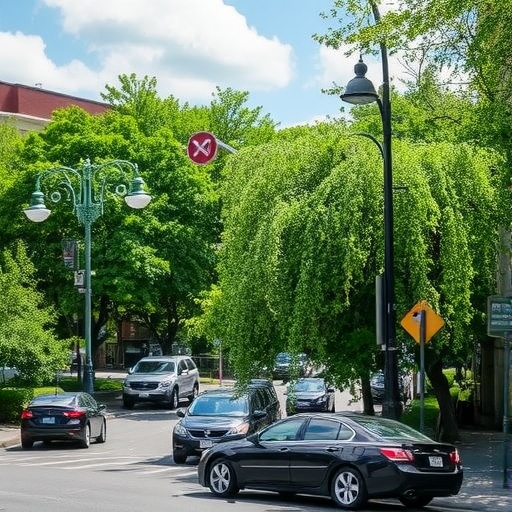
Urban trees have long been recognized as natural air conditioners, offering a respite from the relentless heat that increasingly grips our cities. A groundbreaking study led by Su, Makowski, Zhang, and their colleagues presents a comprehensive remote sensing-based analysis of how urban trees contribute to cooling effects across multiple European cities. Published in the prestigious npj Urban Sustain journal in 2026, this research leverages advanced satellite imagery and data analytics to quantify the extent to which urban forestry mitigates urban heat islands, a critical factor as climate change exacerbates summertime temperatures globally.
The urgency of this investigation is underscored by the rapid expansion of urban areas coupled with the intensification of heatwaves observed over recent decades. Cities, due to the dense concentration of impervious surfaces like concrete and asphalt, tend to absorb and radiate heat, resulting in localized warming known as the urban heat island effect. This phenomenon disproportionately affects vulnerable populations, increasing the risk of heat-related illnesses and stressing urban infrastructure. Urban trees have been proposed as a cost-effective and sustainable solution to alleviate these heat burdens, but prior to this study, the quantification of their cooling impact across continental scales remained elusive.
Employing remote sensing technology, the researchers gathered high-resolution satellite data, including multispectral and thermal imagery, to assess the spatial distribution of urban vegetation and surface temperatures simultaneously. This methodology allowed for a nuanced understanding of how tree canopy coverage correlates with temperature variations in urban agglomerations. By analyzing data from diverse metropolitan contexts across Europe, from the Mediterranean climates to temperate zones, the team was able to assess the consistency and variability of urban tree cooling effects under different environmental conditions.
One of the key technical advancements presented in this research is the integration of multi-temporal satellite data, which accounts for seasonal variations in vegetation vigor and thermal dynamics. Utilizing time-series analyses, the study captures fluctuating cooling contributions of urban forests, revealing that the mitigating effects are most pronounced during peak summer periods when heat stress is critical. This temporal depth enhances our understanding of how urban greenspaces function dynamically rather than as static features.
The findings demonstrate that urban trees can reduce surface temperatures by an average of 2 to 4 degrees Celsius in densely built environments. The cooling effect was found to be spatially heterogeneous, with larger, contiguous tree clusters exhibiting more pronounced temperature reductions compared to sparse or isolated specimens. Importantly, the shading provided by tree canopies combined with the evapotranspiration process, where water vapor release from leaves cools the surrounding air, were identified as the primary mechanisms behind the temperature moderation observed.
Moreover, the study highlights the interaction between urban morphology and tree cooling efficiency. Areas with narrow streets and high building density, sometimes called urban canyons, showed variable cooling patterns dependent on tree placement and height. The research suggests that strategic urban planning integrating tree planting in targeted locations can maximize thermal comfort benefits, advocating for urban forestry policies informed by geospatial data.
Beyond purely environmental benefits, urban tree cooling has profound socio-economic implications. By lowering ambient temperatures, trees reduce dependency on energy-intensive air conditioning, leading to decreased electricity consumption and carbon emissions. This translates into cost savings for residents and municipalities and contributes to broader climate mitigation goals. The study quantifies these secondary impacts, estimating potential energy savings if urban tree cover were increased to recommended thresholds.
The methodology adopted in this research sets a new standard for urban sustainability assessments by combining remote sensing with urban climatology models. This cross-disciplinary approach enables the disaggregation of factors influencing urban heat islands and offers scalable tools that city planners worldwide can adopt. The use of open-access satellite data also promotes transparency and encourages continued scientific collaboration.
Importantly, the research emphasizes that not all trees are equally effective in cooling urban environments. Species selection matters significantly, with some tree varieties demonstrating higher transpiration rates and canopy densities that enhance their cooling potential. This insight calls for integration of ecological knowledge into urban forestry strategies, ensuring that tree species planted are adapted to local climates and maximize ecosystem service provision.
The study also addresses challenges related to urban tree maintenance, such as water availability and soil compaction, which can diminish tree health and cooling capacity. The authors advocate for sustainable urban green infrastructure management, ensuring urban trees have the necessary resources to thrive and continue providing ecosystem services amid growing climatic stressors.
In illustrating how cities in Southern Europe, which experience hotter and drier summers, benefit differently compared to Northern European counterparts, the research highlights the importance of regional tailoring of urban greening initiatives. Policymakers are urged to consider climatic, cultural, and socio-economic contexts in designing urban forestry programs to optimize cooling outcomes and promote equitable access to green spaces.
The study’s implications extend into public health domains as well, with cooler microclimates reducing heat-related morbidity and mortality. The research supports mounting evidence that urban vegetation serves as an essential public health intervention, particularly as heatwaves become more common due to climate change.
While the remote sensing approach provides robust data over extensive areas, the authors note limitations related to sub-canopy temperature readings and nighttime cooling effects, suggesting avenues for future research employing complementary ground-based sensors and modeling techniques. Such multi-modal investigations would further enrich understanding of urban forestry’s role in urban climate adaptation.
In conclusion, this pioneering research offers compelling evidence that urban trees are indispensable allies in cooling cities, enhancing livability, safeguarding public health, and contributing to sustainable urban futures. Its rigorous scientific approach, combining remote sensing technology with climatology and urban planning perspectives, equips stakeholders with critical insights to harness nature-based solutions in combating urban heat islands. As European cities face unprecedented challenges from climate change, investments in protecting and expanding urban forests emerge as both a pragmatic and transformative pathway towards resilient urban environments.
Su, Y., Makowski, D., Zhang, X. et al. A remote sensing-based assessment of the cooling effects of urban trees in European cities.
npj Urban Sustain (2026). https://doi.org/10.1038/s42949-026-00399-w
Cite Scienmag News
Sloane Callahan. (April 28, 2026). Urban Trees’ Cooling Impact: Remote Sensing Reveals. Scienmag. https://scienmag.com/urban-trees-cooling-impact-remote-sensing-reveals/
Sloane Callahan. "Urban Trees’ Cooling Impact: Remote Sensing Reveals." Scienmag, 28 April 2026, https://scienmag.com/urban-trees-cooling-impact-remote-sensing-reveals/. Accessed 5 September 2026.
Sloane Callahan. "Urban Trees’ Cooling Impact: Remote Sensing Reveals." Scienmag. April 28, 2026. https://scienmag.com/urban-trees-cooling-impact-remote-sensing-reveals/


