


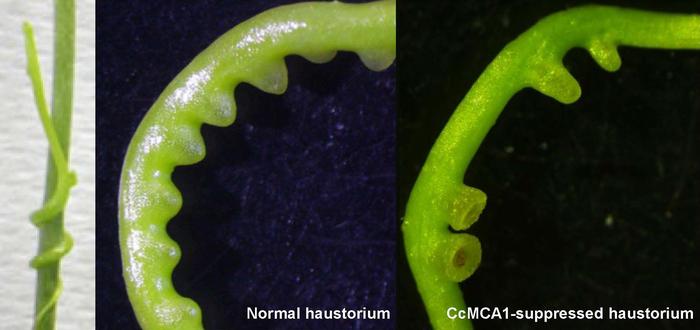
The parasitic vine known as Cuscuta campestris has long fascinated botanists and horticulturists alike due to its incredible ability to thrive by attaching itself to host plants. This vine employs specialized organs called haustoria to penetrate the tissues of the host, facilitating nutrient absorption. Recent research led by Professor Koh Aoki at Osaka Metropolitan University has revealed new insights into the genetic mechanisms that underpin this fascinating process. The findings focus on the role of a specific gene, CcMCA1, crucial in regulating haustorium development when influenced by mechanical stimuli.
In its quest for survival, Cuscuta campestris does not just passively seek hosts; it actively engages with its environment. When the vine coiling process begins, ion channels within the cell membrane of Cuscuta campestris are stimulated, triggering a cascade of cellular responses that ultimately lead to the formation of the haustorium. Understanding which ion channels are involved in this process has previously been a significant barrier in botanical research, leaving many questions unanswered.
Professor Aoki’s research team has broken new ground by identifying these ion channels and how they function. Their study indicates that suppression of the CcMCA1 gene results in a notable decline in haustorium formation, casting light on the fundamental genetic pathways that assist in this extraordinary parasitic behavior. This revelation signifies the first time that mechanosensitive ion channels linked specifically to the climbing abilities of vines have been mapped.
The importance of this research extends beyond mere academic curiosity; it has practical implications for agriculture and crop management. Since Cuscuta campestris is notorious for causing substantial economic harm to various crops by hindering their growth and nutrient uptake, understanding the genetic basis behind its parasitic efficiency could pave the way for developing innovative control measures. Professor Aoki emphasized the need for ongoing research to identify other ion channel genes involved in the parasitic process, potentially leading to comprehensive strategies for mitigating the economic impact of such invasive species.
This research has been rigorously documented in the journal Plant and Cell Physiology, further enhancing the credibility of the findings. The detailed analyses provided by Aoki’s team not only highlight the involvement of CcMCA1 but also set a precedent for future studies focused on the interactions between non-photosynthetic plants and their environments. The understanding of plant sensory mechanisms at the microscopic level is essential for global agricultural practices, especially as climate change intensifies the challenges faced by farmers worldwide.
Moreover, the advances in deciphering the complex signaling pathways of Cuscuta campestris offer a model for studying other parasitic plants, broadening the horizons of plant biology. This research underscores the intricate relationship between plants and their physical environments, leading to a better comprehension of bioengineering possibilities. By manipulating these pathways, scientists could potentially develop crops that are resistant to parasitic invasions, safeguarding food security for the future.
The study has drawn attention not only for its academic rigor but also for its potential applications in the agricultural sector. As the world grapples with increasing demands for food production due to population growth, understanding the factors that inhibit crop yield is of utmost importance. Professor Aoki’s team exemplifies the commitment to accelerating scientific inquiry that not only enriches our knowledge of plant biology but also seeks tangible solutions for modern agricultural dilemmas.
In addition to its scientific contributions, this research could stimulate discussions regarding biodiversity and conservation efforts. The balance between invasive species and native flora is delicate, and the insights garnered from understanding parasitic species like Cuscuta campestris can guide conservationists in prioritizing strategies that protect native plants while managing invasive ones. Innovative research such as this encourages a holistic approach to environmental stewardship, integrating scientific advancements with practical field applications.
Finally, as the findings proliferate through academic discourse and popular media channels, they have the potential to inspire a new generation of scientists and biologists. Engaging young minds with tangible examples of genetic research in plants can foster a deeper appreciation for botany and conservation efforts. Education is critical in building a sustainable future, and uncovering the mysteries of plant interactions could serve as a unique gateway into the world of scientific exploration for students and enthusiasts alike.
The impact of this study is bound to resonate within both scientific communities and the broader public. As researchers continue to explore the genetic makeup of parasitic plants, we may soon uncover even more about the complex symbioses and interactions present in nature. Each revelation adds depth to our understanding of ecology, agriculture, and the delicate balance of life that sustains our planet.
Cite Scienmag News
Juliet Wilcox. (March 27, 2025). Unveiling Nature’s Parasitic Wonder: The Motivations Behind Cuscuta campestris. Scienmag. https://scienmag.com/unveiling-natures-parasitic-wonder-the-motivations-behind-cuscuta-campestris/
Juliet Wilcox. "Unveiling Nature’s Parasitic Wonder: The Motivations Behind Cuscuta campestris." Scienmag, 27 March 2025, https://scienmag.com/unveiling-natures-parasitic-wonder-the-motivations-behind-cuscuta-campestris/. Accessed 4 September 2026.
Juliet Wilcox. "Unveiling Nature’s Parasitic Wonder: The Motivations Behind Cuscuta campestris." Scienmag. March 27, 2025. https://scienmag.com/unveiling-natures-parasitic-wonder-the-motivations-behind-cuscuta-campestris/


