


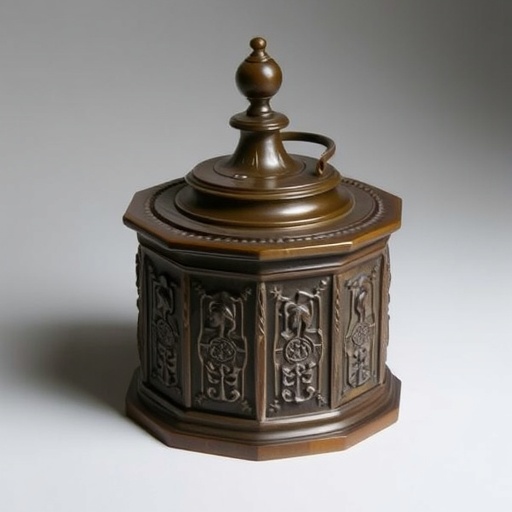
In a groundbreaking study titled “Tracing literacy in Roman Conimbriga: insights from the metallurgy and ink of a Biebrich inkwell,” researchers have unveiled intriguing insights into the literacy practices of ancient Roman society through technological analysis. This investigation, spearheaded by an international team led by Oliveira and published in Archaeological and Anthropological Sciences, integrates an intricate examination of the metallurgy involved in the production of a Biebrich inkwell with the organic components utilized for ink, providing a dual lens into the cognitive and material culture of Roman Conimbriga.
The team’s exploration began with the examination of the historical context of Conimbriga, one of the most significant Roman settlements in present-day Portugal. Once a bustling hub of communication, trade, and culture during the Roman Empire, Conimbriga offers a wealth of archaeological evidence. By analyzing remnants such as the Biebrich inkwell, which was likely used in writing practices, researchers aim to piece together not just the functional use of such artifacts but also their broader implications concerning literacy and education in ancient Rome.
Metallurgy plays a crucial role in this context. The study delves into the specific metals used in crafting Roman writing instruments, and the inkwell offers a tangible connection to the artistry and technological advancements of the time. The careful selection of materials, including various alloys, reflects not only the artisanship but also the societal norms and values associated with writing instruments. Such insights reveal how metallurgy facilitated not just utility, but also artistic expression and cultural identity within Roman society.
Moreover, the ink itself provides another layer of significance. Analysis of the organic components within the ink extracted from the Biebrich inkwell reveals a sophisticated understanding of chemistry during that era. The study identifies various additives that enhanced the ink’s properties, signing a testament to the ingenuity of ancient Romans. Such advancements in the formulation of ink underscore the importance they placed on written communication, indicating that literacy was not a mere luxury for the elite but a more extensive societal goal that permeated across various strata of their community.
The investigation further explores the correlation between the availability of specific materials and the spread of literacy. With access to certain pigments and binding agents, the Roman populace was not only able to write effectively but also to preserve knowledge through the written word. The physical act of writing thus becomes a vital mechanism for cultural transmission, enabling the continuity of ideas, governance, and education through generations. In this way, the Biebrich inkwell serves as a critical artifact that connects the dots between material culture and intellectual development.
Interestingly, the findings challenge existing historical narratives regarding literacy distributions in Roman society. Instead of being an isolated privilege, the evidence suggests that literacy was an integral aspect of life for many. This insight is particularly poignant when considering the rise of various social classes within Roman Conimbriga, prompting a reevaluation of who participated in scholarly and administrative functions.
As the study unfolds, the researchers emphasize the interdisciplinary nature of their work. Combining methodologies from archaeology, chemistry, and historical analysis allows for a richer and more textured understanding of the relationships between people and materials in ancient Rome. It illustrates how such collaborative endeavors can uncover stories that might otherwise remain silent beneath the layers of time, waiting for the right questions and technologies to be unearthed.
The potential implications of this research resonate beyond the immediate findings. By illustrating the symbiotic relationship between technology, culture, and literacy, it prompts further questions about how contemporary societies might learn from the past. As digital technologies transform modern communication, the inquiry into the historical roots of literacy may provide valuable insights into our own practices today.
One of the more compelling aspects of the research is the emphasis on the cultural significance of writing. Through examining the inkwell’s design and its intended use, the team highlights how the mere act of writing transcended functionality; it was also an embodiment of identity, status, and cultural belonging. In a world increasingly defined by rapid communication, this reflection on the historic significance of written language serves to remind us of the power inherent in the act of inscribing one’s thoughts onto a surface, from clay tablets to the software of our devices.
Finally, the work stands as a call to pay attention to the material dimensions of history. The researchers urge that by focusing too narrowly on texts alone, scholars risk overlooking the vital role that objects like the Biebrich inkwell play in our understanding of historical literacy. These findings herald new avenues for future research, where the artifacts of everyday life reveal the complexities and nuances of human civilization.
By connecting ancient technologies to contemporary issues surrounding communication, literacy, and creativity, Oliveira and her team make a compelling case for how history and archaeology can inform and enrich current societal discourse. Their work reminds us that while tools may change, the fundamental human drive to communicate and share knowledge remains unwavering through the ages.
Oliveira, C., Bottaini, C., Kaal, J. et al. Tracing literacy in Roman Conimbriga: insights from the metallurgy and ink of a Biebrich inkwell.
Archaeol Anthropol Sci 17, 216 (2025). https://doi.org/10.1007/s12520-025-02330-3
Cite Scienmag News
Courtney Benton. (November 16, 2025). Unveiling Literacy in Roman Conimbriga’s Biebrich Inkwell. Scienmag. https://scienmag.com/unveiling-literacy-in-roman-conimbrigas-biebrich-inkwell/
Courtney Benton. "Unveiling Literacy in Roman Conimbriga’s Biebrich Inkwell." Scienmag, 16 November 2025, https://scienmag.com/unveiling-literacy-in-roman-conimbrigas-biebrich-inkwell/. Accessed 8 September 2026.
Courtney Benton. "Unveiling Literacy in Roman Conimbriga’s Biebrich Inkwell." Scienmag. November 16, 2025. https://scienmag.com/unveiling-literacy-in-roman-conimbrigas-biebrich-inkwell/


