


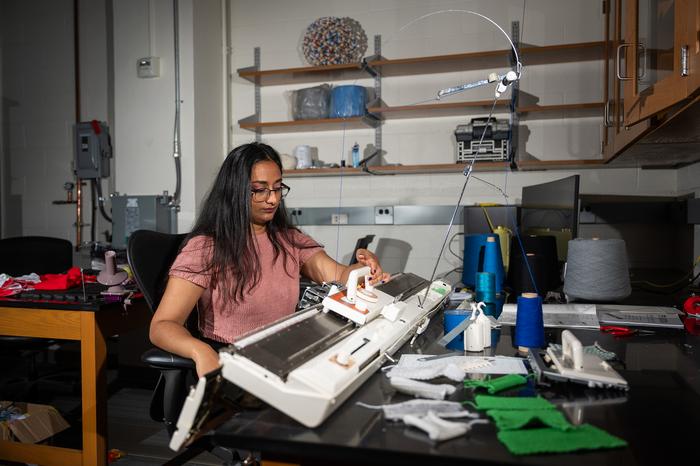
Knitting, the age-old craft of looping and stitching natural fibers into fabrics, has received renewed attention for its potential applications in advanced manufacturing. Far beyond their use for garments, knitted textiles are ideal for designing and fabricating emerging technologies like wearable electronics or soft robotics — structures that need to move and bend.

Credit: Georgia Institute of Technology
Knitting, the age-old craft of looping and stitching natural fibers into fabrics, has received renewed attention for its potential applications in advanced manufacturing. Far beyond their use for garments, knitted textiles are ideal for designing and fabricating emerging technologies like wearable electronics or soft robotics — structures that need to move and bend.
Knitting transforms one-dimensional yarn into two-dimensional fabrics that are flexible, durable, and highly customizable in shape and elasticity. But to create smart textile design techniques that engineers can use, understanding the mechanics behind knitted materials is crucial.
Physicists from the Georgia Institute of Technology have taken the technical know-how of knitting and added mathematical backing to it. In a study led by Elisabetta Matsumoto, associate professor in the School of Physics, and Krishma Singal, a graduate researcher in Matsumoto’s lab, the team used experiments and simulations to quantify and predict how knit fabric response can be programmed. By establishing a mathematical theory of knitted materials, the researchers hope that knitting — and textiles in general — can be incorporated into more engineering applications.
Their research paper, “Programming Mechanics in Knitted Materials, Stitch by Stitch,” was published in the journal Nature Communications.
“For centuries, hand knitters have used different types of stitches and stitch combinations to specify the geometry and ‘stretchiness’ of garments, and much of the technical knowledge surrounding knitting has been handed down by word of mouth,” said Matsumoto.
But while knitting has often been dismissed as unskilled, poorly paid “women’s work,” the properties of knits can be more complex than traditional engineering materials like rubbers or metals.
For this project, the team wanted to decode the underlying principles that direct the elastic behavior of knitted fabrics. These principles are governed by the nuanced interplay of stitch patterns, geometry, and yarn topology — the undercrossings or overcrossings in a knot or stitch. “A lot of yarn isn’t very stretchy, yet once knit into a fabric, the fabric exhibits emergent elastic behavior,” Singal said.
“Experienced knitters can identify which fabrics are stretchier than others and have an intuition for its best application,” she added. “But by understanding how these fabrics can be programmed and how they behave, we can expand knitting’s application into a variety of fields beyond clothing.”
Through a combination of experiments and simulations, Matsumoto and Singal explored the relationships among yarn manipulation, stitch patterns, and fabric elasticity, and how these factors work together to affect bulk fabric behavior. They began with physical yarn and fabric stretching experiments to identify main parameters, such as how bendable or fluffy the yarn is, and the length and radius of yarn in a given stitch.
They then used the experiment results to design simulations to examine the yarn inside a stitch, similar to an X-ray. It is difficult to see inside stitches during the physical measurements, so the simulations are used to see what parts of the yarn have interacted with other parts. The simulations are used to recreate the physical measurements as accurately as possible.
Through these experiments and simulations, Singal and Matsumoto showed the profound impact that design variations can have on fabric response and uncovered the remarkable programmability of knitting. “We discovered that by using simple adjustments in how you design a fabric pattern, you can change how stretchy or stiff the bulk fabric is,” Singal said. “How the yarn is manipulated, what stitches are formed, and how the stitches are patterned completely alter the response of the final fabric.”
Matsumoto envisions that the insights gleaned from their research will enable knitted textile design to become more commonly used in manufacturing and product design. Their discovery that simple stitch patterning can alter a fabric’s elasticity points to knitting’s potential for cutting-edge interactive technologies like soft robotics, wearables, and haptics.
“We think of knitting as an additive manufacturing technique — like 3D printing, and you can change the material properties just by picking the right stitch pattern,” Singal said.
Matsumoto and Singal plan to push the boundaries of knitted fabric science even further, as there are still numerous questions about knitted fabrics to be answered.
“Textiles are ubiquitous and we use them everywhere in our lives,” Matsumoto said. “Right now, the hard part is that designing them for specific properties relies on having a lot of experience and technical intuition. We hope our research helps make textiles a versatile tool for engineers and scientists too.”
Note: Sarah Gonzalez (Georgia Tech) and Michael Dimitriyev (Texas A&M) are also co-first authors of the study.
Citation: Singal, K., Dimitriyev, M.S., Gonzalez, S.E. et al. Programming mechanics in knitted materials, stitch by stitch. Nat Commun 15, 2622 (2024).
Funding: Research Corporation for Science Advancement, National Science Foundation, and the Alfred P. Sloan Foundation
#####
The Georgia Institute of Technology, or Georgia Tech, is one of the top public research universities in the U.S., developing leaders who advance technology and improve the human condition. The Institute offers business, computing, design, engineering, liberal arts, and sciences degrees. Its more than 45,000 undergraduate and graduate students, representing 50 states and more than 148 countries, study at the main campus in Atlanta, at campuses in France and China, and through distance and online learning. As a leading technological university, Georgia Tech is an engine of economic development for Georgia, the Southeast, and the nation, conducting more than $1 billion in research annually for government, industry, and society.
Journal
Nature Communications
Method of Research
Experimental study
Article Title
Programming mechanics in knitted materials, stitch by stitch
Article Publication Date
23-Mar-2024
Cite Scienmag News
Katie Riggs. (June 4, 2024). Unraveling the physics of knitting. Scienmag. https://scienmag.com/unraveling-the-physics-of-knitting/
Katie Riggs. "Unraveling the physics of knitting." Scienmag, 4 June 2024, https://scienmag.com/unraveling-the-physics-of-knitting/. Accessed 7 September 2026.
Katie Riggs. "Unraveling the physics of knitting." Scienmag. June 4, 2024. https://scienmag.com/unraveling-the-physics-of-knitting/

