


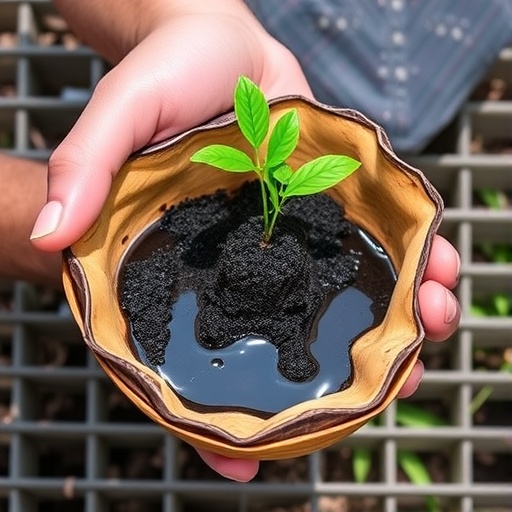
Pharmaceutical pollution is one of the quiet success stories of modern chemistry and one of the quiet failures of modern wastewater treatment. Every day, compounds such as painkillers, antibiotics, and antihistamines slip through conventional treatment plants and enter rivers, lakes, and groundwater. Now, a team of researchers from Ecuador, working with a collaborator in Germany, has developed a hybrid adsorbent that turns an abundant agricultural waste product—cocoa pod husks—into a high-performance material capable of capturing loratadine, a widely used second-generation antihistamine, from contaminated water. The work, published in Case Studies in Chemical and Environmental Engineering, combines sustainable materials chemistry with rigorous adsorption science and offers a template for addressing a class of pollutants that has received far less attention than it deserves.
Loratadine may seem an unlikely environmental villain. It sits in medicine cabinets around the world and is metabolized and excreted by millions of users daily, which means it and its active metabolite desloratadine are continuously introduced into wastewater streams. Studies have detected these compounds in influents, effluents, and surface waters across multiple regions, and ecotoxicological research has documented acute and chronic effects in algae, rotifers, crustaceans, activated sludge microbial communities, and zebrafish embryos. A 2017 global analysis by Kristofco and Brooks flagged loratadine as a compound requiring further ecotoxicological attention because some surface-water observations exceeded therapeutic hazard values. More recent work has shown that even treating loratadine-contaminated water with hypochlorite can generate degradation byproducts with their own toxic effects—a reminder that simply transforming a pollutant molecule is not the same as neutralizing its environmental impact.
The research team, led by Michael A. Vega and including authors from Universidad Central del Ecuador, Universidad ECOTEC, Universidad Estatal Amazónica, and the Karlsruhe Institute of Technology, took a different approach. Rather than breaking loratadine down, they designed a material that removes it from water through adsorption—the physical and chemical process by which molecules stick to a solid surface. Adsorption is attractive for water treatment because it is operationally simple, works at low contaminant concentrations, and can be tuned by engineering the surface properties of the adsorbent material. The key design question is always what material to use, and here the researchers made two strategic choices that together define the novelty of the work.
The first choice was the starting biomass. Cocoa pod husk is a lignocellulosic residue generated in enormous quantities in cocoa-producing regions of Latin America, where most of the world’s chocolate raw material is grown. The team converted dried and milled husk into pristine biochar through microwave-assisted pyrolysis, heating 100-gram batches at 720 watts for 15 minutes until the material reached a maximum temperature of 730 kelvin. This rapid, energy-efficient thermal treatment produces a carbon-rich, porous solid. The researchers then treated the pristine biochar with a dilute sodium hydroxide solution, which removed weakly bound inorganic residues and soluble organic fractions, partially unblocked pores, and increased the availability of oxygen-containing surface groups on the carbon. The result, labeled BC-M, served as the structural foundation for the next stage.
The second choice was the functional phase grown on top of that foundation. Zeolitic imidazolate framework-8, or ZIF-8, is a metal-organic framework—a crystalline material built from zinc ions connected by nitrogen-rich 2-methylimidazolate linkers into a porous, sodalite-like architecture. ZIF-8 offers hydrophobic cavities, defined porosity, and chemically tunable surfaces, all properties that complement the aromatic domains and residual oxygenated groups of biochar. Rather than mixing the two materials together physically, the team grew ZIF-8 directly on the modified biochar surface through an in situ synthesis. They first soaked the biochar in a methanolic solution of zinc nitrate for six hours, allowing zinc ions to bind to the oxygenated surface groups, then slowly added a solution of 2-methylimidazole and stirred the mixture for twelve hours while nanocrystals of ZIF-8 nucleated and grew on the carbon scaffold.
An extensive characterization campaign confirmed that the strategy worked. X-ray diffraction revealed the characteristic reflections of crystalline ZIF-8 on the hybrid surface, with an average crystallite size of 52.68 nanometers. Fourier-transform infrared spectroscopy showed the vibrational fingerprints of imidazolate rings and zinc-nitrogen bonds. Scanning electron microscopy captured the transformation of the biochar’s fibrous, honeycomb-like surface into one decorated with polyhedral ZIF-8 particles. Perhaps most strikingly, elemental analysis showed that the nitrogen content of the material jumped from 1.45 percent to 9.27 percent after framework growth, while zinc content rose from below 1 percent to 8.19 percent—clear compositional evidence that the nitrogen-rich imidazolate framework had been successfully integrated onto the biochar support.
The textural improvements were equally dramatic. Alkaline modification alone increased the Brunauer-Emmett-Teller surface area of the biochar from 3 to 43 square meters per gram. After ZIF-8 growth, the surface area reached 197 square meters per gram, with total pore volume increasing more than fourfold to 0.0988 cubic centimeters per gram. While these figures are modest compared with pure ZIF-8, which can exceed 1,000 square meters per gram, they are entirely reasonable for a hybrid material in which the carbonaceous support dilutes the framework phase. The point of zero charge of the hybrid was 9.67, meaning the surface remains positively charged under mildly acidic to near-neutral conditions—an important detail for understanding how the material interacts with dissolved contaminants.
With the material in hand, the researchers turned to adsorption testing. Using synthetic loratadine solutions quantified by high-performance liquid chromatography with ultraviolet detection, they systematically varied solution pH, adsorbent dose, contact time, initial contaminant concentration, and temperature. The optimal conditions emerged as pH 6, a contact time of 60 minutes, and an adsorbent dose of 75 milligrams per 100 milliliters of solution, at which point the material achieved a removal efficiency of 56.52 percent and a maximum adsorption capacity of 36.06 milligrams of loratadine per gram of adsorbent. The pH dependence is telling: at very acidic or alkaline conditions, performance declined, but the dominant mechanism is not simple electrostatic attraction, because loratadine exists predominantly in neutral form at pH values above its pKa of approximately 4.8. Instead, the evidence points to a cooperative interplay of hydrophobic interactions, pore filling, hydrogen bonding, π-π stacking between loratadine’s aromatic rings and the carbonaceous domains, and weak Lewis acid-base interactions.
Kinetic modeling revealed that the pseudo-first-order equation best described the uptake across a range of initial loratadine concentrations from 3 to 60 milligrams per liter, with coefficients of determination between 0.958 and 0.993 and calculated equilibrium capacities that closely matched experimental values. The equilibrium data, collected at four temperatures spanning 278.15 to 313.15 kelvin, were most consistently represented by the Sips isotherm, which combines features of Langmuir and Freundlich models and captures adsorption on heterogeneous surfaces with finite capacity. The Langmuir maximum capacity ranged from 23.027 to 24.879 milligrams per gram, remarkably stable across the temperature range and consistent with the kinetic results, suggesting that the accessible adsorption domains of the hybrid material approach saturation within the tested concentration window.
Thermodynamic analysis added nuance to the mechanistic picture. The Gibbs free energy change was negative across all tested temperatures, ranging from −21.407 to −24.270 kilojoules per mole, confirming that adsorption is spontaneous. The enthalpy change was very small and positive at 1.425 kilojoules per mole, indicating a weakly endothermic process driven by physical and physicochemical interactions rather than strong chemical bonding. The positive entropy change of 81.984 joules per mole per kelvin suggests that water molecules are displaced from both the adsorbent surface and the hydration shell of loratadine as the molecule migrates into hydrophobic and aromatic domains—an entropic contribution that helps drive the process forward.
Practical performance held up over repeated use. After ten washing steps that reduced zinc leaching to below detection limits by inductively coupled plasma optical emission spectroscopy, the researchers ran five consecutive adsorption cycles without any chemical or thermal regeneration. The material retained approximately 82.9 percent of its initial capacity by the fifth cycle, declining from 23.45 to 19.45 milligrams per gram. This suggests reasonable operational stability, though the authors are careful to note that formal regeneration studies using desorption agents, post-cycle structural characterization, and testing in real water matrices remain necessary before practical deployment.
The work is not a claim of immediate water-treatment readiness. The team is transparent about the moderate capacity relative to some highly engineered metal-organic framework systems that have achieved hundreds of milligrams per gram for other pharmaceuticals. But the significance lies in the specific combination achieved here: a scarcely studied adsorbate-material pairing, an abundant agro-industrial residue valorized as a functional carbon support, and a mechanistic framework that connects material design to adsorption performance. A preliminary techno-economic assessment estimated laboratory-scale production costs of approximately 14.80 US dollars per gram of hybrid material, with reagents dominating the expense—an area where solvent recovery and process optimization could yield significant savings at scale.
What the study ultimately demonstrates is that the path to cleaner water may run through some of the world’s most underutilized waste streams. Cocoa pod husks, discarded by the ton in producing regions, can be transformed into sophisticated hybrid materials whose performance emerges from the complementary chemistries of biochar and metal-organic frameworks. As monitoring programs in Latin America and elsewhere begin to grapple with contaminants of emerging concern, materials like ZIF-8@BC offer a model for how sustainability and performance can be engineered together rather than traded off. The next chapters—real water testing, regeneration optimization, and life cycle assessment—will determine whether this cocoa-derived adsorbent can move from the laboratory bench to the treatment plant, but the foundation is now firmly in place.
Cite Scienmag News
Bethany Barker. (September 7, 2026). Cocoa-shell biochar with ZIF-8 removes loratadine from water. Scienmag. https://scienmag.com/cocoa-shell-biochar-with-zif-8-removes-loratadine-from-water/
Bethany Barker. "Cocoa-shell biochar with ZIF-8 removes loratadine from water." Scienmag, 7 September 2026, https://scienmag.com/cocoa-shell-biochar-with-zif-8-removes-loratadine-from-water/. Accessed 7 September 2026.
Bethany Barker. "Cocoa-shell biochar with ZIF-8 removes loratadine from water." Scienmag. September 7, 2026. https://scienmag.com/cocoa-shell-biochar-with-zif-8-removes-loratadine-from-water/


