


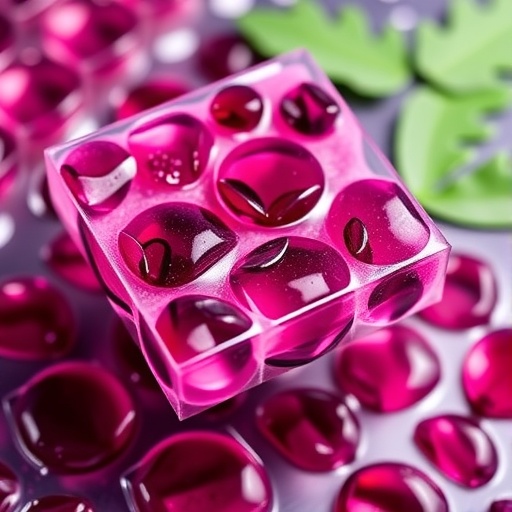
Researchers in Malaysia have developed a biodegradable packaging film that can visibly signal food spoilage as it happens, shifting through a spectrum of colors from red to green as the environment around it changes. The material, described in a new study in Polymer Bulletin, combines starch, chitosan nanoparticles, and anthocyanins—natural pigments responsible for the deep purple hues of fruits like purple sweet potato—into a single smart film that could one day replace conventional plastic packaging while giving consumers and retailers an instant, intuitive read on freshness.
The team, led by Siti Hajar Othman of Universiti Putra Malaysia’s Department of Process and Food Engineering, used a solvent casting approach to create films containing chitosan nanoparticles embedded in a starch matrix, with anthocyanin loadings ranging from 0 to 20 percent by weight. Chitosan, a polysaccharide derived from crustacean shells, has long been prized in food packaging research for its natural antimicrobial properties and film-forming ability. Starch, meanwhile, offers a cheap, abundant, and fully biodegradable base. The problem with both materials, however, has always been that films made from them tend to be brittle, weak, and permeable to water vapor—serious drawbacks for protecting moist foods like seafood and fresh produce. By reinforcing the starch matrix with chitosan nanoparticles and then infusing it with anthocyanins, the researchers set out to solve several problems at once: structural weakness, moisture sensitivity, spoilage detection, and antibacterial protection.
The mechanical results were striking. As anthocyanin concentration climbed to 20 percent, the films’ tensile strength increased by nearly half—a 49.2 percent improvement—while Young’s modulus, a measure of stiffness, rose by 67.3 percent. In practical terms, the film became both stronger and more rigid, better able to withstand the handling stresses of real-world packaging. The thermal profile improved in parallel. The onset temperature of thermal degradation rose to 248.21 °C, and the temperature of maximum degradation reached 288.39 °C, meaning the film can survive heat exposure that would compromise lesser biopolymer films. Not every property moved in a desirable direction: elongation at break, which measures how far a film can stretch before snapping, dropped by 54.9 percent, and water vapor permeability fell by 42.4 percent. Yet the researchers frame the drop in water vapor permeability as a genuine advantage, since blocking moisture transmission is precisely what a good food packaging film should do. The stiffness trade-off, meanwhile, reflects the denser, more tightly bound network that forms as anthocyanin molecules interact with the starch and chitosan nanoparticle components.
Those gains, the authors argue, stem from synergistic interactions among the three components. Hydrogen bonding between the hydroxyl groups of starch, the amine and hydroxyl groups of chitosan, and the phenolic hydroxyls of anthocyanins creates a more cohesive matrix. The nanoscale dimensions of the chitosan particles allow them to fill microscopic voids in the starch network, restricting polymer chain mobility and forcing any migrating water molecules to follow a longer, more tortuous path through the film. The anthocyanins, which can act as both pigment and crosslinking agent, further reinforce this network. The result is a film that is simultaneously tougher, stiffer, more thermally stable, and more resistant to moisture than the base starch material alone.
Perhaps the most commercially significant property, though, is the color change. Anthocyanins are natural halochromic compounds—their molecular structure shifts depending on the pH of their surroundings, and each structural form absorbs light differently, producing a different color. In the films developed by the Malaysian team, this translated into a clear, readable gradient: red at pH 1 to 6, purple at pH 7, blue at pH 8 to 9, and green at pH 10 to 12. Because food spoilage, particularly of protein-rich foods, generates alkaline compounds that raise the local pH, this color transition provides a direct visual proxy for deterioration. A fresh product sitting at neutral pH would show purple; as bacteria break down proteins and release volatile amines like trimethylamine and ammonia, the pH rises and the film shifts toward blue and then green.
The team put this to the test using chilled shrimp, a food notorious for rapid spoilage. Over six days of refrigerated storage, the purple color of the film gradually faded, tracking the accumulation of volatile basic nitrogen compounds—the standard chemical signature of seafood decomposition. In other words, the film didn’t just detect spoilage in a laboratory setting; it tracked it in real time, on a real food product, under real storage conditions. For consumers, this could mean no more guessing whether shrimp in the fridge is still safe based on smell alone. For retailers, it could mean more accurate shelf-life management and less food waste from premature disposal.
The antibacterial results were more nuanced. When the researchers tested the anthocyanin-loaded films against Staphylococcus aureus and Escherichia coli, two common foodborne pathogens, they found no clear inhibition zones—halos of killed bacteria surrounding a film disc that would indicate the active compounds were diffusing outward through the agar. Instead, they observed clear areas directly beneath the films, where the film had made direct contact with the bacterial lawn. This points to a contact-dependent antibacterial mechanism: the active compounds, likely the chitosan and anthocyanins together, are effectively immobilized within the film matrix and cannot diffuse freely, but they can still kill or inhibit bacteria they touch. For packaging applications, this is actually a meaningful finding. A film that kills microbes on contact at the food surface could suppress the bacterial growth that drives spoilage, without leaching active compounds into the food itself—a property that might raise regulatory and consumer concerns if it were more mobile.
The work sits at the intersection of two major trends in food packaging research: the search for sustainable alternatives to petroleum-based plastics, and the emergence of “intelligent” packaging that does more than simply contain food. Conventional plastic packaging, while cheap and effective, contributes massively to global waste and offers no information about the state of the food inside. Biopolymer films like the ones described here address the first problem by using renewable, compostable materials. The addition of anthocyanin—a pigment extracted from food waste streams such as fruit peels in some studies—addresses the second problem by turning the film itself into a freshness indicator. Smart packaging of this kind has gained traction in recent years, with researchers exploring anthocyanins from red cabbage, butterfly pea flower, roselle, dragon fruit, and other sources in a variety of polymer matrices. What distinguishes this study is the combination of all three functional elements—nanoreinforcement, antibacterial action, and pH-sensitive color change—within a single starch-based film, and the demonstration that all three improve, rather than interfere with, one another.
There are still hurdles before such films reach supermarket shelves. Anthocyanins are notoriously sensitive to light, oxygen, and heat, which can degrade the pigment and blunt its color response over time. The chitosan used to make the nanoparticles comes from crustacean shells, raising questions about scalability and cost, as well as potential concerns for consumers with shellfish allergies. And while the mechanical and thermal properties improved substantially, the drop in elongation at break could limit the film’s use in applications requiring flexible packaging. Real-world adoption would also require validation across a wider range of food products and storage conditions, along with regulatory approval for food contact.
Still, the study offers a compelling proof of concept: a fully biodegradable film, made from abundant natural polymers and plant pigments, that is stronger, more moisture-resistant, and more thermally stable than the base material, that actively kills bacteria on contact, and that tells you at a glance whether the food inside is still fresh. As the researchers note, the films demonstrated enhanced structural and functional properties and are promising for use as environmentally friendly smart packaging for real-time food quality monitoring. In a world grappling with both plastic pollution and food waste, a piece of packaging that solves both problems simultaneously—while communicating with the consumer through nothing more than a shift in color—is the kind of elegant, multifunctional solution that food science has been working toward for years. The Malaysian team’s work suggests that the ingredients for that solution may already be sitting in the kitchen, waiting to be cast into film.
Cite Scienmag News
Bethany Barker. (September 6, 2026). Anthocyanin-enriched starch-chitosan films show promise for smart packaging. Scienmag. https://scienmag.com/anthocyanin-enriched-starch-chitosan-films-show-promise-for-smart-packaging/
Bethany Barker. "Anthocyanin-enriched starch-chitosan films show promise for smart packaging." Scienmag, 6 September 2026, https://scienmag.com/anthocyanin-enriched-starch-chitosan-films-show-promise-for-smart-packaging/. Accessed 6 September 2026.
Bethany Barker. "Anthocyanin-enriched starch-chitosan films show promise for smart packaging." Scienmag. September 6, 2026. https://scienmag.com/anthocyanin-enriched-starch-chitosan-films-show-promise-for-smart-packaging/


