

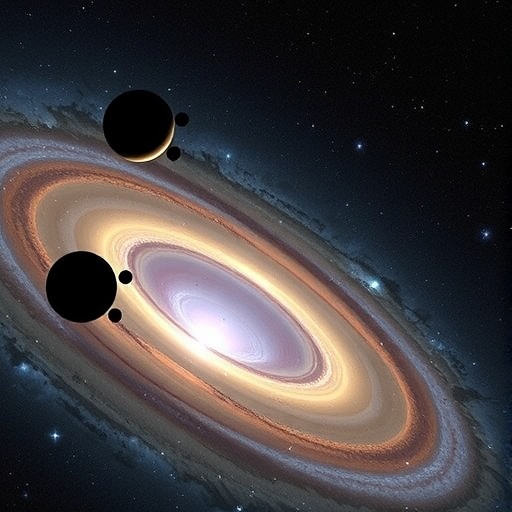
In an exciting new revelation from the cosmos, scientists from the University of Missouri have thoroughly examined the depths of the universe using data from NASA’s groundbreaking James Webb Space Telescope (JWST) and have discovered 300 exceptionally bright astronomical objects. These objects exhibit an unusual brightness that defies existing standards, prompting the researchers to classify them as potential candidate galaxies from the early universe. This compelling finding raises a critical question regarding the formation and evolution of galaxies during this formative era.
Professor Haojing Yan from the University of Missouri’s College of Arts and Science, who is involved in this groundbreaking research, expressed significant optimism about the potential of these findings to reshape our understanding of galactic formation. “These mysterious objects might represent very early galaxies,” Yan stated, asserting that if their hypotheses hold true, they could radically challenge the prevailing theories concerning galaxy formation during the nascent stages of the universe when the first stars and galaxies emerged.
Identifying celestial bodies in the vastness of space is not a swift endeavor. It entails a methodical and intricate process, incorporating advanced technologies and extensive analyses, alongside a keen investigative approach akin to cosmic sleuthing. The team executed a series of meticulous steps, beginning with the application of JWST’s advanced infrared imaging capabilities, specifically utilizing its Near-Infrared Camera and Mid-Infrared Instrument to detect and analyze the light emitted by distant celestial objects.
The utilization of infrared technology is paramount in the pursuit of understanding objects from the distant universe. Light emitted by celestial bodies transforms as it travels vast distances, elongating into longer wavelengths due to the stretching phenomenon known as redshift. This redshift is crucial for cosmologists as it allows for the estimation of distances in the cosmos. “As these early galaxies’ light travels through space, it shifts from visible light to infrared. The degree of redshift correlates with the distance of these galaxies from Earth and positions them closer to the universe’s early history,” explained Yan, offering insight into the mechanics of the universe’s structure.
To filter through and pinpoint their candidates, the Mizzou researchers employed a well-established technique known as the dropout method. This technique identifies high-redshift galaxies by detecting objects that seem to fade from visible light to redder wavelengths, indicating the vast distances the light has traversed over time. Bangzheng “Tom” Sun, a Ph.D. student involved in the study, elaborated on this process, stating that the dropout phenomenon is characterized by the ‘Lyman Break,’ which manifests in spectral outlines due to the absorption of ultraviolet light by neutral hydrogen. As the redshift increases, the Lyman Break shifts into redder wavelengths, effectively indicating the distance and age of the galaxies.
The next phase of the research aimed to ascertain whether these identified candidates indeed existed at “very” high redshifts. Though spectroscopic data is the gold standard for accurate measurement of such distances, when this data is limited, researchers can employ spectral energy distribution fitting. This approach enabled Sun and Yan to make educated estimations regarding the redshifts and other characteristics of the galaxies under consideration, such as their age and mass.
Historically, a misconception existed among scientists suggesting that many of these exceptionally radiant objects did not represent early galaxies but rather phenomena that appeared similar. However, based on their nuanced analyses, Sun and Yan contend that these objects merit a more thorough investigation, advocating against premature dismissal of their significance in the context of cosmic evolution. Yan intriguingly noted, “Even if only a fraction of these candidates are confirmed to be from the early universe, it will compel a re-evaluation of existing galaxy formation theories.”
The culmination of this research will hinge on the definitive testing through spectroscopy, heralded as the definitive method for confirming the nature of these candidate galaxies. This technique offers profound insights by dispersing light into various wavelengths, akin to how a prism reveals a spectrum of colors. It provides researchers with a unique cosmic fingerprint for each galaxy, unveiling critical information regarding their formation, age, and composition.
In a remarkable twist, one of the objects already underwent spectroscopic analysis, confirming its identity as an early galaxy. However, the researchers emphasize that this solitary confirmation does not suffice to overturn existing theories. To substantiate their claims fully, additional confirmations are essential to ensure a robust challenge to current understandings of galaxy formation.
This study is documented in a manuscript titled “On the very bright dropouts selected using the James Webb Space Telescope NIRCam instrument,” which has been published in The Astrophysical Journal. This research not only advances our comprehension of the universe but also invites a broader discourse on the complexities of galaxy formation and evolution during one of the most enigmatic epochs in cosmic history.
In summary, the discoveries made by the University of Missouri researchers underscore a significant stride towards unraveling the early universe’s mysteries. Their methodical blend of advanced infrared imaging, innovative identification techniques, and a deliberate approach to cosmic investigation exemplifies the ongoing quest for understanding the universe’s origins, lending exciting insights into the formative stages of cosmic evolution.
Subject of Research: Early Universe Galaxy Candidates
Article Title: On the very bright dropouts selected using the James Webb Space Telescope NIRCam instrument
News Publication Date: 27-Jun-2025
Web References: Journal Article
References: The Astrophysical Journal
Image Credits: Bangzheng “Tom” Sun/University of Missouri
Keywords
Early galaxies, James Webb Space Telescope, infrared imaging, redshift, cosmic evolution, spectroscopy.


