


In a significant advancement for agricultural science, a research team led by Professor YE Jian from the Institute of Microbiology at the Chinese Academy of Sciences has made groundbreaking revelations concerning citrus greening disease, commonly known as huanglongbing (HLB). This study, recently published in the prestigious journal Science, sheds light on the intrinsic mechanisms underpinning natural citrus resistance to HLB, a malady that has wreaked havoc on citrus crops globally. As citrus greening continues to escalate as a formidable threat to agriculture, this new research could represent a turning point in our battle against this devastating disease.
Citrus greening disease is characterized by its severe impact on the economy and food supply, causing over $10 billion in losses each year. The disease is primarily caused by the bacterium Candidatus Liberibacter asiaticus (CLas) and perpetuated by the Asian citrus psyllid, Diaphorina citri. Once infected, citrus trees typically decline and die within a matter of years, leading to significant losses for growers and a decline in production worldwide. The emergence of this disease has rendered all commercially cultivated citrus varieties vulnerable, marking it as one of agriculture’s most destructive pathogens.
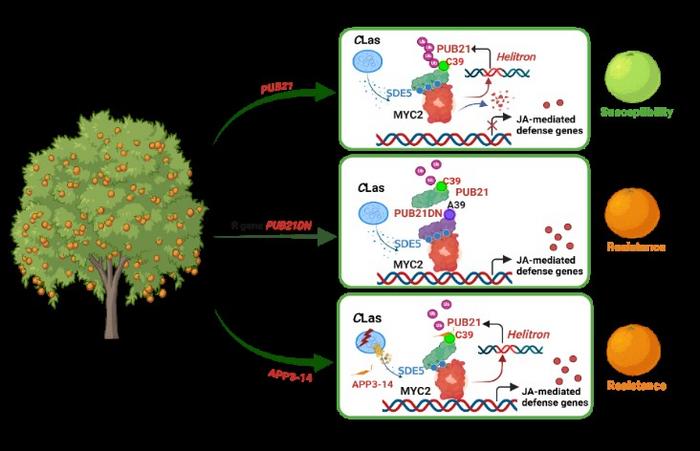
The research team’s focus was on elucidating the resistance mechanisms present within citrus species against HLB. The breakthrough was the identification of a crucial resistance pathway associated with the transcription factor MYC2 and its regulator, the E3 ligase PUB21. By investigating various citrus species and their relatives in the Rutaceae family, the team discovered PUB21 paralogs in Bergera koenigii (the curry leaf plant) and Zanthoxylum bungeanum (the Sichuan pepper). These findings are particularly noteworthy as they elucidate a complex interaction between these proteins that plays a vital role in enhancing plant defense mechanisms.
In their investigation, the researchers defined how the PUB21 protein, through a dominant-negative variant called PUB21DN, operates to stabilize MYC2, thereby boosting the plant’s defensive responses against pathogens. Through mutational analysis, it was revealed that a critical alteration at residue 39 of PUB21 mitigates its activity, triggering a cascade of enhanced defense signaling pathways. This discovery marks a pivotal step towards engineering HLB-resilient citrus varieties, as transgenic plants overexpressing PUB21DN were shown to exhibit notable resistance against HLB.
In an innovative tangent, this research harnessed the power of artificial intelligence in conjunction with traditional molecular biology techniques. Utilizing AI-driven screening technologies, the team sought to further develop methods of stabilizing MYC2 by targeting PUB21 activity. This multifaceted approach resulted in the identification of a novel class of antimicrobial peptides, specifically anti-proteolysis peptides (APPs). Among these, APP3-14 stood out, demonstrating exceptional promise during both greenhouse and field trials.
The efficacy of APP3-14 in controlling CLas is particularly noteworthy, with reports of achieving approximately 80% control efficiency in just a single growing season. This breakthrough is not only a potential game-changer in terms of immediate agricultural application but also represents a sustainable method for combating diseases that currently lack viable treatments. By employing eco-friendly bio-pesticides derived from these peptides, the research team is pioneering a strategy that minimizes chemical usage while maximizing disease control.
The implications of this research extend far beyond citrus greening. The methodologies and findings could be applicable to a variety of plant diseases caused by challenging-to-cultivate pathogens. Future applications may address diseases like maize rust fungus and plant afflictions caused by Xylella fastidiosa, which is associated with Olive Quick Decline Syndrome (OQDS). This research presents a transformative blueprint for disease resistance in crops—a crucial step towards sustainable agricultural practices in an increasingly challenging climate.
In conclusion, the work led by Professor YE Jian and his team signifies a remarkable stride in plant pathology and agricultural biotechnology. By unraveling the mechanisms of citrus resistance to HLB and developing practical applications utilizing AI-designed therapies, this research highlights the synergy between modern technology and traditional plant science. As global agricultural faces mounting pressures from climate change and pest pressures, the insights gleaned from this work could play a vital role in ensuring food security and sustainability for future generations.
The pressing need for effective solutions against citrus greening has never been more urgent. With the findings from this study, scientists and agricultural practitioners may finally have the tools necessary to restore the citrus industry and protect it from one of its most formidable adversaries. As research continues to evolve, the potential for further advancements remains expansive, with an overarching mission to secure agricultural viability and bolster food systems worldwide.
Cite Scienmag News
Alan Morgan. (April 10, 2025). Unraveling Citrus Greening Resistance: Scientists Harness AI to Develop Innovative Treatments. Scienmag. https://scienmag.com/unraveling-citrus-greening-resistance-scientists-harness-ai-to-develop-innovative-treatments/
Alan Morgan. "Unraveling Citrus Greening Resistance: Scientists Harness AI to Develop Innovative Treatments." Scienmag, 10 April 2025, https://scienmag.com/unraveling-citrus-greening-resistance-scientists-harness-ai-to-develop-innovative-treatments/. Accessed 3 September 2026.
Alan Morgan. "Unraveling Citrus Greening Resistance: Scientists Harness AI to Develop Innovative Treatments." Scienmag. April 10, 2025. https://scienmag.com/unraveling-citrus-greening-resistance-scientists-harness-ai-to-develop-innovative-treatments/


