


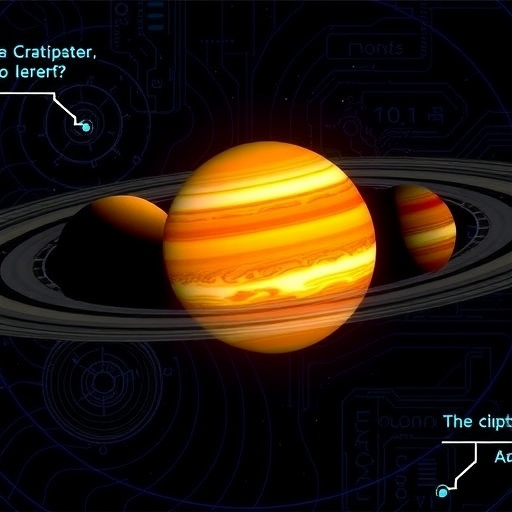
In a breakthrough study led by Ismael Mireles, a PhD candidate at The University of New Mexico (UNM), astronomers have unveiled a dynamic and complex exoplanetary system orbiting the star TOI-201. Published in the prestigious journal Science Advances, this research sheds light on three distinct celestial bodies within the system—a super-Earth, a warm Jupiter, and a brown dwarf—that interact in ways that challenge conventional understanding of planetary formation and orbital evolution.
The TOI-201 system forms a unique laboratory for the study of orbital dynamics because of the diverse nature of its constituents and their unusual interactions. Mireles, under the mentorship of Professor Diana Dragomir, undertook an observational study combining multiple precise measurement techniques to not only identify these bodies but to actively track the evolving orbits in real-time—an exceptional feat given that planetary movements typically occur on timescales of millions of years. This discovery allows astronomers a rare glimpse into the fast-paced dynamical shifts occurring in such distant systems.
The innermost planet, designated TOI-201 d, is classified as a super-Earth. It is approximately 1.4 times Earth’s radius and about six times its mass, completing an orbit around its host star every 5.85 days. Given its proximity to the star, this rocky planet experiences intense stellar radiation, rendering it inhospitable to liquid water and likely incapable of supporting life as we know it. Its rapid orbit and composition provide invaluable clues about planetary survival and atmospheric retention in close stellar environments.
Sitting further out is TOI-201 b, a warm Jupiter. Unlike the hot Jupiters orbiting within just days, this gas giant completes an orbit every 53 days and possesses about half the mass of Jupiter. Warm Jupiters occupy a particularly enigmatic niche in exoplanetary research, as the mechanisms that govern their migration from formation locations to observed orbits remain contentious. The confirmation of such a planet in the TOI-201 system adds vital data for disentangling gas giant formation theories, especially the processes governing inward migration and orbital stabilization.
The most massive and dynamically influential body in the system is TOI-201 c, a brown dwarf residing on a highly elliptical orbit with an orbital period close to eight years. Brown dwarfs occupy the mass range between stars and planets—too massive to be planets but insufficiently massive to ignite sustained hydrogen fusion like a star. With a mass roughly 13 times that of Jupiter, TOI-201 c represents a boundary object that blurs the distinction between formation pathways typical of stars versus planets. This object’s elongated orbit induces complex gravitational interactions, driving dynamical changes in the inner planets and resulting in significant orbital inclinations that challenge prior theories assuming coplanar planetary formation.
One of the most riveting aspects of this research is the system’s rapid orbital evolution. Mireles emphasizes that the system stands apart because its orbital changes unfold on observable human timescales rather than geological eons. Currently, the planetary orbits are misaligned, pulling and tilting each other as they dance gravitationally. Over centuries, these interactions will cause the planets to temporarily cease transiting their star from Earth’s viewpoint; notably, TOI-201 d is expected to stop transiting within 200 years, followed by TOI-201 b and eventually TOI-201 c. These orbital inclination cycles are reminiscent of complex celestial mechanics seen in multi-body systems but rarely documented in real-time within extrasolar contexts.
The team’s success hinged on leveraging four complementary observational techniques. First, radial velocity measurements revealed subtle stellar wobbles induced by orbiting companions, helping characterize masses and orbits. Multiple high-precision spectrographs including CORALIE, HARPS, and PFS in Chile, supplemented by archival data from FEROS and MINERVA-Australis in Australia, marked an international collaboration maximizing data fidelity. Second, transit photometry using NASA’s TESS spacecraft alongside ground telescopes such as the ASTEP facility in Antarctica and the Las Cumbres Observatory Global Telescope (LCOGT) network provided crucial light curve data confirming planetary transits and constraining sizes.
Transit Timing Variations (TTVs) formed the third technique, detecting slight irregularities in transit times caused by mutual planetary gravitational pulls—an effective probe of dynamic interactions and planetary masses. The fourth approach, astrometry, utilized data from the Hipparcos and Gaia space observatories to detect minuscule star position shifts attributable to the gravitational influence of massive orbiting bodies. These combined modalities produced a comprehensive, nuanced portrait of TOI-201’s architecture and dynamics unattainable by any single measurement method alone.
The implications of this research extend deep into understanding how planetary systems form and evolve, especially when stellar formation and disk dynamics lead to inclined orbits and complex gravitational interplays. The misaligned, dynamically active state of TOI-201 challenges classical models that posit planets form and remain in flat, aligned planes co-rotating with the protoplanetary disk—a hallmark seen in our own Solar System. Scientists now must unravel the processes—whether past gravitational encounters, disk torques, or early perturbations—that yield such orbital disarray.
Professor Dragomir highlights an additional puzzle posed by TOI-201 c’s ambiguous nature near the dividing line between giant planets and brown dwarfs. Understanding whether this massive companion originated through planet-like accretion or star-like collapse could unlock crucial clues about formation thresholds and the demographics of substellar objects. This is particularly compelling given TOI-201 c’s status as the longest-period transiting object ever discovered, representing a new observational frontier for brown dwarf and exoplanet research.
The research holds promise not just for professional astronomers but also for engaged citizen scientists. The next predicted transit of TOI-201 c is slated for March 26, 2031, an event that, while rare, offers a golden opportunity for worldwide observational campaigns. The global astronomy community, equipped with both professional-grade and advanced amateur telescopes, will be poised to capture data critical for refining models of orbital evolution, atmospheric properties, and dynamical interactions.
Ultimately, this study exemplifies the power of multi-year, international collaboration and multi-technique observational campaigns in unraveling the complexities of distant planetary systems. Each transit observed, each radial velocity measurement taken, contributes incrementally to peeling back the layers obscuring the 3D arrangement and internal gravitational choreography of TOI-201. The system’s unparalleled dynamism provides a rare real-time window into the ongoing narrative of planetary migration, interaction, and orbital evolution—processes fundamental to understanding not only distant exoplanetary systems but also the history and future of our own cosmic neighborhood.
Keywords
TOI-201, exoplanets, super-Earth, warm Jupiter, brown dwarf, orbital dynamics, transit photometry, radial velocity, transit timing variations, astrometry, planetary system evolution, misaligned orbits
Cite Scienmag News
Grant Pearson. (April 15, 2026). UNM Astronomers Unveil Dynamic Multi-Planet System in Constant Flux. Scienmag. https://scienmag.com/unm-astronomers-unveil-dynamic-multi-planet-system-in-constant-flux/
Grant Pearson. "UNM Astronomers Unveil Dynamic Multi-Planet System in Constant Flux." Scienmag, 15 April 2026, https://scienmag.com/unm-astronomers-unveil-dynamic-multi-planet-system-in-constant-flux/. Accessed 4 September 2026.
Grant Pearson. "UNM Astronomers Unveil Dynamic Multi-Planet System in Constant Flux." Scienmag. April 15, 2026. https://scienmag.com/unm-astronomers-unveil-dynamic-multi-planet-system-in-constant-flux/


