


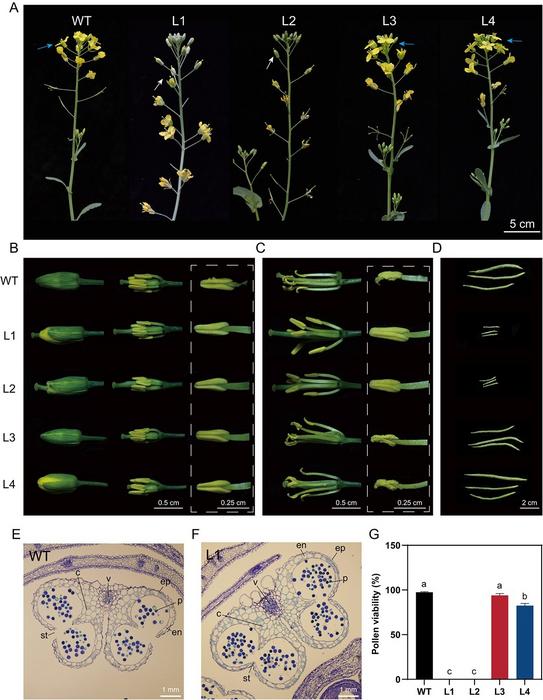
In a transformative advance for agriculture, scientists have utilized CRISPR/Cas9 technology to develop a male-sterile line in rapeseed. This innovation simplifies the hybrid seed production process, overcoming traditional limitations and enhancing the crop’s yield and sustainability. By targeting the BnDAD1 gene, the study disrupts the jasmonic acid pathway, essential for pollen development, leading to a controlled and efficient method for creating hybrids that can significantly boost vegetable oil output to meet global demands.

Credit: Horticulture Research
In a transformative advance for agriculture, scientists have utilized CRISPR/Cas9 technology to develop a male-sterile line in rapeseed. This innovation simplifies the hybrid seed production process, overcoming traditional limitations and enhancing the crop’s yield and sustainability. By targeting the BnDAD1 gene, the study disrupts the jasmonic acid pathway, essential for pollen development, leading to a controlled and efficient method for creating hybrids that can significantly boost vegetable oil output to meet global demands.
Hybrid production in rapeseed faces several significant challenges, primarily due to the complexities and limitations of current male sterility systems. Traditional methods often involve intricate management processes and are highly sensitive to environmental conditions, resulting in unstable and inefficient hybrid seed production. Due to these issues, there is a pressing need for a more efficient, stable, and environmentally resilient system to improve hybrid production in rapeseed, ensuring higher yields and better adaptability to varying agricultural conditions.
Researchers from Zhejiang University and Jiaxing Academy of Agricultural Sciences, publishing (DOI: 10.1093/hr/uhae139) in Horticulture Research on May 28, 2024, developed a novel approach using CRISPR/Cas9 technology. This method targets the BnDAD1 gene, creating male-sterile lines in rapeseed, thus simplifying hybrid seed production.
The study effectively disrupted the BnDAD1 gene, which plays a crucial role in the jasmonic acid biosynthesis pathway, using CRISPR/Cas9 technology. This disruption resulted in male sterility due to defects in anther dehiscence and pollen maturation in rapeseed. By applying exogenous methyl jasmonate, the researchers were able to restore fertility in the male-sterile lines, enabling the production of F1 hybrid seeds. This new two-line system offers a more straightforward and efficient method for hybrid seed production compared to traditional systems, which often face environmental stability issues. The male sterility induced by the CRISPR/Cas9 method proved to be stable and complete, independent of environmental conditions, making it a robust solution for hybrid rapeseed production. This innovative approach holds significant commercial potential, promising to enhance the efficiency and sustainability of rapeseed cultivation.
Dr. Lixi Jiang, lead researcher from Zhejiang University, stated, “Our findings present a significant advancement in rapeseed hybrid production. The use of CRISPR/Cas9 to induce male sterility simplifies the breeding process and holds great promise for enhancing rapeseed yield and sustainability.”
This innovative approach can revolutionize hybrid seed production in rapeseed, providing a more efficient and stable method. The application of this technology can lead to increased yields and sustainability in rapeseed cultivation, addressing the growing global demand for vegetable oil.
###
References
Original Source URL
Funding information
This work was sponsored by the STI 2030 – Major Projects (2023ZD04008).
About Horticulture Research
Horticulture Research is an open access journal of Nanjing Agricultural University and ranked number one in the Horticulture category of the Journal Citation Reports ™ from Clarivate, 2022. The journal is committed to publishing original research articles, reviews, perspectives, comments, correspondence articles and letters to the editor related to all major horticultural plants and disciplines, including biotechnology, breeding, cellular and molecular biology, evolution, genetics, inter-species interactions, physiology, and the origination and domestication of crops.
Journal
Horticulture Research
Subject of Research
Not applicable
Article Title
A CRISPR/Cas9-induced male-sterile line facilitating easy hybrid production in polyploid rapeseed (Brassica napus)
Article Publication Date
28-May-2024
COI Statement
The authors declare that they have no competing interests.
Cite Scienmag News
Juliet Wilcox. (August 9, 2024). Unlocking the potential of rapeseed: CRISPR edits for hybrid efficiency. Scienmag. https://scienmag.com/unlocking-the-potential-of-rapeseed-crispr-edits-for-hybrid-efficiency/
Juliet Wilcox. "Unlocking the potential of rapeseed: CRISPR edits for hybrid efficiency." Scienmag, 9 August 2024, https://scienmag.com/unlocking-the-potential-of-rapeseed-crispr-edits-for-hybrid-efficiency/. Accessed 6 September 2026.
Juliet Wilcox. "Unlocking the potential of rapeseed: CRISPR edits for hybrid efficiency." Scienmag. August 9, 2024. https://scienmag.com/unlocking-the-potential-of-rapeseed-crispr-edits-for-hybrid-efficiency/

