


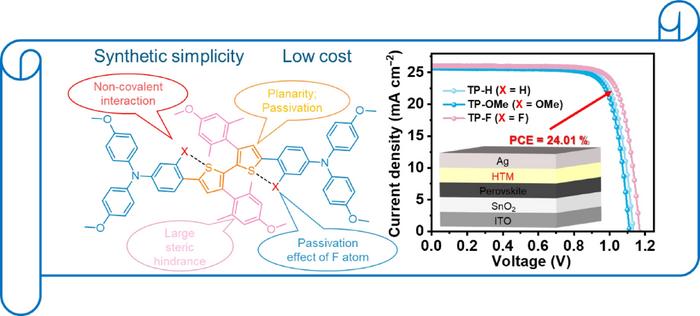
Perovskite solar cells (PSCs) are celebrated for their exceptional photovoltaic performance and affordability. However, the high cost of charge transport materials remains a major obstacle to their commercialization. Conventional materials like 2,2′,7,7′-Tetrakis[N,N-di(4-methoxyphenyl)amino]-9,9′-spirobifluorene (Spiro-OMeTAD), are expensive and complex to produce. Therefore, developing low-cost, efficient alternatives is essential to make PSCs more economically viable. Addressing these issues is crucial for advancing solar technology and achieving broader adoption. Hence, this study focuses on creating cost-effective hole transport materials to overcome these barriers and enhance the commercial potential of PSCs.

Credit: Energy Materials and Devices, Tsinghua University Press
Perovskite solar cells (PSCs) are celebrated for their exceptional photovoltaic performance and affordability. However, the high cost of charge transport materials remains a major obstacle to their commercialization. Conventional materials like 2,2′,7,7′-Tetrakis[N,N-di(4-methoxyphenyl)amino]-9,9′-spirobifluorene (Spiro-OMeTAD), are expensive and complex to produce. Therefore, developing low-cost, efficient alternatives is essential to make PSCs more economically viable. Addressing these issues is crucial for advancing solar technology and achieving broader adoption. Hence, this study focuses on creating cost-effective hole transport materials to overcome these barriers and enhance the commercial potential of PSCs.
Researchers from Huaqiao University and Qufu Normal University have unveiled a pioneering advancement in the field of solar energy. Their study (DOI: 10.26599/EMD.2024.9370036), published in June 2024 in the esteemed journal Energy Materials and Devices, introduces three novel hole transport materials that could redefine the efficiency of n-i-p PSCs. These materials, meticulously designed and synthesized, exhibit remarkable properties that have the potential to surpass the current benchmarks in solar cell performance, offering a promising step towards the future of renewable energy.
This study presents the development of three cost-effective hole transport materials (HTMs), 4,4′-(3,3′-bis(4-methoxy-2,6-dimethylphenyl)-[2,2′-bithiophene]-5,5′-diyl)bis(N,N-bis(4-methoxyphenyl)aniline) (TP-H), 4,4′-(3,3′-bis(4-methoxy-2,6-dimethylphenyl)-[2,2′-bithiophene]-5, 5′-diyl)bis(3-methoxy-N,N-bis(4-methoxyphenyl)aniline) (TP-OMe), and 4,4′-(3,3′-bis(4-methoxy-2,6-dimethylphenyl)-[2,2′-bithiophene]-5,5′-diyl)bis(3-fluoro-N,N-bis(4-methoxyphenyl)aniline) (TP-F), using a bithiophene core. These materials were designed to enhance molecular crystallinity and solubility, crucial for effective hole transport in PSCs. TP-F, in particular, achieved a power conversion efficiency (PCE) exceeding 24%, attributed to its fluorine atom substitution, which enhanced intermolecular packing, lowered the highest occupied molecular orbital (HOMO) energy level, and improved hole mobility and conductivity. These improvements reduced defect states and minimized trap-mediated recombination in PSCs. The study highlights the potential of the 3,3′-bis(4-methoxy-2,6-dimethylphenyl)-2,2′-bithiophene core structure for creating efficient, low-cost HTMs, demonstrating significant advancements in PSC technology and paving the way for more commercially viable solar energy solutions.
Dr. Wei Gao, a leading researcher in the study, stated, “The development of these novel HTMs marks a significant step towards making PSCs more commercially viable. The enhanced efficiency and reduced costs of these materials could accelerate the adoption of PSCs in the solar energy market, providing a more sustainable and cost-effective energy solution.”
The implications of this research are profound, as it opens up new avenues for the commercial production of high-efficiency, low-cost PSCs. The successful integration of TP-F into PSCs demonstrates the potential for these materials to significantly reduce production costs while maintaining high performance. This advancement could lead to broader adoption of solar energy technologies, contributing to global efforts in sustainable energy development and reducing reliance on fossil fuels.
This work was financially supported by the National Natural Science Foundation of China (Grant Nos. U23A20371, U21A2078, and 22179042), the Natural Science Foundation of Fujian Province (Grant No. 2023J06034), the Natural Science Foundation of Xiamen, China (Grant No. 3502Z20227036), and the Scientific Research Funds of Huaqiao University (Grant No. 605-50Y23024).
About Energy Materials and Devices
Energy Materials and Devices is launched by Tsinghua University, published quarterly by Tsinghua University Press, exclusively available via SciOpen, aiming at being an international, single-blind peer-reviewed, open-access and interdisciplinary journal in the cutting-edge field of energy materials and devices. It focuses on the innovation research of the whole chain of basic research, technological innovation, achievement transformation and industrialization in the field of energy materials and devices, and publishes original, leading and forward-looking research results, including but not limited to the materials design, synthesis, integration, assembly and characterization of devices for energy storage and conversion etc.
About SciOpen
SciOpen is an open access resource of scientific and technical content published by Tsinghua University Press and its publishing partners. SciOpen provides end-to-end services across manuscript submission, peer review, content hosting, analytics, identity management, and expert advice to ensure each journal’s development. By digitalizing the publishing process, SciOpen widens the reach, deepens the impact, and accelerates the exchange of ideas.
Journal
Energy Materials and Devices
Article Title
Bithiophene-based cost-effective hole transport materials for efficient n–i–p perovskite solar cells
Article Publication Date
31-May-2024
Cite Scienmag News
Bethany Barker. (July 25, 2024). Unlocking solar efficiency: a leap in perovskite solar cell technology. Scienmag. https://scienmag.com/unlocking-solar-efficiency-a-leap-in-perovskite-solar-cell-technology/
Bethany Barker. "Unlocking solar efficiency: a leap in perovskite solar cell technology." Scienmag, 25 July 2024, https://scienmag.com/unlocking-solar-efficiency-a-leap-in-perovskite-solar-cell-technology/. Accessed 9 September 2026.
Bethany Barker. "Unlocking solar efficiency: a leap in perovskite solar cell technology." Scienmag. July 25, 2024. https://scienmag.com/unlocking-solar-efficiency-a-leap-in-perovskite-solar-cell-technology/

