


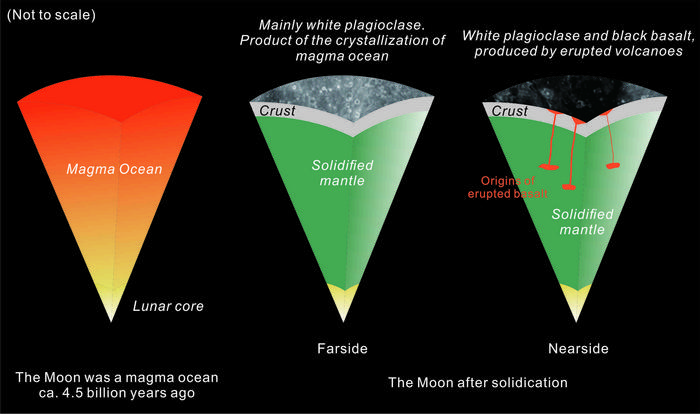
Around 4.5 billion years ago, in the tumultuous infancy of our solar system, the Moon formed through a colossal collision between the proto-Earth and a Mars-sized body known as Theia. This cataclysmic impact released an extraordinary amount of energy, melting vast regions of both bodies and creating a global magma ocean enveloping the nascent Moon. Conventional scientific understanding has long posited that as this magma ocean cooled and solidified, it would produce a relatively uniform lunar crust composed largely of plagioclase minerals. However, the stark dichotomy that we observe between the Moon’s nearside and farside presents a significant challenge to this view, suggesting a far more complex geological history behind our satellite.
From Earth, the Moon always reveals the same face – a stark landscape dominated by dark basaltic plains called lunar maria and bright highland regions. The near hemisphere, perpetually facing Earth due to tidal locking, is richly embroidered with these extensive basaltic seas, formed by volcanic eruptions approximately 3.5 billion years ago. Contrastingly, the lunar farside appears notably different, featuring an absence of these maria and instead a terrain dominated by rugged, bright highlands marked by an almost complete lack of basaltic volcanism. This hemispherical asymmetry, or lunar dichotomy, has long intrigued planetary geologists and demands an explanation rooted in the early Moon’s formation and evolution.
Recent groundbreaking research conducted by an international collaboration including the Geodynamics Research Center at Ehime University, Universität Münster, and Vrije Universiteit Amsterdam offers crucial insights into the Moon’s evolutionary pathways. Focusing on the behavior of halogen elements, particularly chlorine (Cl), within lunar minerals and magmatic melts, the team sought to elucidate the underlying cause of this hemispherical disparity. Halogens such as fluorine and chlorine, despite their trace abundances, bear significant geochemical importance because of their volatility and sensitivity to magmatic processes, effectively recording chemical conditions and events during lunar crust formation.
The researchers employed sophisticated high-pressure and high-temperature laboratory experiments designed to simulate the extreme conditions of lunar magma oceans and subsequent crust formation. These experiments allowed precise determination of chlorine’s partitioning behavior between solid lunar minerals and coexisting melts under variable conditions. Incorporating these experimental partitioning data into geochemical models that incorporate physical and chemical lunar mantle evolution, the researchers then compared predicted halogen abundances with those measured from authentic lunar crustal specimens, derived primarily from Apollo mission samples and lunar meteorites.
Their analyses uncovered a striking enrichment of chlorine in the samples obtained from the lunar nearside crust – a signature conspicuously missing from farside samples. This differential Cl concentration implies the widespread presence of a volatile chloride-rich vapor phase that was likely confined to the nearside environment during and after the formation of the lunar crust. Given chlorine’s known behavior as a highly incompatible and volatile element during magmatic differentiation, the presence of such a vapor phase suggests a distinct geochemical process influencing the nearside’s crustal evolution that did not affect the farside in the same manner.
This vapor phase metasomatism – a process whereby gases chemically alter the solid rock composition – likely originated from extensive degassing episodes associated with prolonged volcanism on the lunar nearside, particularly in the Procellarum KREEP Terrane, a geochemically enriched region known for its unique potassium (K), rare earth elements (REE), and phosphorus (P) signatures. The release of metal chlorides into a vapor phase during volcanic eruptions or impact-induced evaporation could have chemically modified the lunar nearside crust substantially, imparting it with its observed chlorine enrichment and contributing to its distinct mineralogical and physical characteristics.
Meanwhile, the lunar farside, devoid of this chloride vapor interaction, retains a more primordial geochemical signature. The crustal rocks here are consistent with magmatic products derived from deeper mantle sources dating back to approximately 4.3 billion years ago, closer to the initial magma ocean crystallization epoch. This preserved geochemical heritage offers a rare window into the Moon’s earliest differentiation events, relatively undisturbed by later resurfacing or volatile-mediated modification processes. In particular, the identification of Mg-suite lithologies within the farside crust, associated via F/Cl ratio modeling to deep mantle residues, highlights the importance of examining these pristine regions to reconstruct lunar magma ocean dynamics.
These discoveries carry significant implications for our understanding of lunar formation and the key processes that sculpted its hemispheric asymmetry. Chlorine-rich vapors, acting as geochemical agents during volcanic plumes and impact vaporization events, emerge as important drivers in modifying the lunar nearside’s crustal composition and structure. This volatile-driven alteration adds an essential piece to the puzzle of how the Moon’s two hemispheres diverged so markedly in both appearance and internal composition, tying chemical evolution tightly to volcanic history and surface processes.
Beyond advancing lunar petrology, this research underscores the value of halogen geochemistry as a sensitive tracer for volatile histories in planetary bodies. The strong dichotomy in halogen signatures between the nearside and farside rocks suggests that localized volatile cycles and degassing regimes can heavily influence planetary crust formation and preservation, a concept applicable not only to the Moon but also potentially other terrestrial planets and satellites.
The findings lend noteworthy support to the scientific imperative behind recent and future lunar missions targeting the farside of the Moon. Missions such as China’s Chang’e program and NASA’s Artemis initiative owe part of their scientific motivation to the farside’s status as a relatively untouched archive of the Solar System’s early history. Comprehensive sampling and in situ analyses from these regions promise to validate and extend the nuances of lunar volatile evolution now illuminated by halogen geochemistry.
In summation, this research constructs a compelling narrative that clarifies the lunar dichotomy through the lens of volatile element behavior, particularly chlorine, bridging laboratory experimentation with planetary-scale geochemical modeling and actual lunar sample data. It presents the Moon not as a homogeneous relic frozen in time, but as a dynamic world whose surface and interior have been chemically and physically sculpted by processes far more intricate than mere cooling and solidification of a molten sphere.
Future inquiries targeting the interplay between volatile species, high-temperature magmatic processes, and impact-induced vaporization are poised to unravel additional secrets concerning the Moon’s evolution and its stark hemispherical contrasts. These endeavors will continue to enrich our knowledge not only of our nearest celestial neighbor but also of the fundamental planetary formation and differentiation mechanisms operating throughout the cosmos.
Web References: http://dx.doi.org/10.1038/s41467-025-60849-4
Cite Scienmag News
Violet Maxwell. (June 23, 2025). Unlocking Lunar Secrets: How Halogens Reveal the Moon’s Crustal History. Scienmag. https://scienmag.com/unlocking-lunar-secrets-how-halogens-reveal-the-moons-crustal-history/
Violet Maxwell. "Unlocking Lunar Secrets: How Halogens Reveal the Moon’s Crustal History." Scienmag, 23 June 2025, https://scienmag.com/unlocking-lunar-secrets-how-halogens-reveal-the-moons-crustal-history/. Accessed 5 September 2026.
Violet Maxwell. "Unlocking Lunar Secrets: How Halogens Reveal the Moon’s Crustal History." Scienmag. June 23, 2025. https://scienmag.com/unlocking-lunar-secrets-how-halogens-reveal-the-moons-crustal-history/


