


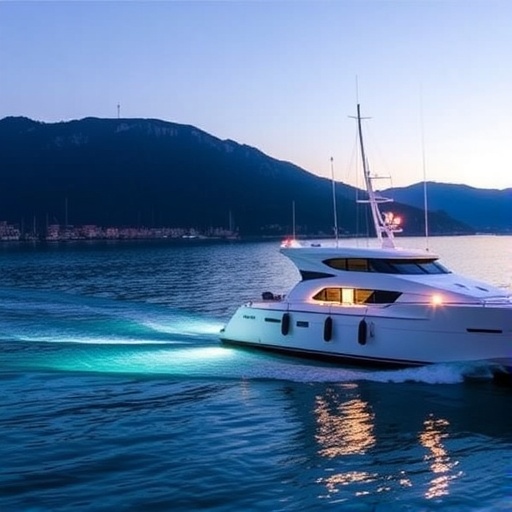
A groundbreaking initiative led by the University of Vaasa, Finland, is propelling the maritime industry toward a zero-carbon future through innovative hydrogen technology. The ambitious H4PERION project – Hydrogen FOR Performance Enhancement and Reliable Ice OperatioN – is set to pioneer the operational use of hydrogen-capable internal combustion engines (ICE) aboard large commercial vessels. This unprecedented venture marks a pivotal moment in advancing clean maritime propulsion, combining decades of engineering insight with cutting-edge hydrogen fuel applications.
Long-distance maritime shipping has persistently posed substantial decarbonization challenges due to the immense energy demands and uncompromising reliability required for vessels navigating global trade routes over extended periods. Conventional solutions such as batteries and fuel cells, while advancing rapidly, remain insufficient for the scale and endurance needed by large ocean-crossing ships. This gap necessitates alternative propulsion technologies aligned with stringent International Maritime Organization (IMO) regulations targeting drastic emission reductions within the current decade.
Hydrogen emerges as a highly promising zero-carbon fuel candidate due to its clean combustion properties and adaptability to existing engine technologies. Unlike fossil fuels, hydrogen combustion emits no carbon dioxide, positioning it as a frontrunner for sustainable shipping energy. Crucially, hydrogen’s compatibility with internal combustion engines — familiar and extensively tested systems — offers a practical pathway for vessel operators to transition without abandoning proven engine frameworks. Yet, real-world demonstrations on large-scale vessels remain absent, highlighting knowledge barriers in fuel handling, safety protocols, and regulatory compliance.
H4PERION is designed to confront these challenges head-on by orchestrating a multidisciplinary collaboration that harnesses European expertise across maritime engineering, energy technology, and safety standards. The centerpiece of this project is the development and at-sea demonstration of a novel hydrogen-capable internal combustion engine integrated into a large commercial vessel—the Aurora Botnia—operating regular routes between Finland and Sweden. Simultaneously, an identical full-scale engine will undergo rigorous laboratory testing to simulate real sailing conditions and optimize performance through extensive data collection and iterative improvements.
The project’s technological innovations focus on three core aspects: an engine capable of operating on a fuel blend of hydrogen and biomethane with an eventual aim of pure hydrogen use; a sophisticated fuel blending and supply system designed for seamless switchability between zero-carbon fuels; and an advanced exhaust aftertreatment mechanism that optimizes emissions cleanliness under varying operational parameters. These integrated solutions are intended to ensure operational reliability and environmental compliance, addressing past limitations of hydrogen fuel deployment in marine settings.
In parallel with engine development, the project incorporates a digital twin architecture, mirroring on-board and laboratory conditions to create a dynamic virtual model. This digital twin enables continuous performance monitoring, predictive maintenance, and design refinements, substantially accelerating development cycles and facilitating robust risk assessments critical for maritime deployment.
The University of Vaasa contributes its expertise in Reactivity Controlled Compression Ignition (RCCI), a sophisticated combustion method that aims to exploit hydrogen’s unique reactivity properties. By combining RCCI with fully variable valve actuation and state-of-the-art emissions aftertreatment techniques, the project targets a net thermal efficiency exceeding 55%, coupled with negligible pollutant output. Achieving these ambitious objectives relies on tightly integrated simulation environments, autonomous calibration processes, and empirical validation through synchronized onboard and lab testing.
Beyond technological milestones, H4PERION embraces a holistic approach to maritime hydrogen adoption, encompassing training modules for crews and port operators, contributions to safety frameworks, and active engagement with regulatory bodies. This comprehensive strategy ensures that the pathway from innovation to scalable operation is underpinned by knowledge dissemination and institutional readiness.
The consortium underpinning H4PERION represents a formidable European alliance of sixteen partners spanning seven countries, encompassing academic institutions, maritime design firms, classification societies, engine manufacturers, and shipping operators. This collaborative fabric ensures that technical, operational, safety, and policy dimensions are cohesively integrated, delivering solutions designed for immediate practical application and future adaptability.
For the Vaasa region, the project elevates its stature as a maritime innovation hub, with key contributions from the University of Vaasa, Wärtsilä, and Wasaline showcasing Finland’s leadership in clean shipping technology development. The project’s €11.2 million Horizon Europe funding, including €3.2 million supporting the University of Vaasa specifically, underscores the European Union’s commitment to decarbonizing difficult-to-abate sectors such as maritime transport.
When operationalized, H4PERION’s hydrogen-capable internal combustion technology could revolutionize maritime propulsion paradigms, laying the groundwork for a sustainable shipping industry decoupled from fossil fuels. The pioneering demonstration aboard Aurora Botnia promises critical insights, practical experience, and scalable solutions applicable across the global fleet, aligning with broader environmental goals while maintaining the economic vitality of long-distance maritime trade.
The project embodies a visionary blend of scientific rigor, engineering excellence, and policy engagement, setting new benchmarks for hydrogen integration in heavy-duty transport. As the maritime sector grapples with increasing emission constraints and energy transitions, H4PERION’s success will serve as a beacon for innovative zero-carbon fuel deployment, driving a cleaner, safer, and more sustainable future for ocean shipping worldwide.
News Publication Date:
Not specified in the source.
Web References:
https://mediasvc.eurekalert.org/Api/v1/Multimedia/0b324959-073a-4e82-9f0d-0d9a0abfe79b/Rendition/low-res/Content/Public
Cite Scienmag News
Violet Maxwell. (May 6, 2026). University of Vaasa to Lead Groundbreaking European Hydrogen Demonstration in Maritime Sector. Scienmag. https://scienmag.com/university-of-vaasa-to-lead-groundbreaking-european-hydrogen-demonstration-in-maritime-sector/
Violet Maxwell. "University of Vaasa to Lead Groundbreaking European Hydrogen Demonstration in Maritime Sector." Scienmag, 6 May 2026, https://scienmag.com/university-of-vaasa-to-lead-groundbreaking-european-hydrogen-demonstration-in-maritime-sector/. Accessed 4 September 2026.
Violet Maxwell. "University of Vaasa to Lead Groundbreaking European Hydrogen Demonstration in Maritime Sector." Scienmag. May 6, 2026. https://scienmag.com/university-of-vaasa-to-lead-groundbreaking-european-hydrogen-demonstration-in-maritime-sector/


