


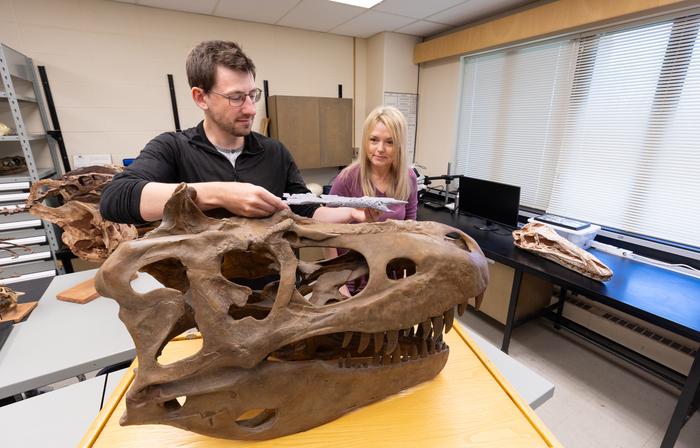
In a groundbreaking discovery set to redefine our understanding of Tyrannosaur evolution, paleontologists from the University of Calgary, alongside an international team of researchers, have identified a new species of dinosaur named Khankhuuluu. This species is now recognized as the closest-known ancestor to the iconic giant Tyrannosaurs, a lineage that includes the legendary Tyrannosaurus rex. Published in the prestigious journal Nature, this study sheds light on a pivotal transitional phase in Tyrannosaur evolution, revealing the complex evolutionary history of these apex predators.
The research leaders, Dr. Darla Zelenitsky and PhD candidate Jared Voris, uncovered that Khankhuuluu roamed the Earth approximately 86 million years ago during the Late Cretaceous period. Unlike its colossal descendants, this species was a medium-sized predator known for its remarkable agility and speed, characteristics that allowed it to thrive after the extinction of many large predatory dinosaurs. This mesopredator occupied a critical ecological niche, evolving to perfection with features optimized for hunting smaller prey.
The significance of Khankhuuluu lies not only in its anatomical features but also in its phylogenetic positioning. Named with a Mongolian term meaning “prince of dragons” or “the dragon prince,” it symbolizes a regal precursor to the famous Tyrannosaurs, signifying its close relationship within the evolutionary lineage leading to Tyrannosaurus rex. Despite sharing numerous traits with its larger descendants, Khankhuuluu lacked several hallmark characteristics of advanced Tyrannosaurs, such as the formidable bone-crushing ability that defined later members of this group.
An in-depth anatomical analysis reveals that Khankhuuluu possessed tiny, rudimentary horns along with a long, shallow skull. These primitive horns are believed to be evolutionary precursors to the more pronounced crests seen in genera such as Albertosaurus and Gorgosaurus. Such features likely played dual roles in mating displays and intimidation strategies, underscoring the complexity of dinosaur social behaviors during this pivotal era. Furthermore, the skull morphology indicates Khankhuuluu lacked the biomechanical adaptations necessary to crunch through bone, a defining behavior better known in the later T. rex.
The fossils of Khankhuuluu were excavated from the Bayanshiree Formation located in southeastern Mongolia—a region that has long been a treasure trove for Late Cretaceous dinosaur discoveries. Initially studied in the 1970s by Mongolian paleontologist Altangerel Perle, these fossils were once thought to belong to the species Alectrosaurus found in China. However, Voris’s 2023 expedition to Mongolia for a detailed re-examination at the Institute of Paleontology revealed distinctive features that warranted classification as a new genus and species.
This discovery not only enriches the morphological dataset of tyrannosauroids but also provides novel insights into their biogeographic history. Dr. Zelenitsky explains that Khankhuuluu or a close relative likely migrated to North America from Asia approximately 85 million years ago via a land bridge. This migratory event marked a critical juncture, leading to the evolution of the large Tyrannosaurs in North America. The study presents compelling evidence supporting the hypothesis that large-bodied Tyrannosaurs originated due to this Asian-North American faunal exchange.
Contrary to earlier assumptions that Tyrannosaur migration was sporadic and frequent, the findings indicate that such movements were more episodic and limited. Khankhuuluu represents the last known Tyrannosaur ancestor discovered in the Asian fossil record, emphasizing a more streamlined, traceable evolutionary path of the group. This discovery also helps clarify the timing and nature of Tyrannosaur dispersal events, which shaped the diversity and distribution of this iconic group across the Northern Hemisphere.
Once in North America, the lineage evolved in isolation to produce some of the largest apex predators ever to have walked the planet. The fossil record suggests that after several million years of geographic exclusivity, Tyrannosaurs migrated back to Asia, where their evolutionary trajectory divided into two distinct groups. One lineage culminated in the monstrous T. rex, while the other evolved into smaller, long-snouted species colloquially dubbed the “Pinocchio rexes” due to their facial morphology.
The study’s detailed phylogenetic analysis and stratigraphic correlations underscore the dynamic evolutionary processes that governed Tyrannosaur evolution. Through combining fossil evidence with state-of-the-art data and statistical methods, the researchers have outlined a comprehensive timeline and migratory pattern that challenges prior models of dinosaur biogeography.
Looking forward, the research team is eager to explore even earlier stages of Tyrannosaur evolution, which remain poorly understood due to a lack of fossil material. Uncovering these primordial ancestors could illuminate the gradual anatomical and ecological changes that set the stage for Tyrannosaurs becoming apex predators at the end of the Cretaceous.
The discovery of Khankhuuluu not only revolutionizes our understanding of Tyrannosaurus ancestry but also exemplifies the power of international scientific collaboration and cutting-edge paleontological techniques. As this "prince of dragons," it provides a vital window into evolutionary dynamics, serving as a crown jewel in the complex saga of dinosaur evolution. The findings underscore that the story of Tyrannosaurs is far richer and more intricate than previously imagined, continuing to captivate scientific and public imagination alike.
Cite Scienmag News
Gavin Prescott. (June 11, 2025). University of Calgary Paleontologists Discover Closest Known Ancestor of Tyrannosaurs. Scienmag. https://scienmag.com/university-of-calgary-paleontologists-discover-closest-known-ancestor-of-tyrannosaurs/
Gavin Prescott. "University of Calgary Paleontologists Discover Closest Known Ancestor of Tyrannosaurs." Scienmag, 11 June 2025, https://scienmag.com/university-of-calgary-paleontologists-discover-closest-known-ancestor-of-tyrannosaurs/. Accessed 5 September 2026.
Gavin Prescott. "University of Calgary Paleontologists Discover Closest Known Ancestor of Tyrannosaurs." Scienmag. June 11, 2025. https://scienmag.com/university-of-calgary-paleontologists-discover-closest-known-ancestor-of-tyrannosaurs/


