


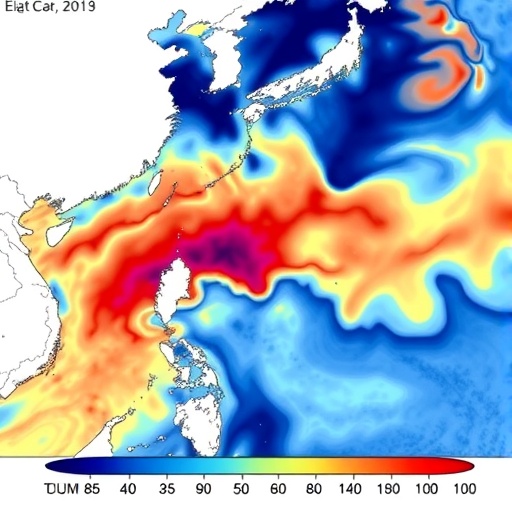
In the realm of East Asian climatology, the western North Pacific subtropical high (WNPSH) has long been recognized as a dominant force shaping summer weather patterns across the region. This atmospheric phenomenon significantly influences precipitation variability, alternating between delivering intense rainfall and inducing severe drought conditions beneath its expansive domain. However, a groundbreaking study published recently in Atmospheric and Oceanic Science Letters challenges this conventional understanding by revealing an exceptional anomaly concerning the East China Sea (ECS). According to the collaborative research efforts of scientists from Hohai University, the Institute of Atmospheric Physics at the Chinese Academy of Sciences, and Nanjing University of Information Science and Technology, the interannual summer precipitation fluctuations over the ECS display an intriguing independence from the WNPSH’s influence.
Traditionally, the East Asian subtropical rainy belt is geographically anchored along the northern edges of the WNPSH, spanning from the middle-lower reaches of the Yangtze River basin (YRB) eastward towards southern Japan. The WNPSH’s zonal shifts have been directly linked to variability in this rain belt, dictating the frequency and intensity of rainfall events critical to regional hydrology and agriculture. Surprisingly, despite the ECS’s proximity—positioned between the YRB and southern Japan—it does not conform to this established pattern. The WNPSH fails to induce statistically significant precipitation anomalies over the East China Sea, marking a unique climatic behavior divergent from neighboring territories.
Delving deeper into the atmospheric mechanisms underlying this distinctive precipitation variability, the study identifies the pivotal role of a localized cyclonic anomaly embedded within the lower troposphere over the ECS. This cyclonic circulation engenders low-level moisture convergence and upward atmospheric motion, both essential conditions for intensified precipitation. Unlike the dominant WNPSH-driven systems modulating rainfall in adjacent zones, the ECS’s wetter periods are more closely linked to the genesis and evolution of this local cyclonic feature, suggesting a decoupling from broader subtropical high dynamics.
Further atmospheric profiling reveals that this lower-tropospheric cyclonic anomaly exhibits a pronounced vertical tilt towards the north as altitude increases. This three-dimensional structural characteristic is intricately connected to the behavior of the upper-tropospheric westerly jet stream. Specifically, a southward displacement of this jet stream tends to favor the formation and persistence of the cyclonic anomaly, indirectly modulating ECS precipitation. This jet stream interaction highlights the complexity of multi-level atmospheric dynamics converging on the ECS region, underscoring the importance of jet stream positioning in regional weather variability.
The implications of these findings are far-reaching for both meteorological studies and regional climate prediction models. Recognizing the ECS as an exceptional microclimate zone requires the refinement of existing precipitation forecasting frameworks, which historically attribute ECS rainfall anomalies primarily to the WNPSH. Such oversights could lead to misestimations of drought risk, flood potential, and resource management planning within this crucial maritime and coastal domain.
Moreover, this study urges a reevaluation of the spatial heterogeneity inherent in the East Asian subtropical rainy belt’s interannual variability. Rather than viewing this rain belt as a monolithic entity controlled by a uniform set of atmospheric drivers, researchers must adopt a segmentation perspective. Diverse regional sectors within the belt are influenced by differing circulatory anomalies and jet stream shifts, necessitating tailored analytical approaches to unravel their unique precipitation dynamics.
Dr. Xinyu Li, the study’s corresponding author, emphasizes the necessity of such nuanced understandings, stating that unraveling the complexity of summer precipitation patterns across East Asia mandates focused investigation of individual regions separately. This approach promises to enhance predictive accuracy and enrich the meteorological community’s grasp of subtropical atmospheric processes.
The methodological approach employed by the researchers involved comprehensive analysis of satellite data, upper-air sounding observations, and advanced atmospheric circulation models. By synthesizing these data sets, they characterized the spatial and temporal patterns of precipitation alongside the behavior of the associated atmospheric anomalies. The cyclonic feature’s emergence and its relation to the upper-level jet stream were delineated with precision, illuminating the layered interactions governing precipitation in the ECS region.
Additionally, the study’s findings resonate in the broader context of climate change and variability studies. As global warming intensifies and alters the configurations of atmospheric circulation patterns, understanding local-scale anomalies such as those over the East China Sea becomes increasingly critical. Such knowledge can inform adaptation strategies for fisheries, coastal communities, and marine transportation which rely heavily on seasonal weather predictability.
This research thus not only redefines the conceptual meteorological paradigm for the East China Sea but also calls attention to the complex and often counterintuitive nature of regional climate drivers. It builds a case for continued interdisciplinary collaboration combining dynamic meteorology, oceanography, and atmospheric physics to unravel the intricacies of East Asian summer climate regimes.
In summary, the discovery that interannual summer precipitation variability over the ECS is uncoupled from the traditional influence of the western North Pacific subtropical high distinguishes this region as a meteorological enclave. It underscores the decisive role of a multi-level atmospheric circulation anomaly—specifically a lower-tropospheric cyclonic vortex favored by shifts in the upper-level westerly jet—as the principal modulator of rainfall. Consequently, this decoupling reveals nuanced spatial heterogeneity in regional precipitation drivers, urging refined, localized climate models to better serve this complex and climatically vital area.
News Publication Date: 27-Oct-2025
Web References:
https://doi.org/10.1016/j.aosl.2025.100734
Cite Scienmag News
Russell Cooper. (November 11, 2025). Unique Patterns of Year-to-Year Summer Rainfall Variation in the East China Sea Revealed. Scienmag. https://scienmag.com/unique-patterns-of-year-to-year-summer-rainfall-variation-in-the-east-china-sea-revealed/
Russell Cooper. "Unique Patterns of Year-to-Year Summer Rainfall Variation in the East China Sea Revealed." Scienmag, 11 November 2025, https://scienmag.com/unique-patterns-of-year-to-year-summer-rainfall-variation-in-the-east-china-sea-revealed/. Accessed 4 September 2026.
Russell Cooper. "Unique Patterns of Year-to-Year Summer Rainfall Variation in the East China Sea Revealed." Scienmag. November 11, 2025. https://scienmag.com/unique-patterns-of-year-to-year-summer-rainfall-variation-in-the-east-china-sea-revealed/


