


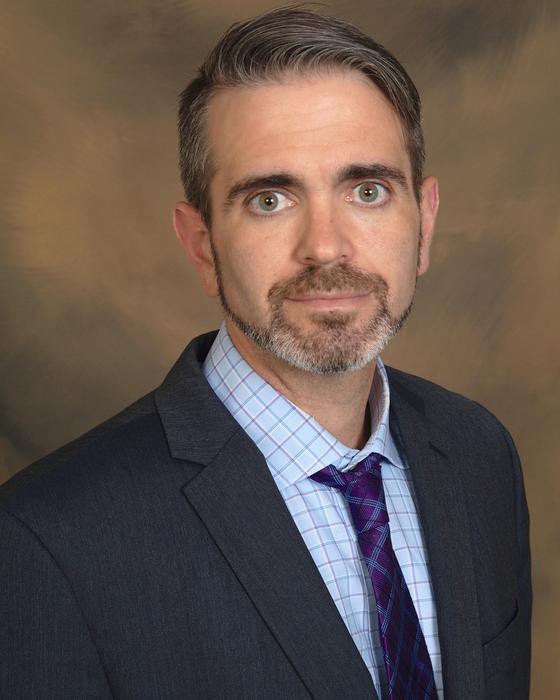
University of Massachusetts Amherst researcher Thomas Mackie has received a $2.1 million funding award from the Patient-Centered Outcomes Research Institute (PCORI) to advance the meaningful engagement of communities that are affected by mental health disparities and underrepresented in research partnerships.

Credit: UMass Amherst
University of Massachusetts Amherst researcher Thomas Mackie has received a $2.1 million funding award from the Patient-Centered Outcomes Research Institute (PCORI) to advance the meaningful engagement of communities that are affected by mental health disparities and underrepresented in research partnerships.
The study, entitled “Improving Research Partnership With Engagement Mapping: A Pilot Study to Advance Engagement Science” and co-led by Karen Tabb, a University of Illinois Urbana-Champaign researcher, is designed to empower community partners to have a greater role in the preparation, implementation, translation and dissemination of research.
Authorized by Congress in 2010, PCORI is an independent, nonprofit organization that funds research to provide patients, their caregivers and clinicians with the evidence-based information needed to make better-informed health care decisions.
The pilot study will test the feasibility of a new engagement approach, called engagement mapping, with three advisory councils at the University of Massachusetts Chan Medical School and one advisory council at Postpartum Support International, a nonprofit organization that helps people affected by perinatal mood disorders.
“To advance mental health equity, researchers must find ways to empower the individuals from communities most affected by the mental health care disparities to be partners in our research, both as researchers and as research partners,” says Mackie, professor of health policy and management in the School of Public Health and Health Sciences’ department of health promotion and policy. “Our team will pilot a novel approach to facilitate partnership with individuals from communities who are far too often not meaningfully engaged in research. We will comprehensively review and identify promising practices for research engagement, and then initiate a pilot study to test the feasibility and acceptability of ‘engagement mapping.’”
Engagement mapping will seek out the expertise and judgement of community partners to identify the barriers to research partnerships, co-design and implement strategies responsive to these barriers and then co-evaluate their effectiveness. The pilot study will also identify engagement methods that align with the values and needs of community partners.
The UMass Amherst-University of Illinois Urban-Champaign proposal was selected in response to a PCORI funding announcement aimed at creating an evidence base for developing measures and methods that enhance meaningful engagement in comparative clinical effectiveness research.
Recent years have seen increased knowledge about participatory research involving key stakeholders like patients, caregivers and clinicians as research partners. However, there’s a lack of systematic study on the most effective engagement techniques and a significant gap in evidence regarding the selection of engagement methods tailored for individuals underrepresented in research partnerships, such as communities affected by mental health care disparities.
In reflecting on the motivation for this study, Mackie says, “A member of our advisory council once told us, ‘Nothing about us without us is for us.’ Engagement mapping aims to empower community partners to identify, implement and evaluate strategies that will support their meaningful and impactful engagement in research.”
“This study was selected for PCORI funding for its potential to strengthen patient-centered and stakeholder-driven comparative clinical effectiveness research by providing evidence about specific engagement methods and measures that promote representative engagement of patients and other stakeholders in research,” says Dr. Nakela Cook, PCORI’s executive director. “We look forward to following the study’s progress and working with the University of Massachusetts Amherst to share the results.”
Cite Scienmag News
Courtney Benton. (July 12, 2024). UMass Amherst awarded $2.1 million to advance the science of engagement in community-academic research partnerships. Scienmag. https://scienmag.com/umass-amherst-awarded-2-1-million-to-advance-the-science-of-engagement-in-community-academic-research-partnerships/
Courtney Benton. "UMass Amherst awarded $2.1 million to advance the science of engagement in community-academic research partnerships." Scienmag, 12 July 2024, https://scienmag.com/umass-amherst-awarded-2-1-million-to-advance-the-science-of-engagement-in-community-academic-research-partnerships/. Accessed 4 September 2026.
Courtney Benton. "UMass Amherst awarded $2.1 million to advance the science of engagement in community-academic research partnerships." Scienmag. July 12, 2024. https://scienmag.com/umass-amherst-awarded-2-1-million-to-advance-the-science-of-engagement-in-community-academic-research-partnerships/

