


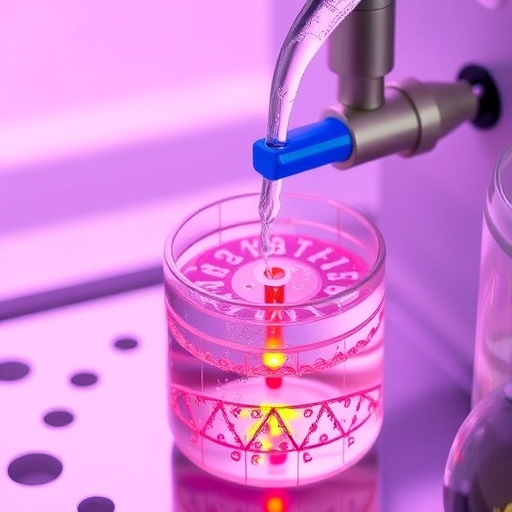
In the quest for sustainable sanitation solutions, the efficient treatment of wastewater remains a daunting challenge worldwide. Wastewater treatment systems must effectively reduce contaminants—particularly total suspended solids (TSS)—to meet stringent environmental regulations and protect public health. Traditional membrane-based filtration technologies, such as microfiltration and ultrafiltration, have long been heralded for their high TSS removal efficiencies. However, their operational complexity, susceptibility to fouling, and excessive energy demands often impede broader implementation, especially in resource-constrained settings. A recent breakthrough study published in Nature Water reveals a pioneering mesh bioreactor (MeBR) technology that integrates piezoelectric transient cavitation to achieve rapid, energy-efficient sludge–liquid separation, marking a potential paradigm shift in wastewater treatment.
Conventional wastewater filtration fundamentally depends on membranes with fine pores capable of sieving out suspended solids from the liquid phase. Despite their effectiveness, these membranes frequently suffer from fouling—accumulation of biological or particulate material that clogs the membrane surface—leading to a significant decline in flux, increased cleaning requirements, and escalated operational costs. Efforts to mitigate fouling include backflushing, chemical cleaning, and physical agitation, but these approaches often induce downtime and degrade membrane lifespan. Gravity-based separation methods, while simpler and less energy-intensive, struggle with inconsistent and typically insufficient removal of TSS to comply with evolving discharge criteria.
Addressing these longstanding challenges, the MeBR integrates a surprisingly straightforward component—a coarse-pore mesh—that is traditionally considered inferior in filtration performance compared to dense membranes. The innovation lies in coupling this mesh with an advanced piezoelectric fouling removal strategy that exploits the physics of transient cavitation. Cavitation refers to the formation, growth, and implosive collapse of microscopic bubbles in a liquid, generating localized bursts of energy. Utilizing piezoelectric ultrasound transducers, the MeBR induces near-field transient cavitation that effectively disrupts and removes fouling layers from the mesh within seconds, a process that has remained elusive with conventional oscillation or chemically induced cleaning methods.
Experimental investigations showcased that this transient cavitation-driven fouling removal could completely eliminate irreversible foulants from the mesh surface in under 10 seconds. This ultrafast cleaning capability is monumental, enabling continuous operation of the bioreactor at extraordinarily high permeate fluxes, measured between 148 to 307 liters per square meter per hour (l m−2 h−1). Such flux values surpass many membrane bioreactors and gravity separation units by multiple orders of magnitude, promising a significant enhancement in throughput without compromising effluent quality.
One of the most impressive features of the MeBR system is its ability to swiftly form a controlled biocake—the biologically active sludge layer essential for biodegradation processes—within less than 10 minutes. This rapid biocake development is critical for stable reactor performance, improving the biological treatment efficiency while maintaining excellent sludge–liquid separation. As the biocake forms, the transient cavitation continues to prevent its excessive accumulation and blocking of mesh pores, ensuring optimum permeability and consistent TSS reduction that meets international regulatory standards across geographies.
The driving mechanism of transient cavitation in this mixer-reactor hybrid is noteworthy not only for its speed but also due to the non-reliance on secondary chemical reactions or membrane oscillation. Whereas other cleaning tactics invoke shear forces or generate reactive oxygen species, the transient cavitation phenomenon operates through mechanical forces generated during bubble collapse, dislodging foulants effectively without introducing harsh conditions or requiring high energy inputs. This distinguishes the MeBR as a more sustainable option, potentially lowering the carbon footprint of advanced wastewater treatment plants.
Energy efficiency is an increasingly vital consideration as the global water sector aims to reduce operational emissions and costs. The piezoelectric transducers employed in the MeBR consume remarkably low power, especially compared with traditional membrane-based systems that require pressurization and frequent chemical dosing. By harnessing physical cavitation forces in a targeted manner, this approach achieves superior cleaning efficacy while curtailing energy consumption—a win-win scenario for both municipal utilities and industrial wastewater treatment facilities.
From an operational perspective, the simplicity of the MeBR’s mesh component reduces capital costs and maintenance burdens. Unlike the delicate membranes that require careful handling and special replacement protocols, the coarse-pore mesh is more robust and less vulnerable to mechanical damage. Combined with the rapid fouling removal, this improves reactor uptime and reduces the total life-cycle cost of wastewater treatment facilities. The system’s design simplicity further allows for scalability and integration possibilities in decentralized and small-scale treatment contexts.
Beyond technological advantages, the transient cavitation-enabled MeBR aligns well with the growing global emphasis on circular economy principles and smart water management. Faster and cleaner sludge–liquid separation facilitates better nutrient recovery, reduced sludge volumes, and enhanced potential for biogas generation or sludge valorization pathways. These benefits synergize with ongoing efforts to transform wastewater treatment plants into resource recovery hubs, contributing to sustainable urban development and climate resilience.
As regulations worldwide tighten to safeguard water bodies from pollution, innovations like the MeBR provide a timely solution to meet ever-stricter TSS discharge standards. Continuous treatment at high flux combined with reliable fouling control ensures that effluent quality remains compliant over extended operational periods. This reliability can significantly mitigate risks of non-compliance penalties and environmental damage, further justifying investment in advanced treatment technologies.
The implications of this study extend beyond municipal wastewater treatment, with promising applications in industrial effluent management, food and beverage processing, and even decentralized sanitation systems in developing regions. Industries producing high-strength wastewater laden with suspended solids stand to benefit greatly from an efficient, energy-conscious technology that reduces operational downtime and chemical use. Moreover, the MeBR technology’s adaptability to various sludge characteristics and flow regimes positions it as a versatile tool for diverse water treatment challenges.
Future research is likely to delve deeper into optimizing the piezoelectric transducers’ frequency and power settings, refining mesh pore structures, and integrating the MeBR into multi-stage treatment trains for enhanced performance. There is also potential to explore synergies with emerging digital monitoring systems that could automate cavitation cleaning cycles, thereby further improving operational efficiency and reliability.
In conclusion, the transient cavitation-empowered mesh bioreactor unveiled by Luo, Guo, Guan, and colleagues heralds a new era in wastewater treatment technology. Marrying physical phenomena with smart engineering, the MeBR addresses the trifecta of critical challenges—fouling, energy consumption, and effluent quality—while maintaining operational simplicity and cost-effectiveness. As water scarcity and pollution pressures mount worldwide, innovations of this caliber will be instrumental in securing sustainable sanitation and safeguarding environmental health for generations to come.
Cite Scienmag News
Violet Maxwell. (October 31, 2025). Ultrafast Fouling Removal via Transient Cavitation in Bioreactors. Scienmag. https://scienmag.com/ultrafast-fouling-removal-via-transient-cavitation-in-bioreactors/
Violet Maxwell. "Ultrafast Fouling Removal via Transient Cavitation in Bioreactors." Scienmag, 31 October 2025, https://scienmag.com/ultrafast-fouling-removal-via-transient-cavitation-in-bioreactors/. Accessed 5 September 2026.
Violet Maxwell. "Ultrafast Fouling Removal via Transient Cavitation in Bioreactors." Scienmag. October 31, 2025. https://scienmag.com/ultrafast-fouling-removal-via-transient-cavitation-in-bioreactors/


