


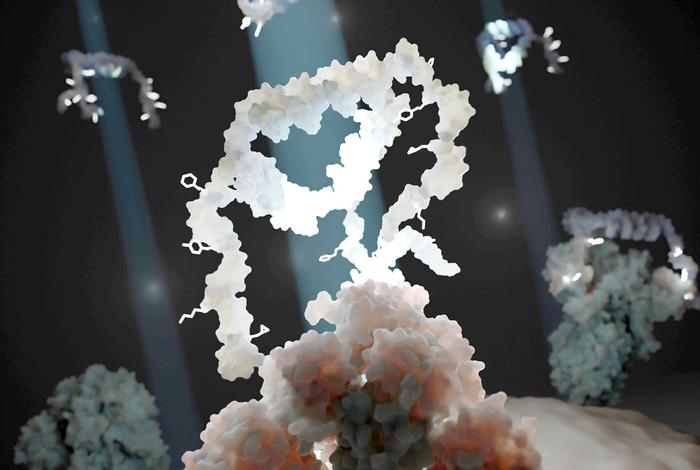
In the realm of biotechnology, the pursuit of precision binding agents has reached a new milestone with the advent of strategies developed by researchers at the École Polytechnique Fédérale de Lausanne (EPFL). Known for their cutting-edge work on aptamers—short strands of DNA or RNA that can bind to specific targets—the researchers have unveiled a pioneering technique dubbed MEDUSA, aimed at creating multimeric aptamers designed to interact with protein complexes in a more effective manner. Aptamers serve as promising alternatives to antibodies in diagnostic and therapeutic applications due to their synthetic nature and cost-effectiveness, but previous methodologies predominantly revolved around monovalent binders, which limited efficacy, particularly when targeting structures like the SARS-CoV-2 spike protein.
Conventional monovalent aptamers bind to a single site on their target, akin to throwing a bowl of spaghetti at a wall—while some may stick, many will miss their mark entirely. As the head of the Programmable Biomaterials Lab at EPFL, Maartje Bastings likens this approach to a random game where functional binding is not guaranteed. This limitation becomes particularly pronounced when dealing with proteins characterized by multidomain architectures, such as those found on viral surfaces. The trimeric nature of protein complexes like the SARS-CoV-2 spike protein presents three distinct binding sites, necessitating a more targeted approach to aptamer design.
The team recognized that enhancing the binding affinity of aptamers required a shift from a monovalent to a multivalent approach. With the creation of MEDUSA, researchers developed a molecular scaffold—an organized structure around which three aptamer binding units could assemble. This bioinspired strategy leverages the natural configurations observed in viruses where multiple binding sites collectively work to increase interaction strength and specificity. By mimicking the geometrical properties of the SARS-CoV-2 spike protein, the scaffolds allowed the aptamer library to preferentially select trimeric candidates that maintain functional binding characteristics.
Each binding unit is pivotal, as they partake in an intricate dance of molecular interactions when combined with the target protein. Through their carefully structured assemblies, the multimeric aptamers exhibit binding affinities that surpass those achieved with traditional monovalent binders by a factor of 10 to 1,000 times. Furthermore, the selectivity of the multivalent aptamers significantly enhances their diagnostic capabilities, an aspect of critical importance in the identification and treatment of infectious diseases.
The evolution of these multivalent binding agents involves iterative rounds of selection and amplification. By employing a rigorous evolutionary process, the researchers incrementally fine-tune and enhance the binding proficiency of aptamer candidates that initially demonstrate potential. This gradual yet methodical evolution—the process akin to natural selection—promises a streamlined pathway toward discovering highly effective binders. Although initial scaffold design can be accomplished in mere hours, the evolutionary phase can extend over weeks, hinting at potential bottlenecks in rapid deployment for clinical use.
One ambitious objective set forth by Bastings and her team is to expedite this evolutionary process to meet the demanding timelines often required in biomedical diagnostics and therapeutics. As global health challenges evolve, so too does the necessity for agile and effective binding agents capable of addressing diverse pathogen configurations. Future research aims to encompass more sophisticated pathogens, such as the Dengue virus, which possesses a six-binding subunit architecture, or anthrax, known for its seven-subunit complexity. These advances will hinge upon harnessing the newly discovered multivalent sequence space to train generative artificial intelligence (AI) models, theoretically automating and accelerating the discovery pipeline for potent binders.
Ultimately, MEDUSA stands poised to revolutionize the landscape of aptamer technology, emphasizing the importance of spatial organization in targeting complex proteins. This approach not only positions multimeric aptamers as formidable contenders in the realm of biosensors and therapeutics but also opens the door to investigating and potentially neutralizing a broader spectrum of infectious agents. With the research promising unprecedented levels of binding strength and specificity, the potential applications for MEDUSA-derived aptamers are vast and varied, hinting at a future where such innovative technologies could redefine our response to infectious diseases, enhancing both diagnostic and therapeutic efficacy.
The implications are profound, as the capacity to design tailored multivalent binders can fundamentally alter our ability to combat viral infections. Researchers stand on the cusp of translating these groundbreaking findings into real-world applications that may soon play crucial roles in public health. As the evolution of these multivalent agents continues, the synthesis of biochemistry and artificial intelligence may unlock innovative pathways in medicine, combining human ingenuity with computational precision to tackle some of the most challenging biomedical dilemmas. With ongoing enhancements and rapid development, the MEDUSA framework could pave the way for a new era of diagnostics and therapeutics, heralding significant advancements in our fight against pervasive viral threats.
Cite Scienmag News
Denise Maddox. (June 6, 2025). Ultra-Selective Aptamers Turn the Tables on Viruses. Scienmag. https://scienmag.com/ultra-selective-aptamers-turn-the-tables-on-viruses/
Denise Maddox. "Ultra-Selective Aptamers Turn the Tables on Viruses." Scienmag, 6 June 2025, https://scienmag.com/ultra-selective-aptamers-turn-the-tables-on-viruses/. Accessed 5 September 2026.
Denise Maddox. "Ultra-Selective Aptamers Turn the Tables on Viruses." Scienmag. June 6, 2025. https://scienmag.com/ultra-selective-aptamers-turn-the-tables-on-viruses/


