


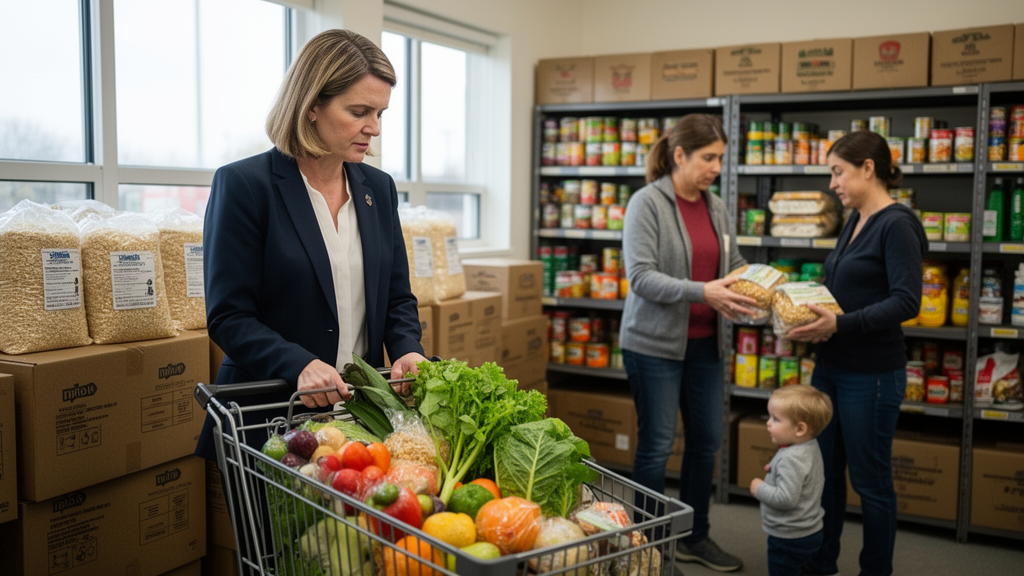
A 2026 perspective in Frontiers in Nutrition argues that global efforts to reduce ultra-processed food consumption remain incomplete because they focus overwhelmingly on commercial markets while overlooking public food assistance and the first 1,000 days of life. The authors identify taxes, marketing restrictions, front-of-pack warning labels and product reformulation as the dominant policy tools, but argue that they reach only part of the food environment in which children and families facing constrained choices actually eat. Their proposed framework would bring assistance programs and early-life nutrition more directly into ultra-processed food governance, while emphasizing that the underlying health evidence is uneven and that several key interventions still require evaluation.
The central concern is not simply that people choose highly processed foods. In public assistance systems and during infancy and early childhood, diets are shaped by procurement rules, benefit cycles, retailer access, marketing, caregiver constraints and developmental needs. The perspective notes that approximately 62% of participants in the US Supplemental Nutrition Assistance Program live in households with children, linking the two policy domains across time. The authors also point to a broad structural disadvantage: conventional ultra-processed food policy often assumes an autonomous adult making independent choices, whereas infants cannot choose their food and assistance recipients operate within purchasing environments established by program design and local availability.
SNAP illustrates the first gap. The largest US food assistance program supported an average of 41.7 million people each month in fiscal year 2024, with federal expenditure reaching $99.8 billion. Benefits are delivered through electronic benefit transfer cards that exclude items such as alcohol, hot prepared foods and dietary supplements but permit many products commonly classified as ultra-processed, including sugar-sweetened beverages, packaged snacks, frozen pizzas and refined breakfast cereals. An analysis linking SNAP participation to two rounds of National Health and Nutrition Examination Survey dietary data found that participants obtained 54.7% of total energy from ultra-processed foods, compared with 53.0% among income-eligible non-participants after adjustment for socioeconomic and health characteristics. Savory snacks and soft drinks were the principal contributors to the difference. This small adjusted gap does not demonstrate that SNAP causes greater ultra-processed food consumption, but it shows that program participation does not erase the structural conditions associated with it.
That analysis also found that household food insecurity was associated with higher ultra-processed food consumption among non-participants, whereas the association was weaker among SNAP participants. The authors interpret this as evidence that assistance does not fully protect households from the purchasing environment created by broad eligibility rules, minimal product-level restrictions and fixed monthly benefit cycles. Toward the end of a benefit period, limited resources may make inexpensive, shelf-stable and energy-dense foods especially convenient, particularly when cooking facilities and time are constrained. The implication is that food assistance is a population-scale nutrition instrument, not a neutral transfer of purchasing power. How benefits, retailer options and available alternatives are configured may influence diet quality as much as the nominal value of the benefit.
That has prompted interest in both restrictions and positive incentives. Twelve US states have approval under Section 4001 of the Food and Nutrition Act to restrict purchases of sugar-sweetened beverages, sweets or both through SNAP, with implementation planned from 2026. Such measures could operate as large natural experiments, but the perspective warns that removing selected products without expanding access to affordable, practical alternatives may deepen inequity. In the Healthy Incentives Pilot, participants received 30 cents for every SNAP dollar spent on targeted fruits and vegetables, and produce consumption increased. A microsimulation study estimated that nationwide fruit and vegetable incentives could prevent more than 300,000 cardiovascular events and reduce healthcare expenditures by approximately $6.8 billion; however, that is a modeled projection rather than an observed outcome of a national program. The authors therefore favor combined action involving adequate benefits, affordable minimally processed foods, incentives and retailer strategies that improve access in underserved communities.
The second gap lies between conception and a child’s second birthday, when diet and development are especially sensitive and when feeding is governed through policies concerning breastfeeding, breast-milk substitutes and complementary feeding. The World Health Organization’s International Code of Marketing of Breast-milk Substitutes, adopted in 1981, restricts advertising, free-sample distribution, direct contact with mothers and the portrayal of formula feeding as normal. World Health Assembly Resolution 69.9 extended its coverage to products marketed for children up to 36 months, but the perspective reports that national protections in many countries stop at six or 12 months. Products for children aged 12 to 36 months may therefore fall outside much of the Code’s reach even as markets expand rapidly for toddler and “growing-up” milks and foods.
Commercial baby and toddler foods are also poorly covered by measures aimed at ultra-processed foods generally. Front-of-pack labels are designed for the general public, sugary-drink taxes may exempt or only partly cover young children’s beverages, and child-directed marketing rules often begin at school age. An analysis across seven Southeast Asian countries found that products marketed as beneficial for child development frequently involved ultra-processing and additives. A separate analysis combining survey data and global sales figures reported that, in most surveyed low- and middle-income countries, between 20% and more than 50% of children aged six to 23 months consumed a sugary drink on the preceding day. Global annual sugar sales in foods for infants and young children rose from 1.75 trillion grams in 2010 to 2.41 trillion grams in 2023, while retail value increased from $35 billion to $74 billion. These measurements document market growth and consumption patterns but do not, by themselves, establish that ultra-processed foods caused the observed health burdens.
The authors’ redesign proposal has two components. Food assistance systems should move beyond improving caloric access toward supporting diet quality, with benefit adequacy, incentives and healthy retail access treated alongside any restrictions. For early-life nutrition, they recommend extending the protective principles of the WHO Code across the complementary-feeding period to 36 months, enforcing guidance on inappropriate promotion, restricting misleading nutrition and health claims and applying nutrient-profile systems to products for young children. Age-specific ultra-processed food definitions and thresholds are also needed because adults’ labeling, marketing and fiscal tools may not capture children’s nutritional requirements, developmental vulnerability or different exposure patterns. Coordinated action across health, social protection, agriculture and food regulation would be necessary, according to the perspective.
Several outcomes would test, and potentially weaken, the argument. The authors say rigorous assessment of state-level SNAP waivers should measure purchasing, diet quality, food security, nutritional outcomes and unintended consequences. A sustained reduction in ultra-processed food intake without increased food insecurity would challenge the claim that restriction-only approaches are insufficient. Conversely, evidence that extending marketing-code coverage to 36 months does not alter toddler-targeted ultra-processed food consumption would question the importance of the regulatory perimeter. If broad measures such as taxes, labels and marketing restrictions reduce inequities more effectively than redesigning assistance programs, the proposed priority order would also need revision. The current evidence has not settled these questions, and the authors acknowledge methodological limitations in the wider literature, including heterogeneity across exposure definitions and study designs, small-study effects and possible excess-significance bias in some pooled analyses.
The resulting message is less that commercial-market policies are ineffective than that they are partial. Ultra-processed food governance has advanced, and an expanding body of research links high consumption with several adverse health outcomes, although the strength and consistency of individual associations differ. Food assistance and early childhood determine which foods become affordable, available, promoted and normalized long before ordinary consumer-choice models can explain them. Bringing those institutions into the policy perimeter could therefore make an already important regulatory strategy more equitable and more complete. Whether it improves health, however, depends on policies that are both protective and practical, and on evaluations capable of detecting benefits as well as trade-offs.
Subject of Research: Perspective on integrating ultra-processed food governance into food assistance and early-life nutrition policy
Article Title: The two missing pillars of ultra-processed food and health policy: food assistance and the first 1,000 days
Article References: Liu, T., Cheng, Z., Xue, B., Kumari, A., & Rahaman, A. (2026). The two missing pillars of ultra-processed food and health policy: food assistance and the first 1,000 days. Frontiers in Nutrition, 13, Article 1912782. https://doi.org/10.3389/fnut.2026.1912782
Image Credits: AI Generated
DOI: 10.3389/fnut.2026.1912782
Keywords: ultra-processed foods, food assistance, SNAP, first 1,000 days, infant nutrition, toddler foods, food policy, WHO marketing code, nutrition incentives, public health, missing, pillars
Cite Scienmag News
Daisy Hatcher. (October 20, 2026). Ultra-processed food policy overlooks food assistance and early childhood. Scienmag. https://scienmag.com/ultra-processed-food-policy-overlooks-food-assistance-and-early-childhood/
Daisy Hatcher. "Ultra-processed food policy overlooks food assistance and early childhood." Scienmag, 20 October 2026, https://scienmag.com/ultra-processed-food-policy-overlooks-food-assistance-and-early-childhood/. Accessed 20 October 2026.
Daisy Hatcher. "Ultra-processed food policy overlooks food assistance and early childhood." Scienmag. October 20, 2026. https://scienmag.com/ultra-processed-food-policy-overlooks-food-assistance-and-early-childhood/


