


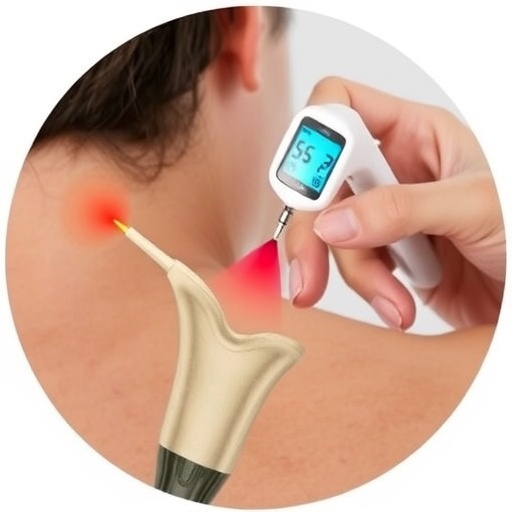
In a groundbreaking advancement for wearable technology, researchers have developed a microfiber epidermal thermometer (MET) that demonstrates extraordinary precision and stability, designed specifically for long-term use on hairy skin. This innovation surmounts several longstanding challenges associated with continuous skin temperature monitoring, particularly in areas covered by hair, making it a pivotal step forward in healthcare monitoring and personalized medicine.
Traditional epidermal thermometers often struggle to provide reliable readings when applied to hairy skin, where mounting devices securely and maintaining consistent contact are notoriously difficult. The new MET device addresses these obstacles by utilizing ultrafine microfiber structures, which conform intimately with the microscopic contours of the skin and navigate through hair follicles without causing discomfort or losing accuracy. This level of conformability ensures the sensor remains in place over extended durations, facilitating continuous monitoring that was previously unfeasible.
At the heart of this technology lies a sophisticated integration of flexible materials and sensitive thermal sensors, harmonized within a microfiber matrix. The microfiber scaffold acts as both a structural backbone and an interface that enhances thermal coupling with the skin surface. Unlike conventional squishy patches that often slip or degrade performance due to sweat or hair interference, the MET capitalizes on the structural integrity and permeability of microfibers, achieving a near-permanent bond that respects skin biomechanics. These properties allow the thermometer to function accurately over multiple days or even weeks without removal.
The design of MET involves intricate fabrication techniques that merge nanometer-scale conductive materials with breathable, skin-like substrates. This composite structure delivers a fine balance between mechanical robustness and flexibility, enabling the sensor to endure normal skin movements, stretching, and bending. Moreover, the sensor exhibits minimal thermal lag—meaning it can rapidly respond to temperature fluctuations, which is critical for detecting ephemeral systemic changes, such as during fever onset or inflammatory responses.
Another remarkable aspect of this research is the device’s ability to maintain precision in challenging environmental conditions. Hairy areas on the skin typically experience variable microclimates due to the presence of hair and glandular activity, factors that often confound temperature readings. The MET’s microfiber architecture naturally facilitates moisture wicking and ventilation, mitigating sweat accumulation that might otherwise distort thermal signals. Consequently, reliable and consistent temperature measurements have been demonstrated even in scenarios of intense physical activity or humid environments.
Extensive in vivo testing on human subjects was conducted to validate the MET’s performance across diverse skin types and body regions. Subjects reported exceptional comfort and no irritation during extended use, affirming the biocompatibility and breathability of the microfiber system. Importantly, data showed that temperature readings were not influenced by hair density or skin movement, underscoring the robustness of the design for practical clinical and daily life applications.
From a technological viewpoint, the MET device integrates seamlessly with wireless communication modules, enabling real-time data transmission to external monitoring systems. This capability opens avenues for its use in telemedicine, remote patient monitoring, and health tracking in everyday life. Healthcare providers can leverage continuous temperature data streams to make more informed diagnostic and therapeutic decisions, offering a more dynamic picture of a patient’s health status than periodic manual measurements.
The implications of this technology extend far beyond simple fever detection. Chronic conditions like diabetes, cardiovascular diseases, and dermatological disorders could benefit from continuous epidermal temperature surveillance, as temperature anomalies often correlate with disease progression or flare-ups. Moreover, by enabling long-term adherence and comfort, MET facilitates longitudinal studies on human thermoregulation and metabolic health, areas that have been previously limited by sensor design constraints.
From the engineering perspective, the researchers achieved a remarkable feat by balancing all necessary parameters—sensor sensitivity, mechanical resilience, user comfort, and consistency on hairy surfaces—which are often mutually exclusive in conventional designs. The microfiber approach not only solves the practical issue of hair interference but also enhances sensor longevity, as the material resists fouling and mechanical wear over time.
This innovation is poised to revolutionize wearable health monitors, setting a new benchmark for epidermal sensors that combine high precision with user-centric design. Unlike bulky, short-term adhesive devices, the MET system’s sleek, textile-like feel invites continuous integration into daily wear, blurring the lines between healthcare technology and fashion. Its potential to empower both patients and clinicians with reliable, real-time health data is immense.
Furthermore, the research opens exciting future directions in the development of multifunctional wearable systems. By incorporating additional sensing modalities—such as hydration, pH, or biochemical markers—into this microfiber platform, comprehensive health monitoring suites could be realized in a single, comfortable epidermal patch. Such advancements would catalyze a paradigm shift in personalized and preventative medicine.
The challenges ahead will involve scaling production and ensuring compatibility across diverse populations and environments. However, given the robustness demonstrated, the research team envisions rapid translation from lab prototypes to commercial wearable devices. Partnerships with medical technology companies and textile manufacturers are anticipated to bring this promising technology to the mass market.
In the context of a rapidly aging global population and increasing emphasis on remote health management, the MET technology aligns perfectly with emerging healthcare needs. It represents a fusion of material science, biomedical engineering, and sensor technology that could dramatically improve quality of life and clinical outcomes.
As wearable technology continues to evolve, the microfiber epidermal thermometer represents a visionary leap, blending scientific ingenuity with practical necessity. It underscores the power of interdisciplinary research in overcoming complex biomedical engineering challenges, ultimately enhancing human health monitoring in ways once thought impossible.
In an era where data-driven healthcare is becoming paramount, such high-precision, durable, and user-friendly sensors provide the crucial link between physiological phenomena and actionable insights. The success of the MET device offers a tangible example of how nuanced engineering can be harnessed to solve real-world problems at an intimate human interface.
Future research will likely explore further miniaturization, integration with artificial intelligence algorithms for predictive health analytics, and expansion into other sensory modalities. Nonetheless, this microfiber epidermal thermometer stands today as a beacon of innovation—an extraordinary fusion of comfort, precision, and utility destined to transform continuous health monitoring paradigms worldwide.
Hanif, A., Park, J., Kim, D. et al. Microfiber epidermal thermometer (MET) with extraordinary high precision designed for long-term use on hairy skin.
npj Flex Electron 9, 82 (2025). https://doi.org/10.1038/s41528-025-00464-x
Cite Scienmag News
Denise Maddox. (August 7, 2025). Ultra-Precise Microfiber Thermometer for Hairy Skin. Scienmag. https://scienmag.com/ultra-precise-microfiber-thermometer-for-hairy-skin/
Denise Maddox. "Ultra-Precise Microfiber Thermometer for Hairy Skin." Scienmag, 7 August 2025, https://scienmag.com/ultra-precise-microfiber-thermometer-for-hairy-skin/. Accessed 3 September 2026.
Denise Maddox. "Ultra-Precise Microfiber Thermometer for Hairy Skin." Scienmag. August 7, 2025. https://scienmag.com/ultra-precise-microfiber-thermometer-for-hairy-skin/


