


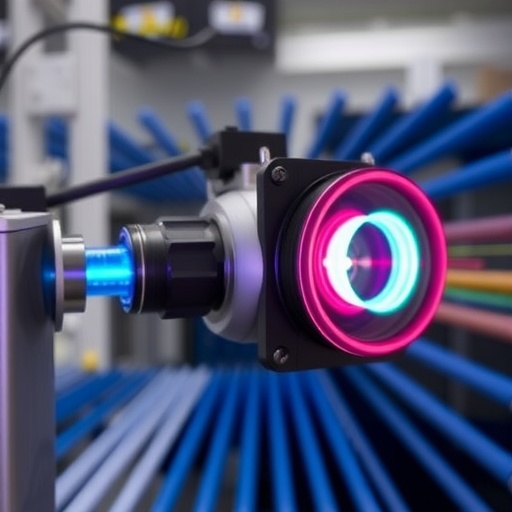
In the ever-evolving tapestry of scientific innovation, the United Kingdom stands as a luminous beacon, particularly in the domain of advanced optical engineering. This field, straddling the intersection of physics, materials science, and engineering, has undergone a transformative leap in recent years. The article “Editors at the frontier: exploring advanced optical engineering in the UK,” authored by Guo and Jiang and published in Light: Science & Applications, chronicles this dynamic progression with remarkable clarity and foresight.
Optical engineering in the UK has rapidly metamorphosed into something profoundly interdisciplinary. At its core, this science explores the design, analysis, and application of devices that manipulate light, a pursuit that powers everything from telecommunications to medical diagnostics and quantum computing. British researchers have delved deep into the nuances of photonic devices, integrating novel materials and complex architectures to push the boundaries of what is scientifically possible. The UK’s rich heritage in optical science, enriched by institutions like the University of Cambridge and Imperial College London, serves as fertile ground for such breakthroughs.
Emerging technologies like metamaterials have been pivotal in redefining how light is controlled and harnessed. These artificially structured materials possess unique properties not found in nature, allowing engineers to bend and manipulate light with unprecedented precision. The UK’s research hubs have pioneered frameworks that combine theoretical physics with nanofabrication, yielding devices capable of extreme light manipulation at scales previously considered unattainable. Such precision is critical for developing sensors with ultra-high sensitivity, enabling applications in environmental monitoring and biomedical sensing.
Quantum optics remains another frontier where British scientists are making remarkable strides. Exploiting the quantum properties of photons—such as entanglement and superposition—enables a fundamentally new class of communication and computation technologies. The UK’s investment in quantum photonics has seeded facilities dedicated to producing quantum light sources and integrating them into chip-scale devices. This miniaturization is vital for realizing scalable quantum networks, which promise revolutionary improvements in secure communication and information processing speeds.
At the engineering level, advancements in integrated photonics have attracted significant attention. By synergizing optical components into compact, chip-based platforms, UK researchers are helping transcend the limitations of traditional bulk optics. These integrated photonic circuits are being engineered to handle complex functions such as signal processing and routing with greater energy efficiency. The UK’s industrial collaborations have further accelerated the transition of these photonic chips from laboratory prototypes to commercial realities, especially in data centers where optical interconnects mitigate bandwidth bottlenecks.
The spread of machine learning and artificial intelligence into optical design workflows marks a paradigm shift in the UK’s approach to engineering. Computational algorithms now assist in optimizing device structures, simulating light-matter interactions with higher fidelity, and even predicting novel material combinations for enhanced optical performance. This marriage between AI and optics has reduced innovation cycles dramatically, enabling faster iteration and fine-tuning of photonic devices tailored for specific industrial challenges.
Another vital dimension explored in the article pertains to novel fabrication techniques. The UK’s photonics laboratories have embraced cutting-edge methods such as two-photon polymerization and atomic layer deposition, which allow engineers to sculpt photonic structures with nanoscale accuracy. These fabrication technologies are crucial in realizing complex 3D nanostructures and multilayered devices that go beyond the capabilities of traditional lithography. Such precision manufacturing is indispensable for advancing applications in biophotonics, where delicate interactions between light and biological tissues must be finely controlled.
Additionally, the sustainability of optical engineering practices has become a critical focus in the UK’s research agenda. By developing photonic materials and devices that consume less energy and leverage recyclable components, scientists are addressing the global imperative for green technology. Advances in low-power optical modulators and energy-efficient lasers not only reduce the carbon footprint but also enable longer-lasting photonic systems crucial for telecommunications and sensing infrastructure operating in remote locations.
In biomedical optics, the UK has emerged as a global leader by integrating novel imaging technologies with engineered optical probes. The development of miniaturized endoscopes and advanced optical coherence tomography (OCT) systems has enhanced the resolution and depth of non-invasive imaging modalities. These tools facilitate earlier disease diagnosis and improved monitoring, transforming clinical practices. The article underscores how multidisciplinary teams in the UK, combining expertise in optics, biology, and medicine, have accelerated the translation of these innovations from research labs to hospital wards.
Moreover, the UK’s strategic emphasis on fostering academic-industrial partnerships has fast-tracked commercialization pathways. Spin-off companies rooted in university research are now delivering cutting-edge photonic devices tailored for markets ranging from telecommunications to defense. This ecosystem nurtures innovation through governmental funding schemes and collaborative research centers explicitly designed to bridge gaps between theoretical findings and practical deployment.
As the article delineates, public and private investment in infrastructure such as advanced cleanrooms, state-of-the-art laser facilities, and high-speed computational clusters underpin these technical achievements. Such resources have empowered researchers to undertake complex experiments requiring extreme environmental control and delicate measurements. The convergence of world-class infrastructure, talent, and collaborative culture fuels a vibrant innovation landscape that continues to expand the horizons of optical engineering.
Looking ahead, the UK’s roadmap for optical engineering accentuates emerging trends including topological photonics and neuromorphic optical computing. These concepts exploit exotic physical phenomena to create devices with novel functionalities, such as light-based neural networks capable of low-energy, high-speed data processing that mimics brain activity. The sustained momentum in these domains signals that the UK is not only consolidating its leading position but also defining the future direction of this transformative discipline.
The article concludes by emphasizing that the interplay of fundamental research, technological ingenuity, and strategic vision forms the backbone of the UK’s advances in optical engineering. By nurturing talent, fostering interdisciplinary teams, and cultivating partnerships between academia and industry, the UK continues to push the envelope of what optical technology can achieve. These advances hold far-reaching implications, from revolutionizing data communication infrastructure to enabling groundbreaking medical diagnostics and paving the way for quantum information technologies.
In essence, the article by Guo and Jiang portrays a vibrant, multifaceted narrative of the UK’s optical engineering sector, highlighting both the scientific milestones and the broader ecosystem that sustains innovation. It paints a picture of a vibrant research community dynamically engaging with some of the most profound challenges and opportunities at the frontier of light-based technologies.
As optical engineering is poised to reshape various industries in the coming decades, the UK’s role as a hub of intellectual rigor and technical excellence ensures it will remain at the forefront of shaping the luminous future of photonics.
Cite Scienmag News
Denise Maddox. (April 20, 2026). UK Pioneers Cutting-Edge Optical Engineering Advances. Scienmag. https://scienmag.com/uk-pioneers-cutting-edge-optical-engineering-advances/
Denise Maddox. "UK Pioneers Cutting-Edge Optical Engineering Advances." Scienmag, 20 April 2026, https://scienmag.com/uk-pioneers-cutting-edge-optical-engineering-advances/. Accessed 6 September 2026.
Denise Maddox. "UK Pioneers Cutting-Edge Optical Engineering Advances." Scienmag. April 20, 2026. https://scienmag.com/uk-pioneers-cutting-edge-optical-engineering-advances/


